







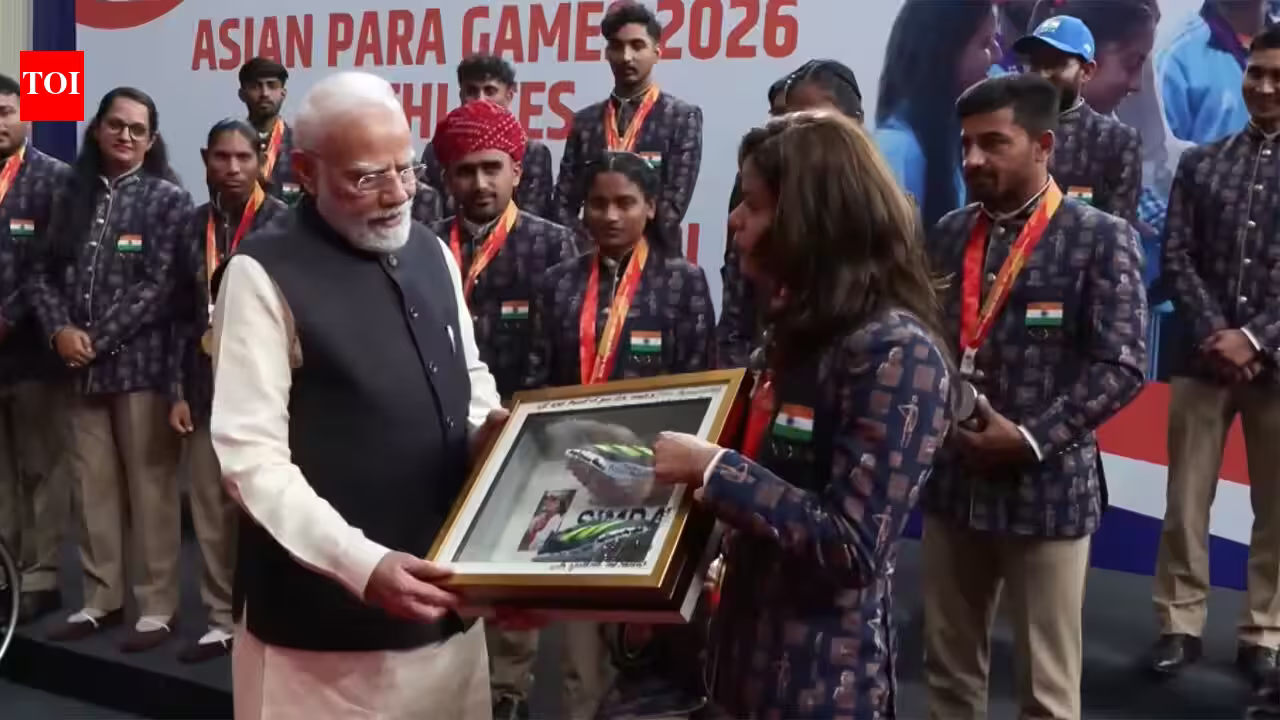
NEW DELHI: The echoes of triumph still resonate from the Aichi-Nagoya Games in Japan, but the real victory lap for India’s para-athletes took place on Thursday at the Indira Gandhi Sports Complex. In a celebratory interaction that crackled with national pride, Prime Minister Narendra Modi welcomed home India’s history-making contingent, officially rebranding their monumental performance as the definitive launch pad for the 2028 Los Angeles Paralympics.
India concluded the 2026 Asian Para Games with a breathtaking haul of 114 medals—comprising 30 gold, 35 silver, and 49 bronze—shattering previous benchmarks and firmly cementing the nation’s status as a burgeoning global powerhouse in para-sports.
## ’14 to 114′: A Staggering Trajectory of Excellence
The atmosphere inside the Indira Gandhi Sports Complex was electric as the Prime Minister drew a sharp, poignant contrast between India’s past and its present. Recalling the 2010 edition of the Games, where India managed a modest total of just 14 medals, including a lone gold, PM Modi framed the leap to 114 as a seismic shift in the country’s sporting identity.
“Your magnificent performance shows that India is emerging as a great power in the world of sports,” Modi declared, addressing the 97 athletes gathered before him. “You have not only won medals, but you have also won the hearts of millions of Indians.”
The numbers tell a story of dominance that extends far beyond the final tally. The campaign featured an extraordinary display of technical superiority, including five world records and nine Asian records. Perhaps most impressive was the sheer depth of the talent pool: 61 athletes were making their Asian Para Games debut, and an astounding 36 of those first-timers returned with hardware around their necks. Furthermore, in a testament to the surging strength of India’s women in sport, 34 of the 56 female athletes in the contingent finished on the podium.
## Overcoming Obstacles and Changing Narratives
For many of these athletes, the road to the podium was paved with societal skepticism and personal adversity. Prime Minister Modi addressed this directly, acknowledging that the stigma once associated with pursuing a sporting career—particularly for those with disabilities—is finally being dismantled.
“Earlier, parents were scared of supporting their kids in sporting careers. People would say nothing can be done about this system which did not support talent,” Modi noted. “But just as you did not give up, we also stayed focused on our goals.”
He emphasized that the current administration is committed to ensuring that talent no longer goes unrecognized or unsupported. “Now, if you have the talent, India will support you and cheer for you. Come, play and shine!”
The event saw personal moments of poignancy, including a special mention of javelin thrower Rinku Hooda. Hooda, who secured gold despite the tragic loss of his mother just months before the Games, became a symbol of the resilience that defined the entire contingent. His emotional victory served as a reminder that behind every record-breaking throw or sprint are stories of profound human spirit. Double-gold medallists, including the world-renowned armless archer Sheetal Devi and visually impaired sprinter Simran, were among the stars who interacted with the Prime Minister, gifting him tokens of their appreciation in a scene that highlighted the mutual respect between the nation’s leadership and its sporting heroes.
## From Aichi-Nagoya to Los Angeles 2028
While the euphoria of the 114-medal haul is well-deserved, the Prime Minister was quick to pivot the conversation toward the horizon. With the sports ministry actively strengthening the domestic infrastructure—evidenced by a significant Rs 1,800 crore investment scheme for sports goods manufacturing—the focus has now shifted entirely to the international stage.
“You should use this success as a launch pad for bigger goals,” Modi urged the athletes. “The next goal of India and most of you is Los Angeles 2028. Our goal is to have as many Indian players in LA 2028 as possible and win as many medals as possible. Celebrate this moment and start preparing for the future.”
The success in Japan was not limited to one or two disciplines; rather, it was a comprehensive display of competitiveness across the board. From the precision of archery and shooting to the physical intensity of powerlifting, athletics, swimming, and badminton, India demonstrated that its para-athletes are no longer just participants—they are the ones setting the pace.
As the athletes departed the Indira Gandhi Sports Complex, the message was clear: the era of “participation” is over. India’s para-sporting movement has entered an era of “domination.” With a government pledge to provide the necessary ecosystem and a cohort of athletes who have proven they can conquer the continent, all eyes are now firmly fixed on Los Angeles. The 114 medals in Japan may be a record, but in the eyes of the Prime Minister and the athletes themselves, they are merely the opening act.
Disclaimer: This content is auto-generated for informational purposes only.
Source: Read Original News