









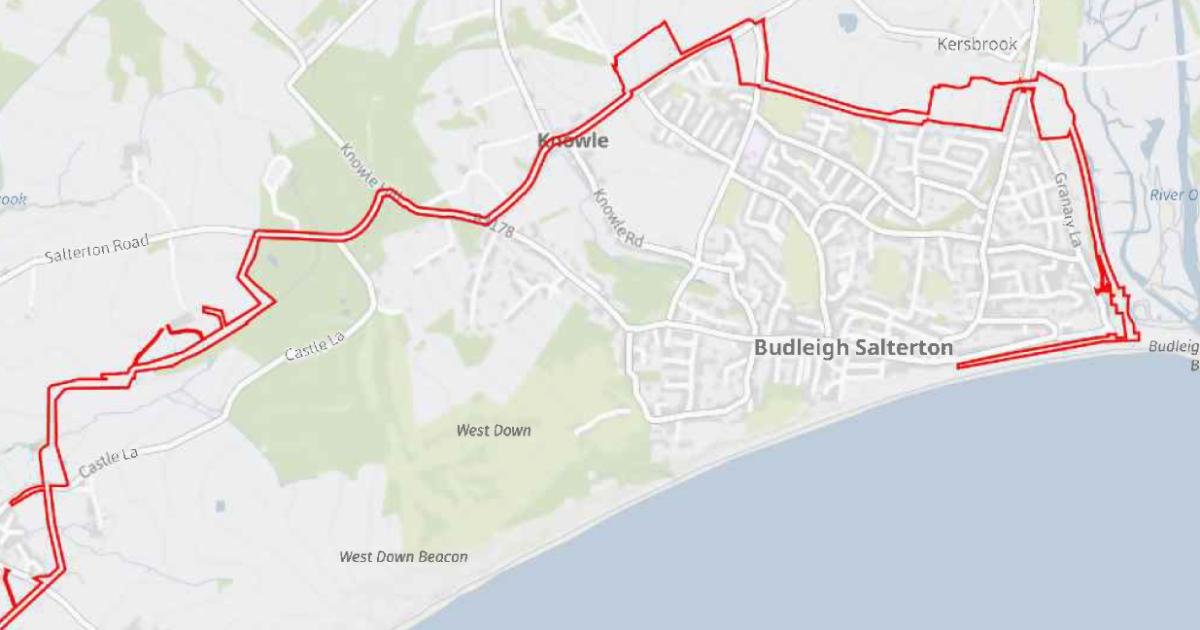
The council has issued a Screening Opinion stating that the proposed Lime Kiln Rising Main scheme constitutes Environmental Impact Assessment (EIA) development because of its scale, location and the potential environmental impacts during construction.
The proposal, submitted on behalf of South West Water, includes replacing pumps, electrical equipment and a generator at Lime Kiln Sewage Pumping Station in Budleigh Salterton, installing an 8.4-kilometre underground rising main, constructing an intermediate pumping station and installing an odour control unit. The new pipeline would transfer wastewater from Lime Kiln Sewage Pumping Station to Maer Lane Sewage Treatment Works near Exmouth.
According to South West Water’s Environmental Impact Assessment Screening Report, the existing rising main is ageing infrastructure that requires replacement to reduce the risk of pipe bursts and increase the amount of wastewater that can be transferred for treatment. The company says the improvements are intended to reduce the frequency of spills from the sewer network and help meet Environment Agency requirements.
In its submission, South West Water argued that, with mitigation measures and industry best practice, the project would not be expected to have significant adverse environmental effects and therefore should not require a full Environmental Impact Assessment.
However, Devon County Council reached a different conclusion.
The authority found the proposal is Schedule 2 development under the Town and Country Planning (Environmental Impact Assessment) Regulations 2017 and noted the scheme exceeds the indicative planning threshold for pipelines over five kilometres in length. It also estimated the overall works area to be about 33.4 hectares.
Planning officers also highlighted the route’s environmentally sensitive location.
The development lies entirely within the East Devon National Landscape and is partly within, or adjacent to, the Dorset and East Devon Coast World Heritage Site and Budleigh Salterton Cliffs Site of Special Scientific Interest. It is also close to the Otter Estuary Site of Special Scientific Interest, the East Devon Pebblebed Heaths Special Area of Conservation and the Exe Estuary Special Protection Area.
Although sections of the pipeline would be installed using horizontal directional drilling and beneath existing roads, the council noted that approximately 5.4 kilometres would be constructed using open-cut trenching across agricultural land, public highway, a cycle route and a brook.
In its decision, the council said the proposal was likely to have significant environmental effects because of its nature, size and location.
Among the factors identified were the disturbance of agricultural land, the potential for pollution and nuisance during construction, possible impacts on protected habitats and species, effects on the landscape and recreational users, cumulative impacts alongside proposed upgrades at Maer Lane Sewage Treatment Works, and potential effects on the historic environment. Construction is anticipated to last around 30 months.
The Screening Opinion does not determine whether the project will ultimately be approved. Instead, it means any future planning application will need to be supported by a full Environmental Impact Assessment examining the likely environmental effects of the proposal before a decision can be made.