





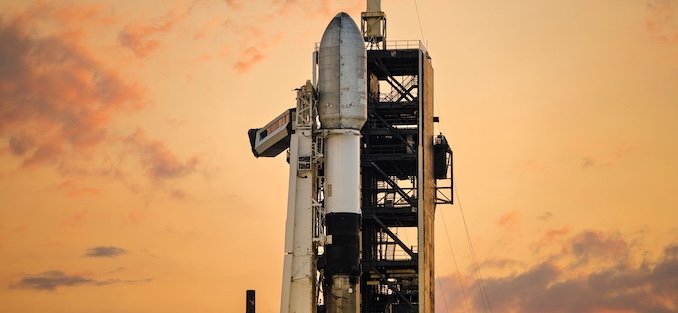
SpaceX is set to push its Falcon 9 rocket fleet to the next level by flying its flight leader, tail number B1067, on a record-breaking 35th flight. It’s set to launch SpaceX’s latest batch of Starlink satellites from Cape Canaveral Space Force Station Monday morning before sunrise.
The Starlink 10-35 mission will add another 29 broadband internet satellites to the low Earth orbit constellation. It consists of more than 10,500 spacecraft currently.
Liftoff from Space Launch Complex 40 is scheduled during a window that opens at 6:07 a.m. EDT (1007 UTC). The rocket will fly on a north-easterly trajectory upon liftoff.
Spaceflight Now will have live coverage beginning about an hour prior to liftoff.
The 45th Weather Squadron forecast a 90 percent chance for favorable weather at the opening of the window, which degrades to 75 percent favorability as the the morning goes on. Meteorologists are watching for the potential impact from thick clouds in the area of the Cape.
“High pressure at the surface and aloft and abundant dry air will keep quiet conditions across the Spaceport to end the weekend,” launch weather officers wrote. “The pattern changes early in the week as the upper ridge breaks over the Florida Peninsula, with a passing upper-level disturbance bringing more upper-level moisture.
“This will lead to a thickening of the mid and upper-level cloud deck across the primary window early Monday morning, with the threat for associated Thick Cloud Layers Rule violations also seeing a modest increase with time across the window.”
The launch of SpaceX’s flight-leading booster, B1067, continues the company’s push to demonstrate it’s rocket’s ability to fly up to 40 times each, a feat that’s unmatched in the world of commercial spaceflight.
As of June 7, SpaceX has seven Falcon boosters that have flown more than 25 times:
- B1063 – 32
- B1067 – 34
- B1069 – 31
- B1071 – 33
- B1077 – 28
- B1078 – 28
- B1080 – 26
In documents published prior to the company’s initial public offering SpaceX noted out of the 165 Falcon 9 launches in 2025, only eight used a Falcon booster making its first flight.
“Although our Falcon 9 boosters have been engineered and demonstrated to support up to 40 flights, we have established a maximum accounting useful life of 25 flights as an estimate based on forecasted utilization,” SpaceX wrote in its prospectus, a document filed to the U.S. Securities and Exchange Commission.
“This estimate reflects: (i) our strategic transition to Starship, which is expected to materially reduce future Falcon 9 flight demand; and (ii) restrictions under certain government contracts that prohibit the use of boosters flown more than five times on their missions,” SpaceX added. “These useful life estimates are periodically reassessed based on engineering qualification data, post-flight inspections, recovery success rates, actual fleet performance, cost sensitivity analyses, and the long-range launch manifest.”