








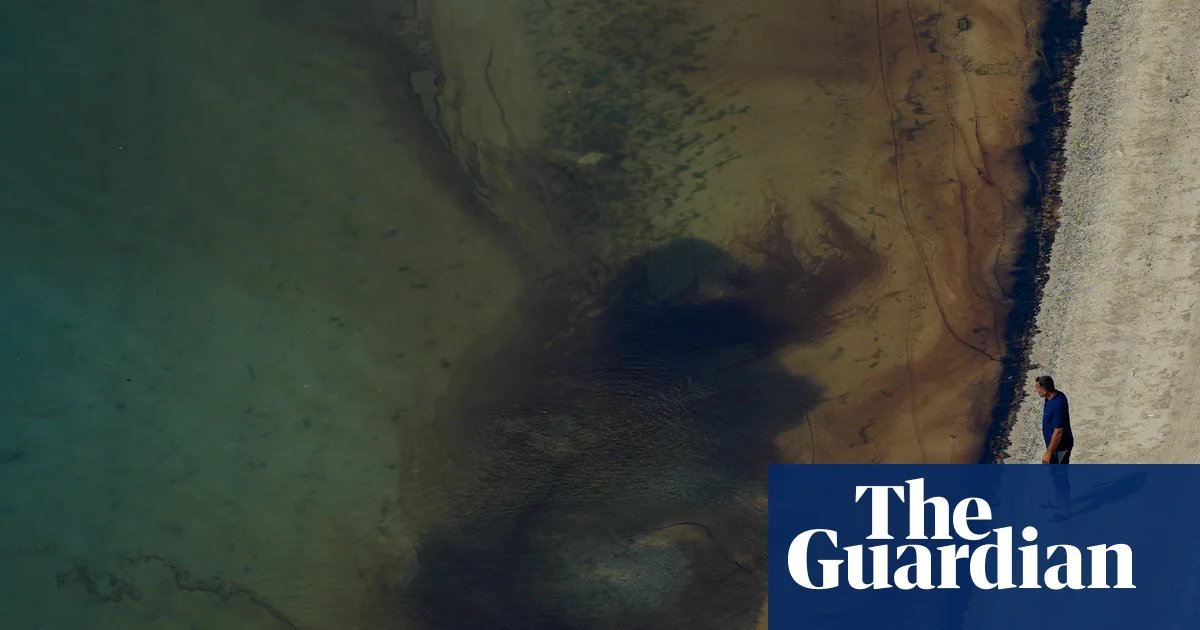
The Strait of Hormuz, the world’s most vital oil shipping artery, has been transformed into a hazardous, oil-slicked battlefield. Eight months into the war between the US and Iran, the waterway is suffering a mounting environmental catastrophe, with crude oil spilling from damaged tankers coating coastlines and threatening fragile marine ecosystems that are home to dolphins, sea turtles, and vast populations of fish.
The scale of the disaster is visible from space, where dark, persistent slicks trail from damaged vessels. While naval blockades have made on-the-ground documentation almost impossible, analysis from environmental experts and marine biologists—paired with satellite imagery—reveals a dire situation. Since the conflict began on 28 February, Greenpeace has identified more than 500 instances of oil spills across the Gulf, the Strait of Hormuz, and the Arabian Sea.
“Adding together the daily mapped footprints gives a cumulative total of approximately 20,000 square kilometres—almost the size of Wales,” said Nina Noelle, a Greenpeace expert on environmental disaster relief.
The pollution has been fueled by a record-breaking wave of violence against maritime infrastructure. More than 133 attacks on oil tankers have been recorded, with October marking a grim peak of over 30 confirmed strikes. Among these, the attack on the supertanker Gem No 2 off the coast of the United Arab Emirates resulted in a slick stretching more than 21 miles. Similarly, satellite data confirmed large-scale pollution following a strike on the Liberian-flagged Minoan Pioneer in August.
The environmental stakes are exceptionally high. The Strait of Hormuz is a delicate ecosystem of coral reefs, seagrass meadows, and mangrove forests, all of which are critical to regional biodiversity. Oil prevents mangroves from absorbing oxygen and smothers the coral reefs, which are already struggling under the stress of the climate crisis.
Bernhard Riegl, a marine biologist at Nova Southeastern University, warned that the region is uniquely vulnerable. “Since the Gulf is shallow, and summer is the least windy period of the year, atmospheric heat is rapidly translated into ocean heat. That heat kills corals, algae, and fishes. There is no cold, deep water that could mix and buffer this heat,” Riegl said. “There is no such thing as a ‘clean war’. Not for the unlucky humans that are drawn into it, nor for the unlucky environment in which the conflict takes place.”
Assigning responsibility for the devastation remains complex. While the Iranian Revolutionary Guard Corps (IRGC) has been blamed for the majority of the tanker attacks, US forces have also engaged in hostilities, including strikes on Iranian vessels. Reports from the Wall Street Journal further indicate that a significant spill was triggered by a UAE airstrike on oil storage tanks on Lavan Island, which sent crude flushing into surrounding nature reserves.
Local authorities in countries like the UAE and Oman have attempted containment efforts, such as closing beaches and deploying cleanup crews, but experts fear the long-term damage is already locked into the ecosystem. Oil trapped in sediments and mangrove roots can persist for decades.
Historical evidence underscores these fears. Studies of the 1980s Iran-Iraq war show that sediments in the region remain contaminated by oil spills from that era, even 40 years later. “Any organism that has to dig into beaches, like sea turtles when they lay eggs, will encounter the contaminated strata,” Riegl noted. “Clearly, the effects of large-scale oil pollution remain detectable for decades—so this is a generational problem. We could really lose something irreplaceable.”
Disclaimer: This content is auto-generated for informational purposes only.
Source: Read Original News