









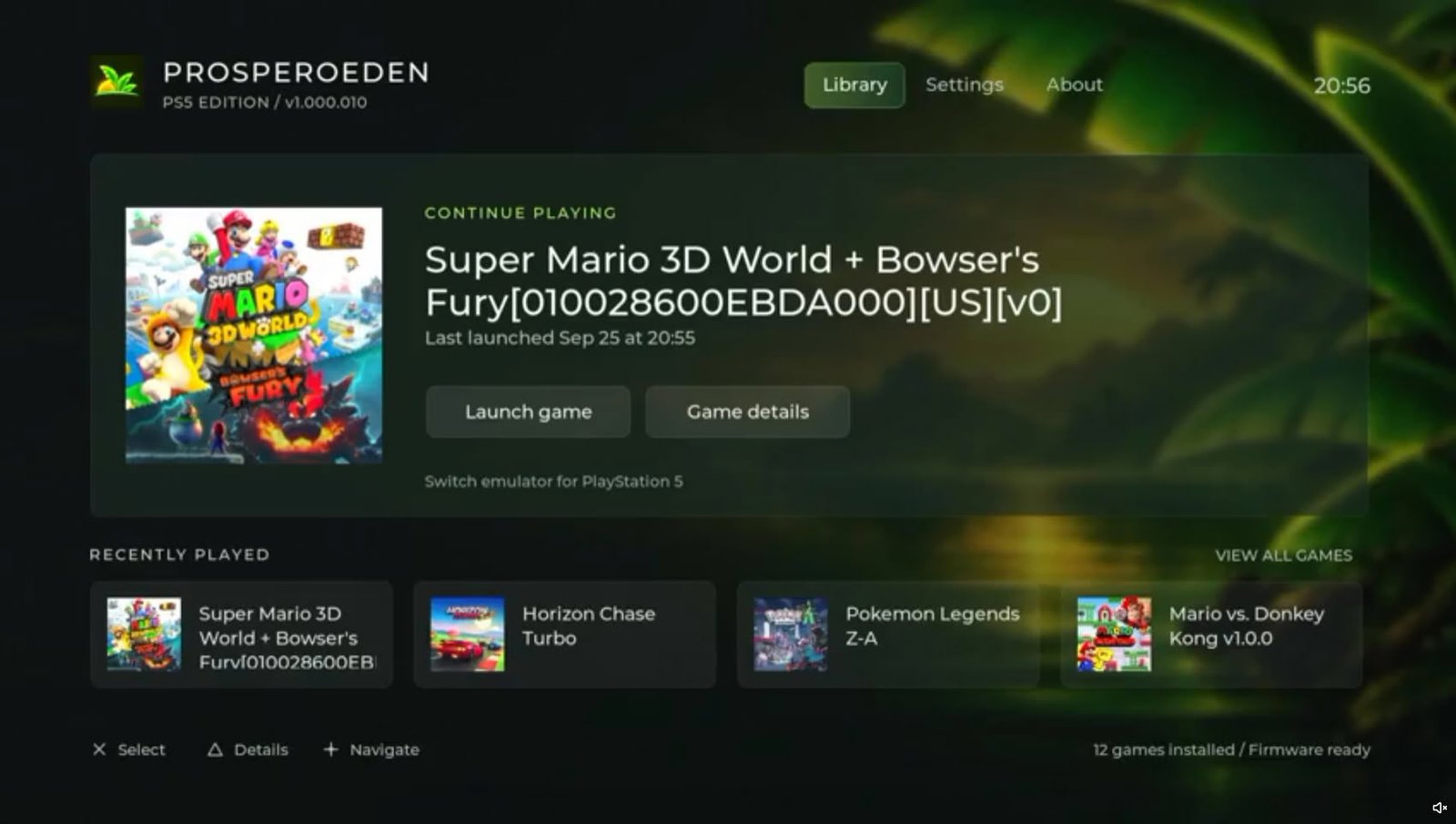
The Emergence of ProsperoEden on PlayStation 5 Hardware
The landscape of video game preservation and homebrew development has reached a new milestone with the arrival of ProsperoEden. This unofficial port of the Eden Nintendo Switch emulator represents a significant technical achievement, as it allows the software to execute natively on jailbroken PlayStation 5 consoles. By bypassing the need for secondary operating systems like Linux or virtualization layers, developer BlackBearReloaded has enabled direct communication between the emulator code and the PS5 custom hardware architecture.
ProsperoEden is built upon the foundation of Eden, which is itself a fork of the Yuzu project—a well-known emulator that ceased development following legal pressures. By adapting this codebase specifically for the PlayStation 5, the project demonstrates how hardware originally intended for locked, proprietary ecosystems can be repurposed for cross-platform emulation. The primary technical hurdle in such a port is translating the instruction sets and graphics API calls from a system designed for a Tegra X1 chip to the custom AMD-based architecture of the PlayStation 5. The release of this software as a native homebrew application marks a shift in how enthusiasts are approaching the capabilities of current-generation gaming hardware.
Technical Architecture and Performance Capabilities
Initial performance data provided by the development team indicates that the alpha build, version 1.000.010, is capable of running several demanding titles. The compatibility reports highlight that Cuphead maintains a steady 60 frames per second, suggesting that the overhead for 2D-heavy titles is well within the processing limits of the PS5’s octa-core Zen 2 processor. Furthermore, 3D titles such as Metroid Dread are achieving roughly 40 frames per second, a result that is impressive given the lack of deep optimization at this early development stage.
Super Mario 3D World has also been confirmed as functional in specific segments of the game. Mario Kart 8 Deluxe, one of the more resource-intensive titles in the Switch library, has achieved the critical milestone of booting into actual gameplay sequences. While it does not yet maintain a locked 60 frames per second experience, the ability to reach an in-game state proves that the underlying translation layers are functioning correctly. These benchmarks serve as a proof-of-concept for the emulator’s potential to handle complex rendering pipelines on Sony hardware.
Current Limitations and Development Hurdles
Despite the success of initial tests, ProsperoEden remains in its alpha phase and faces significant technical limitations. The most prominent bottleneck is the reliance on an OpenGL-only implementation. Unlike modern gaming environments that heavily utilize Vulkan or DirectX 12 to maximize hardware efficiency, the absence of a Vulkan backend on this PS5 port means that the emulator cannot fully tap into the low-level graphics acceleration that the PS5’s GPU is capable of.
Furthermore, the stability of the emulator is currently inconsistent. Compatibility documentation confirms that while some titles reach the gameplay stage, others—such as the upcoming Pokemon Legends Z-A—are plagued by extreme slowdowns and frequent crashes during shutdown procedures. Many of the reported performance metrics are based on static environments, such as menu screens or title sequences, rather than high-intensity, late-game segments that stress the console’s memory bandwidth and thermal management. Developers must now focus on building a Vulkan-compatible pipeline to ensure better performance parity with existing desktop-based emulation standards.
Use-Cases for Homebrew Enthusiasts
The existence of ProsperoEden is primarily directed at the homebrew community, which focuses on pushing hardware beyond the constraints set by manufacturers. For researchers and preservationists, this emulator serves as a study in cross-platform portability. By porting Yuzu-derived code to a closed system like the PlayStation 5, developers are mapping the boundaries of what is possible when given low-level access to the machine.
For the average user, the utility of this emulator is currently experimental. It requires a jailbroken console, a category of hardware that is increasingly rare as Sony updates its system firmware to patch exploits. Consequently, the primary use-case remains the technical verification of the PS5’s raw computational power. Enthusiasts use these builds to document how software translation behaves on non-PC hardware, contributing to a broader understanding of how different architectures process legacy or foreign code. It provides a platform for developers to experiment with optimizations that are specific to the PS5’s memory structure, potentially leading to faster emulation speeds in future updates.
The Broader Impact of Emulation Legalities
The shadow of the original Yuzu project looms large over the development of ProsperoEden. The legal actions taken against Yuzu’s creators, which ultimately resulted in the cessation of that project, have fundamentally altered how the emulation community approaches development and distribution. The development of ProsperoEden is occurring in a climate of heightened caution. Because the project is an unofficial port running on a proprietary device, it creates a unique intersection of hardware hacking and software copyright law.
The long-term viability of ProsperoEden will likely depend on its visibility and the speed with which it reaches a stable state. Should the project begin to facilitate piracy or gain mass-market visibility, it is probable that it will encounter the same regulatory scrutiny that impacted its predecessors. However, as it currently stands, the project functions as a specialized tool for developers and technical hobbyists. The rapid transition from initial deployment to playable 2D experiences suggests that interest in the project will continue to grow, provided the development team can balance technical progress with the realities of the current software landscape. For now, ProsperoEden stands as a testament to the ingenuity of the homebrew scene and its persistence in exploring the limits of modern console hardware.
Disclaimer: This content is auto-generated for informational purposes only.
Source: Read Original News