





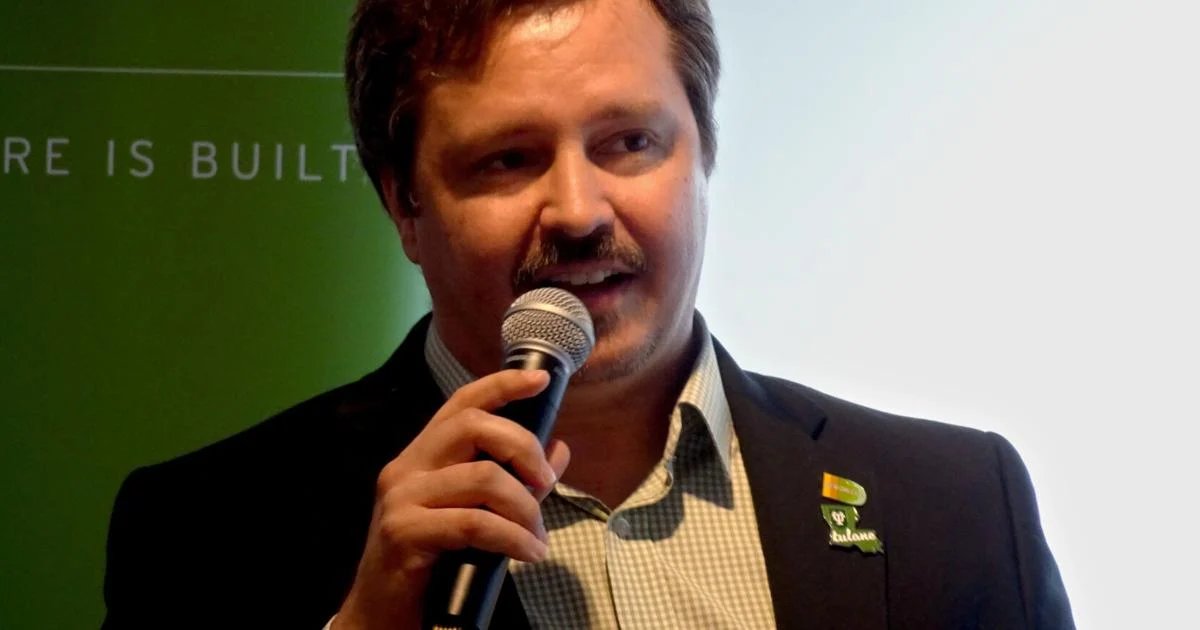
Seth Knudsen, a native New Orleanian with more than two decades of experience in local government, recently completed his first year as executive director of the Downtown Development District.
The state-created business improvement district is funded by a property tax millage on everything within the 1.2 square miles bounded by the Mississippi River, Interstate 10, the Pontchartrain Expressway and Iberville Street.
The district’s $10 million annual budget is split between three areas: sanitation, security and economic development. About 40% goes to cleaning, pressure washing and graffiti abatement. Another 35% is devoted to public safety and its staff of “public safety rangers,” armed private security and off-duty police detail. The rest goes to its economic development team and administration.
Knudsen, a former strategy chief at the New Orleans Redevelopment Authority now steering the DDD through its own strategy planning process, says maintaining a clean and safe environment will always be the foundation of the organization’s work and a requirement of economic development. But all three elements of his portfolio — making the Central Business District “cleaner, safer and stronger” — work together in a virtuous circle.
The following interview has been edited for brevity.
Now that Mayor Helena Moreno has established a Canal Street redevelopment czar to coordinate with the various overlapping authorities, what is your role in the revival of the corridor?
We have a role as a partner in a lot of the specific priorities identified in her executive order establishing a point person at City Hall to coordinate all of these different entities — there are many, but they do have unique and specific roles and responsibilities. When we’re all working at our best, we’re complementing each other and not duplicating the efforts. There are always good intentions around that, but sometimes it can be difficult if there isn’t a single point of contact that is charged with organizing and and structuring everything to enable all of the individual players to play their best. And I think this executive order very much shows an appreciation for that and a specific intent around making sure that we are complementing and leveraging each other’s efforts.
How do you see Canal Street changing?
We’re here to enhance the city’s efforts. Really, in everything that we do as a business improvement district, we are an enhancer entity by definition. The good news is that Canal Street is not vacant. We may have visions of Canal Street of yesteryear, and maybe desires for a different tenant mix, but the reality is that it’s a largely functional real estate market, and so the challenge that we have here is really more one of refining the market as opposed to building one, and there certainly are cities that envy our level of occupancy on Canal Street and retail in downtown more generally.
Do you think that the downtown needs to have more residents?
The short answer is yes. I do think that increasing the number of full-time residents downtown is something that would be very much helpful in continuing to build the strength of downtown as a neighborhood. However, I think it’s a false choice to say that we want that over office or over tourism or hospitality. The reality is that we have some space, whether it’s in existing buildings or surface parking lots or you know a combination of those and other underutilized real estate assets.
How big a deal is the Convention Center hotel and how is DDD involved in the whole project?
We certainly participated in some of the public outreach activities and making sure that our board and our constituents are educated on the project. The project itself has a lot of potential to help us continue to grow as in as a location for events that we’re not currently competitive for. I think there’s the direct job considerations of the hotel itself, but also the effects of more visitors that are going to be spending more in art galleries on Julia Street and restaurants in the Warehouse District and French Quarter and other locations, and it seems the experience in other places is that as new hotel of this scale is absorbed by the market. It’s going to take a few years, but ultimately, it builds some additional demand rather than sort of cannibalizing existing demand.
For Tulane’s Charity downtown campus expansion, do you think that’s a last chance-type of situation to get the deal done?
I wouldn’t characterize it as the “last chance” — I’m not that pessimistic — I think it’s our best chance we’ve had in the post-Katrina era. And I think Tulane is uniquely positioned to be the anchor and driver for a project of that scale, having that kind of institutional investment time horizon, thinking about what Tulane needs over the next 50, 100 years. I think it’s a unique opportunity for that whole quadrant of downtown. There is a lot of underutilized real estate over there, between buildings that aren’t fully occupied or completely vacant in some cases, as well as a lot of surface parking lots. Just as important to the success of that as an individual project is the spillover effect of having all of those new employees and research ventures that are spinning off businesses and bringing researchers downtown, bringing residents downtown. The vision for Charity as the anchor for the BioDistrict and the surrounding neighborhood is very compelling.