

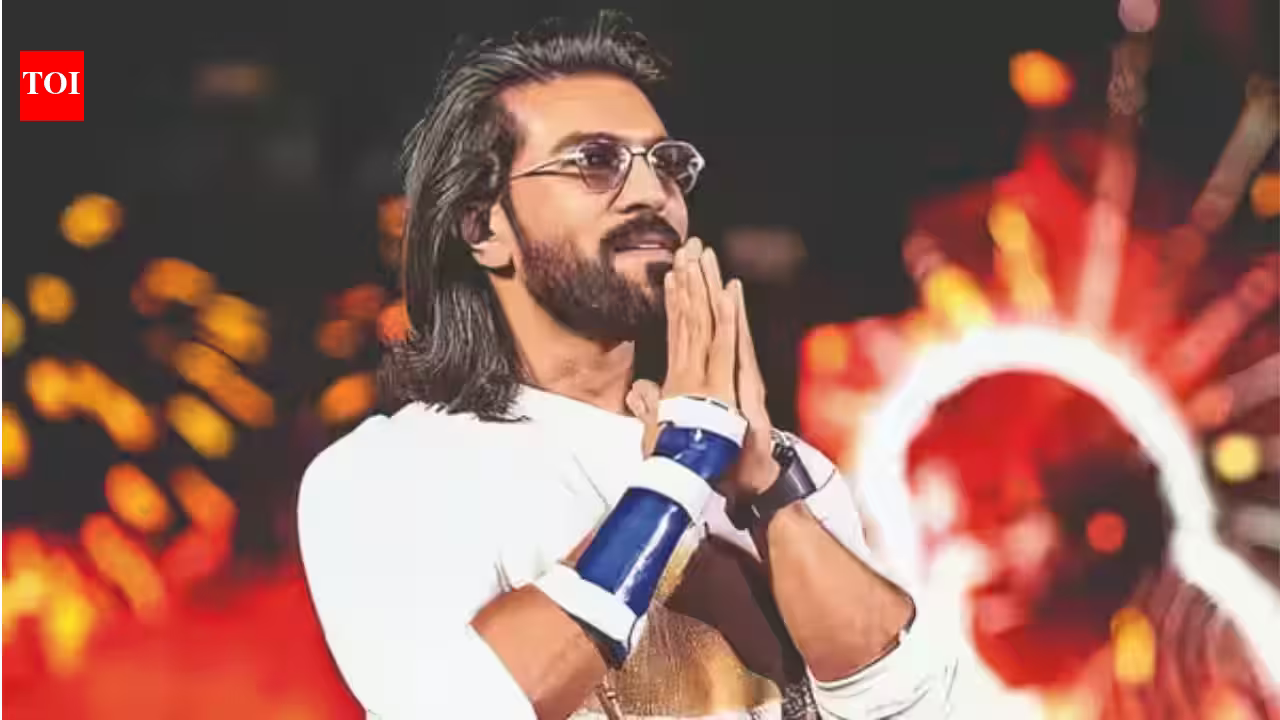




NEW DELHI: In one of the biggest surprises of India’s recent state elections, actor Joseph Vijay Chandrasekha, one of the country’s most famous film stars, has won in Tamil Nadu, reshaping the established political order.
Popularly known as Vijay, the 51-year-old superstar whose career spans over three decades and nearly 70 films, has for years been indirectly involved in the southern state’s political scene through his fan organizations.
His formal involvement in politics, however, began in 2024, when he founded the Tamilaga Vettri Kazhagam party with the stated intent of contesting the 2026 assembly elections.
The TVK on Monday emerged victorious, securing 108 seats in the 234-member legislature, defeating Dravida Munnetra Kazhagam, a long-established player in Tamil Nadu politics.
While it fell 10 seats short of absolute majority required to form a government on its own, Vijay is expected to soon form a coalition and become the state’s chief minister.
“Vijay started a party two years ago and he immediately comes to power. Most of us in Tamil Nadu failed to predict this, because we thought this is not going to happen,” Kavitha Muralidharan, a senior journalist in Chennai, who has been covering elections for over two decades, told Arab News.
The win has drawn comparisons with M. G. Ramachandran, a towering figure in Tamil cinema who served as the state’s chief minister from 1977 to 1987, and J. Jayalalithaa, a leading film actress in the mid-1960s, who served in the same office for more than 14 years between 1991 and 2016.
Another prominent figure from Kollywood — the Tamil film industry — who also served as chief minister, was M. Karunanidhi, a playwright and screenwriter who held the office for nearly two decades across five terms between 1969 and 2011.
“I think people wanted some kind of change, especially youngsters, especially the youth … Tamil Nadu is very prone to personality-oriented politics. But the moment Jayalalithaa and Karunanidhi passed away, I thought this was going to be the end,” Muralidharan said.
In 2009, Vijay began reorganizing his fan clubs into the Vijay Makkal Iyakkam (Vijay People’s Movement), a grassroots welfare network that operated at the neighborhood level, providing educational support and relief aid, when needed.
His party’s backing, according to pollster Pradeep Gupta of Axis My India, was mainly among women and voters aged 18-39, who make up roughly 42 percent of Tamil Nadu’s electorate.
Vijay’s win came as a surprise to most observers and marks a shift from the politics of the Dravida Munnetra Kazhagam, which is rooted in the regional identity of southern India.
Dravidians are the ethnolinguistic group that dominates the south, speaking languages such as Tamil, Telugu, Kannada, and Malayalam, in contrast to northern India, where most languages belong to the Indo-Aryan family.
The DMK has long branded itself as the custodian of the Dravidian identity and as being in opposition to New Delhi dominance — a stance that is common among all major regional parties in the state. Vijay’s TVK, too, has positioned itself in opposition to India’s ruling Bharatiya Janata Party.
“When the DMK has to be alternated in power — because of a vote for change, discontent with its rule, which is a democratic phenomenon — the alternative comes from the screen,” said Rajan Kurai Krishnan, anthropologist and associate professor at the School of Culture and Creative Expressions, Dr. Bhimrao Ambedkar University.
“The film hero makes people feel comfortable, because the film hero gives them an imagined sense of power — the hero’s virtual sovereignty. The hero will beat up all the bad guys, and he is like Superman. That virtual heroism gives them a sense of comfort, because they want to imagine that there is a sovereign symbolism, so that these heroes alternate with the DMK.”
Eventually, while the order that was in place will change, for Krishnan it was not going to be a radical change.
“He is only filling up the space left vacant by MGR and Jayalalithaa,” he said, referring to the two actor-leaders who also broke away with the DMK.
“Vijay’s party will continue to be resoundingly regional, and the BJP cannot gain from this, and nor can Congress make inroads, so the Tamil Nadu politics will remain resoundingly regional.”