








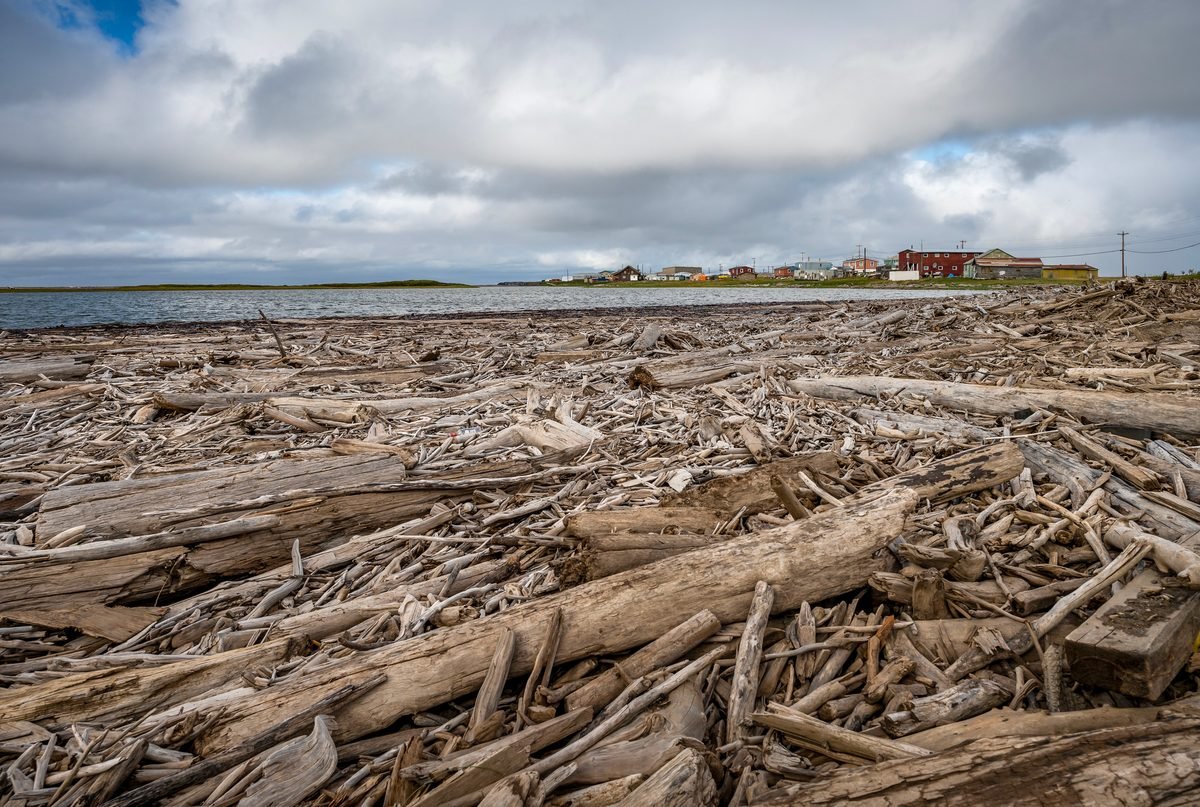
In the remote reaches of Canada’s Northwest Territories, the Mackenzie River winds nearly 1,800 kilometers from the Great Slave Lake to the Arctic Ocean. While most envision rivers as clear, unobstructed paths to the sea, the Mackenzie’s delta tells a different story. It is the site of the world’s most extensive natural logjams, a sprawling 52-square-kilometer labyrinth of tangled timber that acts as a hidden, high-stakes engine for the planet’s climate.
The Mackenzie system is a behemoth, draining 1.8 million square kilometers—an area equivalent to 20 percent of Canada’s landmass. Within its massive delta, thousands of trees, carried by the Liard, Peel, and Arctic Red rivers, converge. During the spring thaw, these trunks are swept downstream, eventually anchoring themselves into colossal, permanent structures. Radiocarbon dating of these logs reveals that some have been lodged in place for over 1,300 years, though the average lifespan of a logjam component is closer to 70 years.
For years, logjams were dismissed as mere nuisances—obstacles to navigation and potential barriers to economic development. However, recent research by Alicia Sendrowski, a research engineer from the Michigan Tech Research Institute, has reframed these structures as vital, functional components of the Arctic ecosystem. Utilizing drones, satellite imagery, and indigenous knowledge, Sendrowski’s work, published in Geophysical Research Letters, highlights the dual role these jams play as ecological havens and critical carbon sinks.
The environmental value of these jams is immense. By diverting river flow, the accumulated wood creates intricate wetland systems and sheltered pools. These areas serve as essential nurseries for aquatic insects and fish, while the sediment trapped by the debris provides prime spawning grounds for salmon. This, in turn, supports a diverse array of bird and mammal species, forming the foundation of a thriving food web that local communities have relied upon for generations. For these communities, the logjams are not obstructions, but rather sources of fuel, timber, and food.
Beyond biodiversity, these logjams are massive repositories of carbon. Sendrowski estimates they store approximately 3.4 million tons of carbon—a quantity roughly equivalent to the annual emissions of 2.5 million cars. Yet, this natural storage facility is under threat. Climate change is rapidly altering the Arctic landscape, causing permafrost to thaw and destabilizing the land. As temperatures rise, trees are being dislodged from the riverbanks in greater numbers, while simultaneously, the existing logjams face the risk of accelerated decomposition. If these logs break down too quickly, the stored carbon will be released back into the atmosphere, creating a problematic feedback loop that exacerbates global warming.
The future of the Mackenzie River is further clouded by geopolitical interest. As Arctic sea ice retreats, global powers are increasingly looking toward the region’s untapped oil and gas reserves. There is a growing concern that this pristine wilderness could be transformed into a transport artery for fossil fuel extraction. Such a development would likely necessitate the removal of the logjams, not only destroying critical wildlife habitats but also triggering a massive carbon release that could have lasting global consequences.
As researchers like Sendrowski continue to document the importance of these natural structures, the Mackenzie River stands at a crossroads. Far from being simple piles of debris, these logjams represent a delicate environmental equilibrium—one that serves as both a protector of local biodiversity and a silent defender against climate change. Whether these systems are preserved as vital natural infrastructure or sacrificed for industrial expansion remains a critical question for the future of the Arctic.
Disclaimer: This content is auto-generated for informational purposes only.
Source: Read Original News