






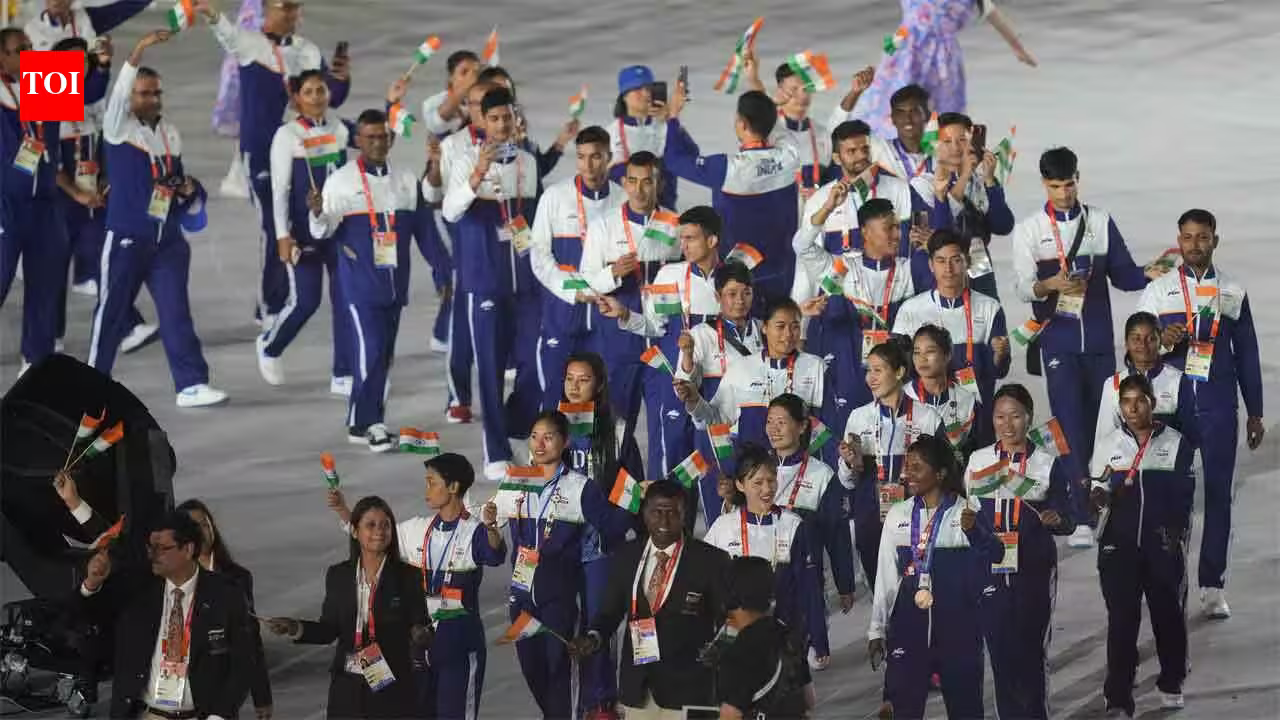
BEYOND THE MEDAL TALLY: India’s Aichi-Nagoya reality check reveals deep cracks in elite performance. When the final dust settled at the Aichi-Nagoya Asian Games, the headline figures—85 medals, 21 gold, and a strong fourth-place finish—painted a portrait of a rising sporting powerhouse. Yet, beneath the veneer of national pride lies a sobering audit that demands an urgent re-evaluation of India’s high-performance strategy. A granular look at the performance data reveals that the country’s massive, 495-member contingent was defined as much by its empty-handed departures as it was by its golden moments.
The “Empty-Handed” Paradox
While the 85-medal haul serves as the second-best performance in Indian history, the math behind the roster tells a more challenging story. Across 16 different disciplines, 137 Indian athletes returned home without a single medal to show for their efforts. This statistic highlights a glaring disconnect between participation and podium readiness.
The scope of the struggle is wide-reaching. Sports such as canoeing, cycling, fencing, esports, and swimming—disciplines that command significant time, infrastructure, and budget—saw dozens of athletes exit the Games early. In total, 201 athletes out of the 495-member squad accounted for a meager six bronze medals across 22 disciplines. From rowing and sepaktakraw to wushu and soft tennis, the heavy investment in personnel failed to yield the expected dividends, signaling that “participation” alone is no longer an adequate metric for success at the continental level.
Investment vs. Impact: A Financial Audit
The fiscal narrative of Indian sport is equally complex. The government’s commitment is undeniable, with an estimated Rs 703 crore earmarked for the preparation cycle spanning November 2023 to August 2026. This funding covers everything from international exposure trips and high-end equipment to the recruitment of foreign coaching expertise.
However, the return on investment (ROI) remains questionable in several high-spend categories. For instance, the government poured Rs 35.9 crore into cycling and Rs 28.2 crore into fencing—disciplines that, despite the heavy financial backing, failed to translate into medal success in Aichi-Nagoya. Similarly, the badminton and table tennis contingents, which received substantial backing, sent 37 athletes combined but returned with only two bronze medals.
These figures expose a “conversion rate” problem. India contested 259 medal events but reached the podium in just 20 of them, representing a dismal 7.7% event-podium conversion rate. When measured against the 356 available medals in which India featured, the nation secured only 23.9% of its potential targets.
The Efficiency Gap: A Warning Signal
To understand why these numbers are concerning, one only needs to look at the comparative data from the 2026 Commonwealth Games in Glasgow. In a much smaller setup, 122 Indian athletes secured 39 medals, resulting in a medal efficiency rate of 32 per 100 athletes. Contrast that with the Aichi-Nagoya performance, where the efficiency rate dropped to 17.2 per 100 athletes.
The data suggests a paradox: as India expands its contingent size and increases its funding, the marginal utility of each additional athlete appears to be shrinking. The sheer volume of athletes supported by high-performance schemes—including 77 from the Target Olympic Podium Scheme (TOPS) Core group and 65 Khelo India Athletes—has not yet translated into the breadth of excellence that the government’s ambitious fiscal policy aims to foster.
The Path Forward: From Exposure to Excellence
The Aichi-Nagoya experience serves as a definitive turning point for India’s sports administration. The era of focusing primarily on providing “international exposure” is nearing its natural limit. With over Rs 250 crore spent on international competition exposure, the lesson from this cycle is that international experience is only valuable if it is paired with a clinical, results-oriented training culture.
The concentration of medals among a small, elite core is a common hurdle for developing sporting nations, but it is a hurdle that must be cleared to transition from a regional player to a global contender. For the Ministry of Youth Affairs and Sports and the various national federations, the mandate is clear: the focus must shift from simply “widening the base” of participation to “deepening the quality” of that participation.
As the country looks toward future Olympic and Asian cycles, the strategy must evolve. Continued investment in grassroots development is essential, but the high-performance arm of the Indian sports machine must now prioritize rigorous selection criteria and data-backed performance tracking. For a country spending upwards of Rs 700 crore to bolster its athletic footprint, the time for “participation pride” is over. The next phase of Indian sport must be defined by cold, hard podium conversion—where every rupee spent on an athlete directly correlates to an athlete’s ability to stand on that stage.
Disclaimer: This content is auto-generated for informational purposes only.
Source: Read Original News