






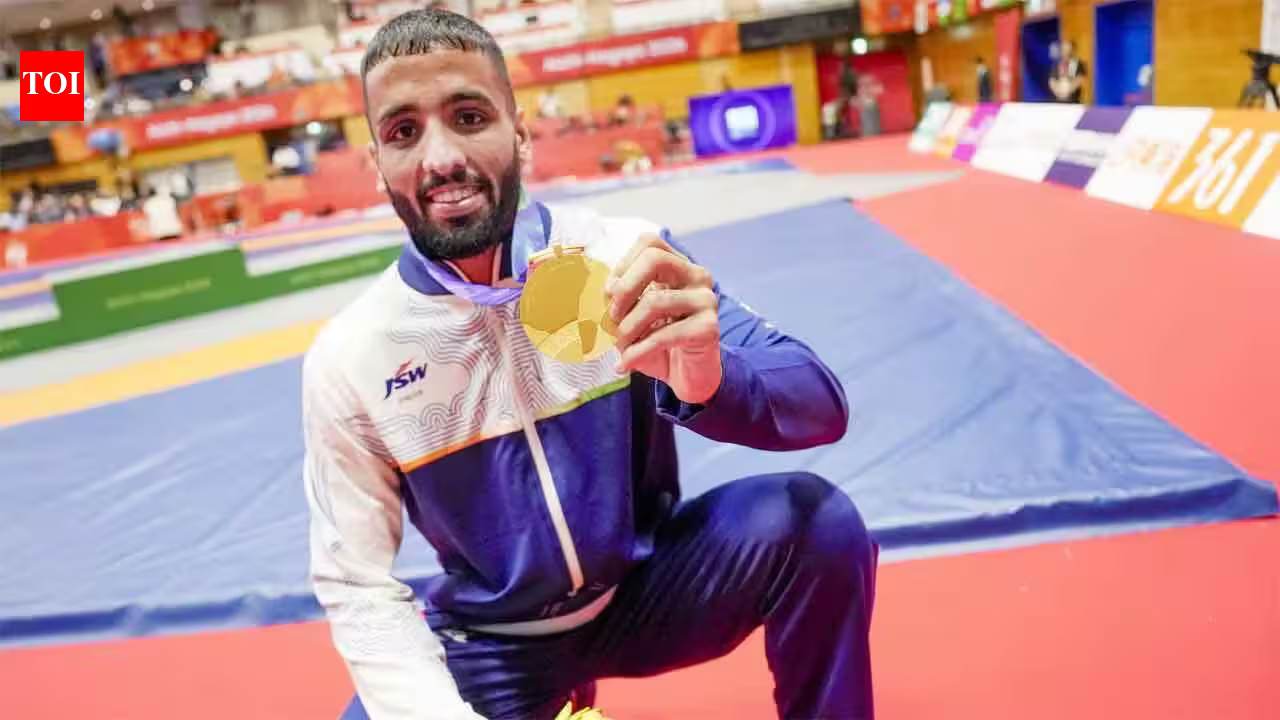
“Gold ke liye jaana hai.” These five words, spoken with the conviction of a man who has stared down his own demons and emerged victorious, serve as the mission statement for India’s wrestling phenom, Sujeet Kalkal.
Two years ago, such a statement might have sounded like ambitious posturing. Today, it resonates as a promise. Following a spectacular gold-medal performance at the Asian Games, the 65kg powerhouse has transformed from a victim of circumstance into a titan of the mat. For Kalkal, this triumph in the continental arena was far more than a glittering addition to his trophy case; it was a defiant answer to the cruelest heartbreak of his career.
From Dubai Despair to Continental Glory
The road to the top of the podium was paved with agony. In 2024, Kalkal found himself stranded at Dubai International Airport for three grueling days, his path to the Asian Olympic Qualifying Tournament blocked by unprecedented floods. As the clock ticked down, he watched his chance to represent India in Paris evaporate into the air. It was a crushing blow, an ordeal that would have forced many athletes to rethink their trajectory.
Instead, Kalkal recalibrated. On Sunday, standing at the pinnacle of the Asian Games, the memory of that airport lounge was effectively exorcised. Trailing 2-9 in the final against Tajikistan’s formidable Abdulmazhid Kudiev, the world No. 2 refused to yield. In a display of technical brilliance and iron-willed grit, he stormed back to secure a 10-9 victory. As the final whistle blew, he looked skyward, tears streaming down his face—not of sorrow, but of total redemption.
A Legacy of Perseverance
By clinching the gold, Kalkal ended India’s eight-year drought in the wrestling category at the Asian Games. His journey to the top of the podium was anything but routine; he navigated a gauntlet of elite opponents that would test any competitor’s resolve.
In the quarterfinals, he sent a thunderous message to the field by tossing Iran’s Abbas Ebrahimzadehsavadkouhi in the opening 20 seconds. If that didn’t turn heads, his semifinal demolition of Olympic champion Kotaro Kiyooka certainly did.
When asked about his ability to dismantle giants, Kalkal remained grounded in the philosophy that carried him through his darkest days. “The simple plan was to wrestle my own way and not be impressed by my opponent’s name,” he told TimesofIndia.com on his way back to his home in Imlota, Bhiwani. “Whether he is an Olympic champion, a world champion, or anyone else, everyone starts from zero on the mat. I just trusted my preparation and my strength.”
The Architecture of a Champion
Kalkal’s career, which already boasts an U23 World Championship crown, Asian Championship success, and a Zagreb Open title, is characterized by a relentless drive to evolve. He openly admits that the “Dubai incident” shifted his psychology. No longer does he shy away from the weight of expectations; he views pressure as a diagnostic tool to measure his own fortitude.
“Fear may never completely go away, but now I know how to fight with fear,” he remarked. “When you go through tough situations in life, small things stop bothering you. What happened in Dubai—missing the Olympic qualifiers—every experience taught me something. Now I don’t run away from pressure. I enjoy pressure because those are the moments when you realize how strong you actually are.”
This mental evolution was on full display during his 10-9 comeback. In a sport where a seven-point deficit is often considered a death knell, Kalkal operated with the clinical composure of a veteran, systematically dismantling his opponent’s lead until the victory was his.
Eyes on Los Angeles 2028
With the Asian Games gold safely tucked away, the conversation has already shifted to the next horizon: Los Angeles 2028. For many, a continental gold would be the peak, but for Kalkal, it is merely a prerequisite for the real objective.
“Paris was very difficult for me to miss, but that experience made me stronger instead of breaking me,” he said. His focus is no longer on simply securing a ticket to the Olympic Games; he is looking to complete his collection with the ultimate prize. “If you’re going to the Olympics, don’t go just to participate, brother,” he insisted. “Go there to win gold.”
As he returns to the village of Imlota to celebrate with his family—crediting his father, in particular, for the unyielding support that kept him anchored through his lean years—there is a palpable sense of momentum. Sujeet Kalkal is no longer defined by the flights he missed or the opportunities that slipped through his fingers. He is defined by the way he stands now: resilient, relentless, and unapologetically hungry for the next big challenge.
The wrestling world has been put on notice. The man from Bhiwani has mastered the art of the comeback, and he has his eyes set firmly on the top of the podium in 2028.
Disclaimer: This content is auto-generated for informational purposes only.
Source: Read Original News