








Beyond the Screen: A "Big Walk" Through the Minds Behind House House’s Latest
In a landscape saturated with remote interactions, one journalist ventured into the digital realm for an interview that transcended the typical Zoom call, offering a unique and deeply personal glimpse into the creative process of House House, the acclaimed developers behind the co-op sensation, Big Walk.
For many, the pandemic solidified a reliance on digital meeting spaces, transforming professional discourse into a mosaic of pixelated faces and occasional audio glitches. This sentiment was keenly felt by a seasoned journalist, whose decade-long career in remote industries had fostered a weariness for the sterility of online interviews. While acknowledging the necessity and occasional efficacy of these virtual exchanges, a longing for more tangible, emotionally resonant connections persisted.
This desire for authentic interaction found an unexpected, yet perfect, outlet in Big Walk, the latest title from the Australian independent studio, House House. Instead of a conventional video call, the developers extended an invitation to conduct the interview within the game itself – an opportunity that proved to be both refreshing and profoundly insightful.
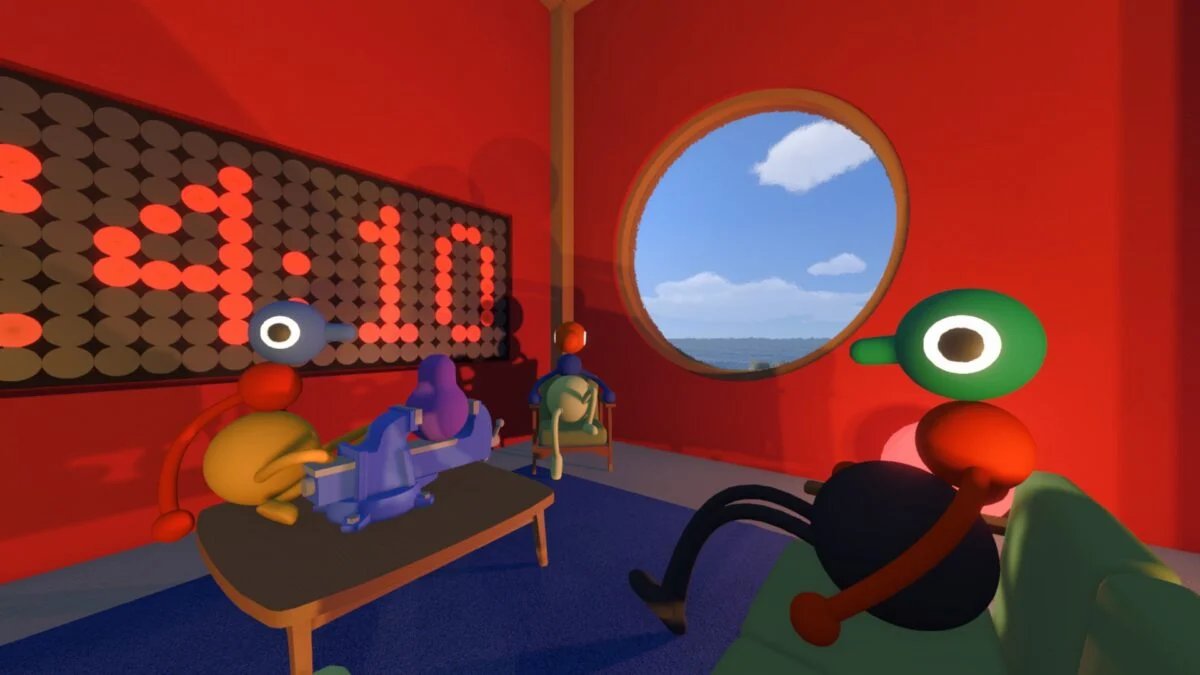
The journalist embarked on a nearly 90-minute virtual stroll with three of House House’s five full-time members: Stuart Gillespie-Cook, Jake Strasser, and Nico Disseldorp. Far from a rigid Q&A session, the interview unfolded organically as their in-game avatars – charmingly simple figures with distinct color schemes – meandered through the vibrant landscapes of Big Walk. This immersive setting, coupled with the playful antics of their digital counterparts, effortlessly dissolved the usual stiffness associated with formal interviews.
Gillespie-Cook, Strasser, and Disseldorp, who all officially bear the title of "developer," offered fascinating insights into their individual contributions. Gillespie-Cook, identifiable in the provided screenshots by his red, blue, and yellow avatar, focuses on "capital G Game Design," animation, and extensive QA. Strasser, whose green, red, and brown avatar reflects his role, is primarily "responsible for the world," placing "all the rocks everywhere" and contributing significantly to technical art. Disseldorp, the programmer and designer, depicted in blue, red, and gold, was instrumental in crafting many of Big Walk‘s challenges. The team also mentioned Michael McMaster, the fifth member, who oversaw the game’s aesthetic direction.
The interview, a comprehensive exploration of Big Walk, began in the tutorial room, leading to a journey across the island, including a train ride to a unique location affectionately dubbed the "Five Minute Room" – a recurring in-game puzzle that serves as a quiet space for reflection.
One of the earliest revelations concerned the game’s nascent stages during the pandemic. The developers recounted how a prototype of Big Walk materialized within a mere week. Disseldorp recalled that the early avatars were "just like a model that jumped up and down," while Gillespie-Cook noted the presence of a few different character models. Strasser clarified that the initial iterations lacked animation.
The nascent world was a vast, empty terrain, powered by proximity voice chat, fostering an immediate sense of camaraderie and the playful necessity of staying together. Disseldorp vividly described the early enjoyment of simply "walking around and making sure we were staying together and making sure no one got too far ahead."
The conversation took a whimsical turn when discussing the initial terrain. Disseldorp confirmed the use of a photo scan, initially of the Faroe Islands – an inspiration that Strasser playfully linked to Björk’s house. While this proved to be a humorous misconception (though a Snopes article exists about the image Strasser referenced), it highlighted the early exploration of isolated, beautiful landscapes. However, the team soon realized a desire to create something "more local" and familiar, leading to the game’s current Australian Wilson’s Promontory National Park-inspired setting.
The shift in design philosophy was partly influenced by their previous success, Untitled Goose Game. Gillespie-Cook mused, "Why aren’t we just making a game about our backyard?" This desire for a more intimate, relatable setting became a driving force.
The discussion then delved into the evolving concept of Big Walk from a casual shared space to a commercial game. Disseldorp admitted, "I think the idea that we were going to sell this to people was way later," initially envisioning it as a tool for friends to "have a little party here." Gillespie-Cook elaborated, highlighting a deeper, pandemic-driven yearning for human connection. He imagined a more natural version of chaotic Zoom calls, where players could simply "walk around the corner" to engage in smaller, more intimate conversations. This concept of fluid social interaction became a cornerstone of the game’s design.
Early challenges, though some were ultimately scrapped for being "un-fun," played a crucial role in shaping the game’s cooperative elements. Disseldorp emphasized that the true revelation was the "scale of the interaction." By focusing on the players themselves, rather than extraneous activities, Big Walk allowed for nuanced communication through hand movements, waves, and even picking up other characters, fostering a sense of intimacy and connection.
The interview culminated in a discussion about the game’s unique rewards and design choices. A recurring red, Kong-toy-shaped object, affectionately known by various player-generated names (often "baby" or "nipple," prompting laughter from the developers), serves as a symbolic reward. Gillespie-Cook revealed its long-standing presence in their design discussions, with Strasser noting he created the "wind-up-clamp" mechanism that secures it "really, really early on."
The developers also addressed the distinctive "bell" antagonists in Big Walk, a playful nod to their previous work on Untitled Goose Game. Disseldorp quipped that the team "really got us pegged as being obsessed with giving our video game characters little bells." This emphasis on sound as an antagonistic element reflects a deliberate design choice, adding to the game’s sensory richness.
The journey through Big Walk was not without its literal and metaphorical ups and downs. The journalist, at one point, accidentally dropped Gillespie-Cook’s light orb off a cliff, prompting shared laughter and highlighting the unpredictable yet charming nature of in-game interactions. The developers, however, showcased their expertise, navigating tricky rock faces and often recalling specific game areas even without the aid of light.
The power of Big Walk‘s social dynamics was further evidenced by player anecdotes. Disseldorp recounted observations of couples discussing their domestic lives within the game, and even a group of colleagues mistakenly believed to be role-playing a meeting, only to discover they were genuinely conducting work discussions. This blurring of lines between game and reality speaks to the immersive and personal nature of Big Walk‘s experience.
A critical aspect of Big Walk‘s design is its accessibility features, particularly the ability to skip puzzles. Gillespie-Cook appreciated the broadness of this feature, allowing players to tailor their engagement. Disseldorp elaborated on how the game often requires translation between senses, making traditional accessibility solutions challenging. He highlighted how specific challenges, like one involving listening to microphones, could be solved without hearing, through text chat or by leveraging diverse abilities within a group.
The game’s exceptional audio design, a collaborative effort with Nicholas Zhang and Em Halberstadt of Shell in the Pit, was a particular point of praise. Disseldorp, recalling their prior work on Untitled Goose Game, emphasized how their sound team "took it way further than we could have ever imagined," transforming sound into an integral part of gameplay, allowing for actions like echoing across valleys.
One humorous anecdote involved the "pbbbbt" sound made upon logging off. Gillespie-Cook revealed that this distinct audio cue was a "classic decision by Em," implemented without prior consultation, showcasing her creative freedom and the team’s trust in her vision. The initial shock of this unexpected sound eventually evolved into a celebrated, rule-breaking element, creating a shared experience even for players not actively present.
Addressing the game’s reception, Disseldorp acknowledged Big Walk as a "high-risk, high-reward option," a project they could afford to undertake thanks to the success of Untitled Goose Game. This financial freedom allowed House House to pursue a "more personal, and a bit more weird, and maybe a bit more of a niche taste," ultimately placing them ahead of the curve in the emerging trend of proximity voice chat multiplayer games.
The conversation naturally veered towards the controversial term "friendslop" – a label for a burgeoning genre of social games. While understanding its shorthand utility, Gillespie-Cook expressed his dislike for the "connotations of carelessness," emphasizing the meticulous craftsmanship behind these titles. Disseldorp playfully added, "And importantly, all artists hate the name of the genre."
Despite their success, House House remains grounded, actively engaging with players and refining Big Walk based on community feedback, including addressing issues with proximity chat. The interview concluded with a poignant reflection on personal favorite moments within Big Walk. Gillespie-Cook cherished the feeling of being "alone, but knowing that someone else is somewhere in the world doing stuff and seeing little evidence of them."
Disseldorp shared a particularly touching anecdote about a group of friends who, after completing all the challenges in an early build, spontaneously decided to swim out into the in-game ocean as a symbolic farewell. The developers, witnessing this organic, unscripted ending, were deeply moved. This experience profoundly influenced the eventual inclusion of "ritualized goodbyes" in Big Walk‘s official endings, recognizing the importance of honoring players’ journeys and the connections forged within the game.
As the journalist’s in-game avatar made a final "pbbbbt" sound and exited the digital world, the experience left an indelible mark. This interview, conducted within the very fabric of Big Walk, demonstrated the power of creative design to foster genuine connection and offer a deeply human glimpse into the art of game development.
You can learn more about House House’s creations and experience the unique social gameplay of Big Walk by visiting their official website.