








Mine action is not as simple as “mines bad, clearing mines good.” Every hectare we clear, and every hectare we choose not to clear, carries an environmental cost, and pretending otherwise does a disservice to the donors, governments and communities we serve. If we want mine action to take the environment seriously, we first have to be honest about the trade-offs, and about what taking it seriously would actually cost.
A Sector Touching Every Part of Recovery
Mine action touches every aspect of life in a mine-affected country. You cannot rebuild a school, build a hospital, drive down a road or plough a field if there is a concern about mines. It is also, whether we have treated it that way or not, an environmental issue.
In Ukraine, one proposal has been to issue a green bond to put wind farms into minefields: clear a small area for a turbine at minimal cost, let the turbine generate power and revenue, and use that use that revenue to fund clearance of the rest of the field one turbine at a time. It is a genuinely green project, with sustainable energy paying for mined land to be cleared while building a independent green source of sustainable energy.
At the other end of the scale, when the Kakhovka Dam was destroyed on 6 June 2023, in what Ukrainian officials at the time described as an environmental catastrophe, the collapse released roughly 18 cubic kilometres of water from the reservoir in a matter of days, flooding towns and farmland downstream along the Dnipro River and displacing thousands of people. The rushing water tore through riverside positions and former front-line areas, dislodging landmines and unexploded ordnance and carrying them, along with fuel, agricultural chemicals and military waste, into areas that had never been mapped or cleared. The environmental damage it caused, toxic chemicals and debris swept downstream, became far harder to address precisely because the areas affected were either already contaminated, or suspected of contamination, with mines: teams could not safely reach flooded land to assess or remediate it until it had also been checked for explosive hazards. Explosive ordnance itself, particularly the more complex items, over time leaches chemicals into the ground so for as long as it sits there contamination is occurring. Even our standard method of destroying old ammunition, open burning, means putting toxic chemicals into the atmosphere to remove a hazard from the ground.
The Case for Restraint: Zone “Rouge” and the DMZ
However not all contaminated land needs to be cleared, and some of it may be better left alone. After the First World War, France declared parts of its former battlefields a Zone “Rouge”, too dangerous or too costly to clear, and left them. At the time, that zone covered more than 1,000 square kilometres; today it has shrunk to roughly 100 sq km, and that remaining land is now among the most biodiverse in the country. The Korean DMZ tells the same story: decades free of human disturbance, because it is mined, have made it one of the most biodiverse strips of land anywhere in the world. Clearing the mines will almost certainly impact this balance.
That is not an argument for abandoning clearance. It is an argument for asking, area by area, whether leaving land uncleared would in fact produce a better environmental outcome than clearing it, and building that question into how we prioritise. In Ukraine, a tool like GRIT, a national digital platform developed by Ukraine’s Center for Humanitarian Demining and Ministry of Economy, Environment and Agriculture with UNDP support, could in principle be extended for this purpose. GRIT already draws on more than thirty layers of date from state and commercial datasets, including minefield records, soil & forestry data, satellite imagery & population movement, using AI/ML models to rank clearance priorities by their impact on people, agriculture, infrastructure and economic recovery. Extending that same logic this same data could be used to flag which areas make sense as long-term “red zones”, rather than absorbing scarce clearance resources for marginal gain, would be a natural next step.
The Damage We Do While Trying to Help
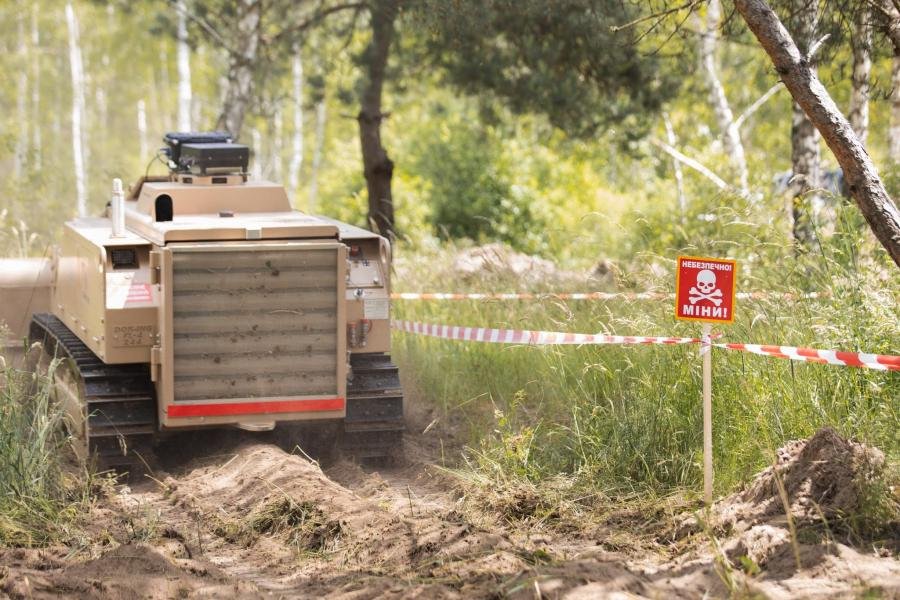
Demining machines, flails, tillers and combinations of the two, dramatically improve the pace of clearance. They also pulverise the ground, destroy root systems and soil structure, release stored carbon and can permanently alter the biomass of a site. I have seen fertile land in Afghanistan effectively destroyed this way, when topsoil loosened by a machine was blown down an entire valley by the wind.
None of this means we should stop using machines. It means machine use needs proper planning around soil type, season and weather, and it means the sector should be thinking harder about remediation: something as simple as fertiliser, seed and fast-growing cover crops sprayed behind a machine to help soil recover, rather than leaving pulverised ground exposed. We do not yet have good answers here. We should be looking for them.
The Missing Fourth Dimension: Time
Mine action is not static, certainly the environmental risk and benefit from it is not and treating it as a single snapshot in time misses the point. Some contamination is leaching into soil or water right now and needs an urgent response. Other munitions will not degrade for another thirty years, some will never cause significant contamination, which raises a genuine question: is it better to clear a complex, with resulting high-impact to the environment site today, or to wait ten years for demining technology, very possibly including autonomous systems, to do the job with a fraction of the environmental and human cost?
The same logic applies to human risk. Every task assigned to a deminer carries both a financial cost and a real chance that the person doing it will be killed or lose a limb. Weighed against a five-year wait for safer, cheaper, autonomous alternatives, that is not a comfortable calculation, but it is one we owe it to our operators to make it honestly rather than by default.
Climate Change Is Already Changing the Risk Picture
Extreme heat and extreme temperature swings accelerate the degradation of explosive items and can cause some explosives to separate into more unstable compounds. But the larger risk is movement: flooding and landslides shift contamination from known, marked and understood areas into places nobody is expecting it. In Ukraine, where light plastic items like PFM-1 “butterfly” mines are present in large numbers, floodwater can carry them well beyond any mapped hazard area, as we saw with the Kakhovka Dam. That is arguably the single biggest climate-linked risk mine action now faces: not that hazards get more dangerous where they are, but that we lose track of where they are at all.
Vision, Then Resourcing, Not the Other Way Around
None of the above is worth much unless the sector is honest about cost. If the United Nations’ mine action work decides that environmentally conscious programming should be standard practice, that is a legitimate choice, but it is not a free one. Ten per cent of a programme manager’s time redirected to environmental considerations, multiplied across twenty-odd country programmes, is not a rounding error; it is real money, on the order of hundreds of thousands to a million dollars a year. A modest upfront investment in better data and planning tools could, over time, cut that ongoing cost substantially, but someone still has to choose to make that investment, and someone has to tell donors, clearly, that a higher environmental standard comes with a higher price tag.
We tried a version of this a decade ago with an initiative called Greening in the Red. It produced good intentions and very little else, because it was never built into strategy or given a budget. The lesson was simple: a memo asking people to try harder is not a policy.
Not a Simple Story
I say this as someone who has spent thirty years in this sector: nothing here is as simple as “mines bad, clearing mines good.” A fenced, marked anti-personnel mine on a former front line poses little risk to anyone today. The same mine, still active in twenty years once the fencing has gone, the trenches are filled and the front line is a memory, is a very different problem. But again a handful of scattered mines on land that will never be used again may do less environmental harm sitting in the ground than the fuel burned and the machinery deployed to remove them.
If mine action is serious about the environment, that seriousness has to show up in three places: in the vision the mine action sector in Ukraine sets for itself, in the strategy that follows from it, and in the resources allocated to deliver it. Anything short of that is a good intention without a plan to deliver a clear outcome, and in this sector, as in most others, good intentions without a solid justification and a plan tend not to survive contact with a budget review committee.