







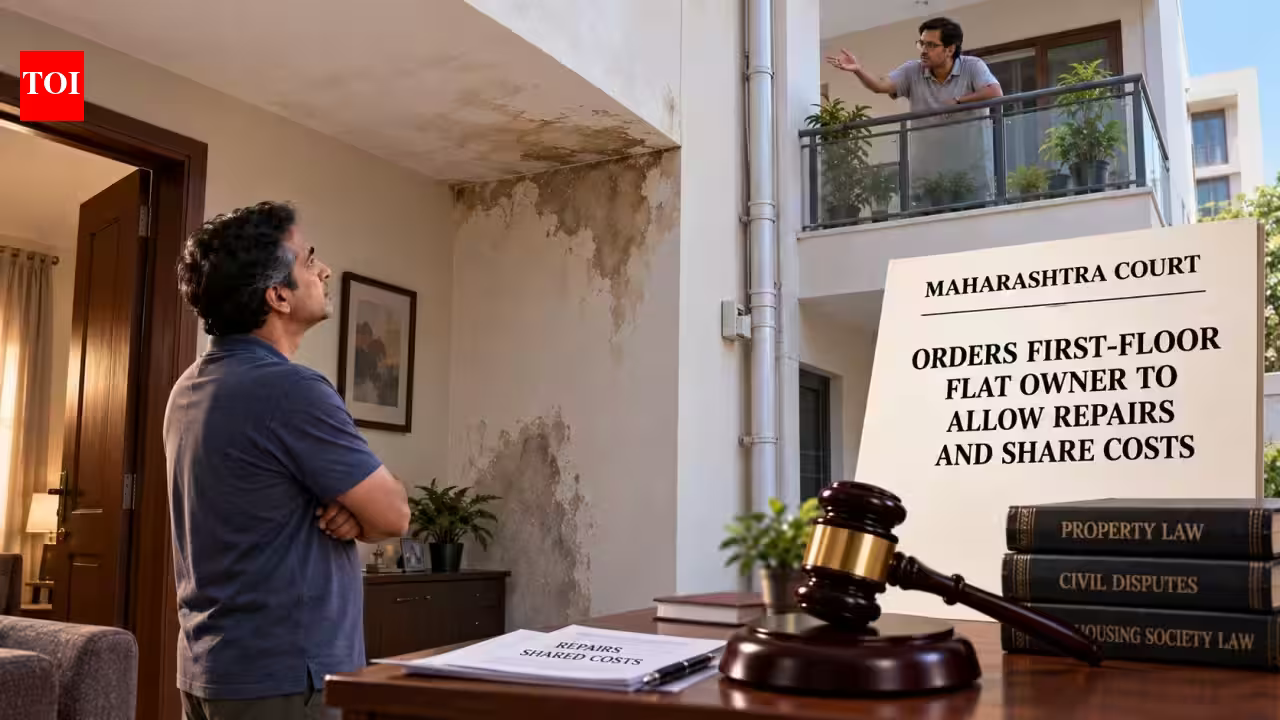
The Structural Conflict in Indian Housing Societies
The Indian urban landscape is dominated by high-density housing societies, a model that maximizes land utility but simultaneously creates complex interdependencies between residents. Among the myriad issues that plague these communal living arrangements, water leakage remains the most persistent and litigious. The recent resolution of a protracted eight-year legal dispute between ground-floor and first-floor occupants in Maharashtra serves as a critical case study in property law, individual rights versus communal obligations, and the efficacy of the Cooperative Societies Act.
In urban centers like Mumbai, Pune, and Bengaluru, where vertical living is the standard, the structural integrity of a building is a shared concern. When a resident experiences water seepage, the origin is rarely confined to their own four walls. It typically involves a vertical flow from plumbing or flooring failures in units above. This creates a binary conflict: the occupant below suffers property damage and health hazards due to mold and dampness, while the occupant above guards their privacy and the integrity of their own flooring. As witnessed in this recent court ruling, these disputes often escalate from minor inconveniences into prolonged legal battles that test the limits of housing society bye-laws.
The Intersection of Privacy and Property Maintenance
At the heart of the dispute was a fundamental disagreement regarding rights. The upstairs resident raised significant arguments centered on the sanctity of the home, citing the need for privacy and the potential for financial loss should repair crews damage their interiors. These are legitimate concerns in a country where renovation costs are high and quality of workmanship is often inconsistent. Furthermore, the upstairs occupant sought to leverage the ambiguity of the situation—specifically, the lack of a definitive technical report identifying the exact point of failure—to resist entry.
However, the legal system in India, through the framework of the Maharashtra Co-operative Societies Act, prioritizes the collective functioning of the housing unit over the absolute discretion of an individual owner. The court’s intervention underscores a vital principle: the ownership of a flat in a housing society does not grant an absolute right to obstruct essential maintenance that affects the structural integrity of the building or the habitability of a neighbor’s unit. By bringing in an independent engineer to assess the situation, the court navigated the impasse, ensuring that the burden of proof was grounded in objective evidence rather than anecdotal claims.
Leveraging Cooperative Bye-Laws for Resolution
A common failure point in Indian housing societies is the inability of Managing Committees to enforce internal resolutions. In the case at hand, the existence of specific society bye-laws and a prior Annual General Meeting (AGM) resolution regarding the cost-sharing of leakage repairs played a decisive role in the final verdict. When residents purchase property in a cooperative housing society, they inherently agree to abide by the governing rules of that society. These rules are designed to prevent the “tragedy of the commons,” where individual selfishness leads to the deterioration of the collective asset.
The appellate court’s reliance on these bye-laws serves as a reminder to housing society administrators that their rulebooks are not merely administrative suggestions but enforceable instruments. In this instance, the court bypassed the resistance of the upstairs owner by referencing the legal obligation to cooperate. This highlights a necessary evolution in how societies handle disputes: rather than allowing matters to fester until they reach a state of total structural failure or litigation, committees must act as authoritative mediators, relying on their own regulatory frameworks to enforce access for necessary repairs.
Financial Responsibility and the Equitable Burden
Financial disputes often act as the primary catalyst for litigation. In the Indian context, the “who pays” question is frequently tied to the “whose fault is it” narrative. The court’s decision to mandate an equal split of repair costs, as per the society’s previous AGM resolution, provides a pragmatic template for other societies to follow. By enforcing a cost-sharing model, the court neutralized the argument that one party should bear the entire financial burden, regardless of whether the leakage was caused by original construction flaws, subsequent renovations by previous owners, or natural aging of the pipes.
This approach is economically sound for housing societies. Protracting disputes through litigation costs far more in legal fees and property depreciation than the actual cost of professional waterproofing or plumbing repairs. By settling the cost-sharing mechanism early, societies can incentivize residents to cooperate rather than fight. The case underscores that when the cost of maintenance is pre-determined and institutionalized, the likelihood of reaching a consensus increases significantly, shielding both parties from the debilitating expenses of a protracted court battle.
The Broader Implications for Urban Real Estate
The resolution of this case sends a clear signal to the real estate sector and the residents of vertical living environments. The judicial stance suggests that while the sanctity of the home is respected, it is not an absolute shield against the responsibilities of community living. The legal system has signaled a preference for professional, third-party assessments of infrastructure damage over protracted arguments between neighbors.
For the Indian real estate market, this trend points toward a more formalized approach to property management. As buildings age, the prevalence of water-related disputes will rise. Consequently, the role of structural auditors and certified engineers will become increasingly central to the maintenance of housing societies. Moving forward, the expectation is that society management committees will adopt more proactive stances, maintaining rigorous records of infrastructure health and enforcing entry protocols for repairs before the damage creates a legal deadlock.
Ultimately, this case serves as a blueprint for conflict resolution. It demonstrates that when individual rights to privacy collide with the functional requirements of a shared structure, the latter must prevail to ensure the viability of the building. The mandate for cooperation is not merely a moral appeal but a legal imperative, anchored in the necessity of maintaining the physical capital of the nation’s urban residential stock. For owners, the lesson is clear: cooperation is the most economical path, and the regulatory framework of a housing society is designed to facilitate, not hinder, the preservation of residential assets.
Disclaimer: This content is auto-generated for informational purposes only.
Source: Read Original News