







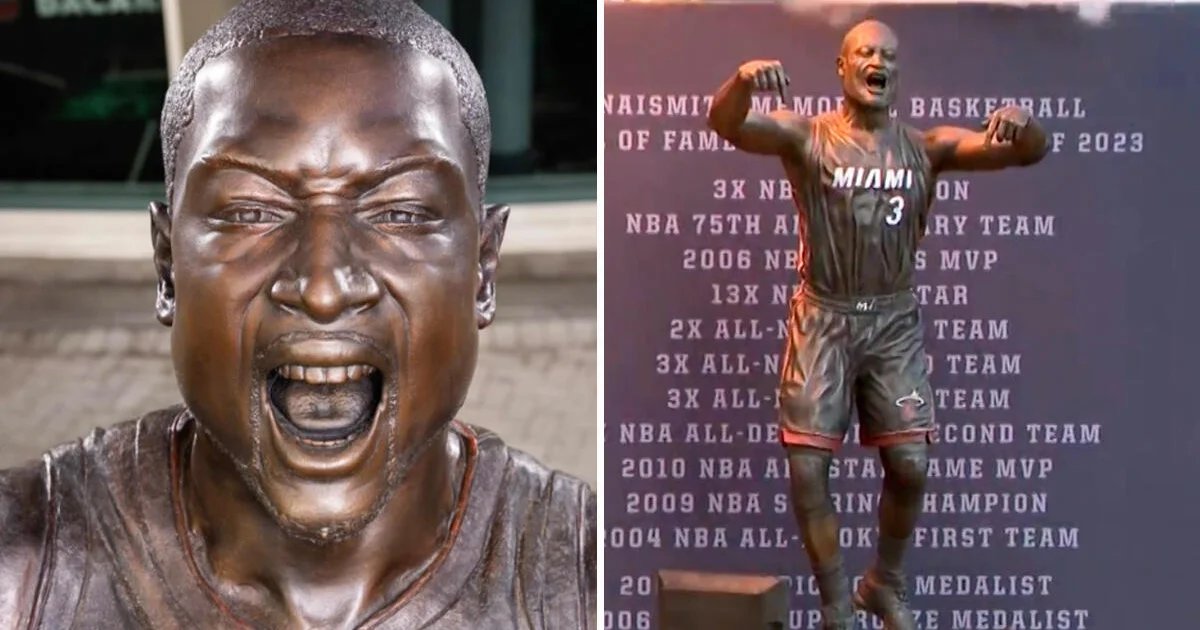
Dwyane Wade has officially addressed one of the most talked-about public art blunders in NBA history. Two years after the Miami Heat unveiled a bronze statue outside their arena to honor the franchise legend, the basketball icon announced on Friday that the sculpture has undergone a significant transformation: a completely new head.
The original iteration of the monument, which captured Wade’s iconic “This is my house” celebration from a 2009 game-winning shot, was immediately met with a wave of internet memes and harsh criticism. Fans and critics alike noted that while the physique and pose were spot-on, the face bore little to no resemblance to the Basketball Hall of Famer. Rather than letting the controversy linger as a permanent punchline, Wade and the Heat organization opted for a rare “software update” in the physical world, deciding to refine the likeness to better resonate with the Miami faithful.
The Tech of Sculpting: Why Precision Matters
While traditional sculpting relies on clay and bronze casting, the process of creating—and fixing—a public monument often bridges the gap between old-world craftsmanship and modern precision. In an era where AI-driven facial recognition and high-fidelity digital modeling have become standard in industries ranging from entertainment to security, the public has grown accustomed to extreme accuracy.
The initial backlash to Wade’s statue highlighted the “uncanny valley” effect, where a figure looks almost human but possesses just enough off-putting features to create a sense of discomfort. By choosing to adjust the head rather than scrap the entire project, the team behind the statue utilized high-resolution feedback and precise modeling to bring the sculpture in line with the expectations of a digital-savvy public. This process mimics the iterative feedback loops found in software development, where a product is launched, tested by the “user base” (the fans), and subsequently patched to improve the user experience.
Community Feedback as an Iterative Process
Wade’s approach to the situation mirrors the philosophy of product development seen at major tech giants like Google. Just as developers listen to user data and community forums to push updates that enhance interface accessibility or aesthetic clarity, Wade realized that the statue was a public-facing asset that needed to serve its community.
“If people don’t feel that connection when they look at the face, why wouldn’t we try to make it better?” Wade wrote in a candid essay accompanying the reveal. By treating the statue not as a static, untouchable piece of art, but as an evolving project, Wade has set a new precedent for how public figures can interact with fan criticism. He emphasized that the adjustment wasn’t a rejection of the original artistry, but an acknowledgment that in the age of viral feedback, public monuments are living entities that must maintain a meaningful connection with their audience.
A Modern Approach to Legacy
The new, improved sculpture—which was kept under wraps beneath a plywood barrier while the adjustments were finalized—is now ready for its close-up. For the Miami Heat, this update ensures that the “305” area code continues to represent excellence without the distraction of a poorly rendered likeness.
In an era where tech companies are constantly refining their branding and user interfaces to stay relevant, Wade’s willingness to “go back to the drawing board” serves as a poignant lesson in accountability and collaboration. The statue now stands as a symbol of the 2009 moment—the roar of the crowd, the intensity of the shot, and now, a face that truly reflects the man who led the team to three NBA championships. It is a reminder that even in the physical realm, the ability to listen, pivot, and improve is the hallmark of a true legend.
Disclaimer: This content is auto-generated for informational purposes only.
Source: Read Original News