









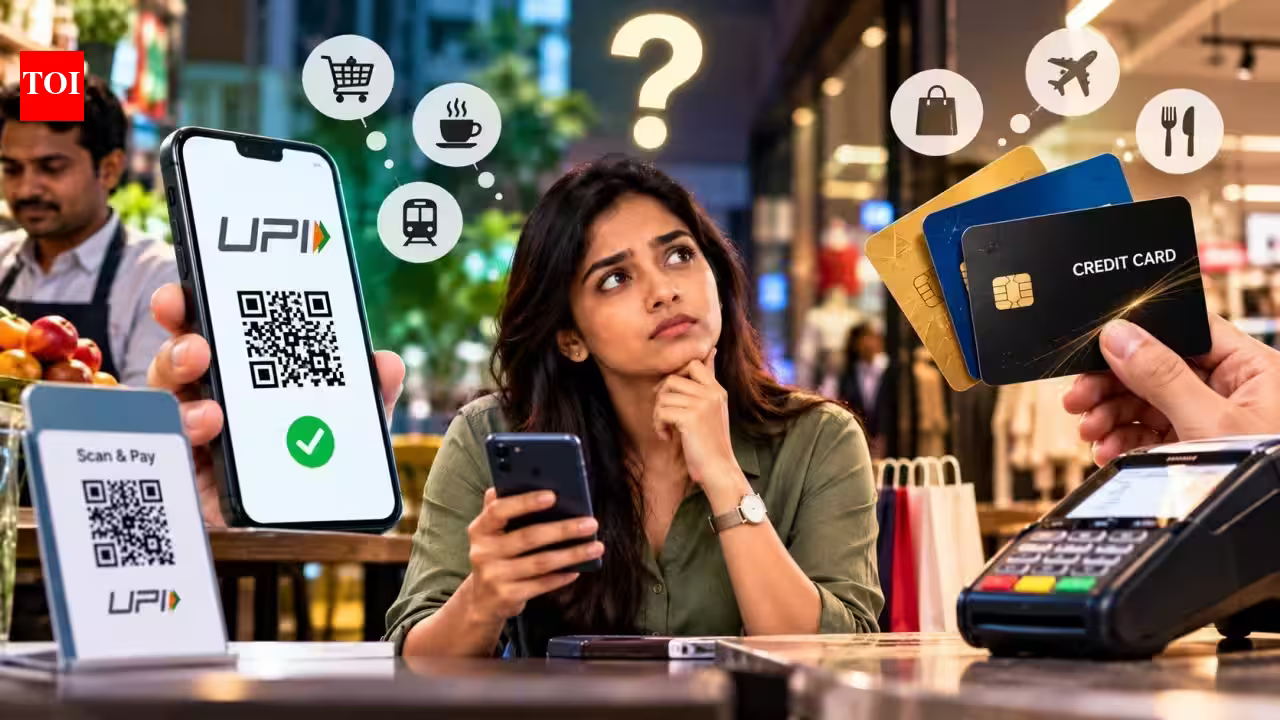
UPI and Credit Cards: Defining Distinct Roles in the Digital Wallet
In the rapidly evolving landscape of Indian digital payments, the choice between Unified Payments Interface (UPI) and credit cards has become a subject of strategic importance for the informed consumer. While UPI has fundamentally altered the payment habits of millions by providing unparalleled convenience and near-instant bank-to-bank settlement, credit cards remain a powerful tool for financial management, provided they are utilized within a disciplined framework.
UPI is intrinsically linked to the immediate liquidity of a bank account. Its primary utility lies in frictionless, real-time transfers that demand zero interest or credit risk. Conversely, a credit card functions as an instrument of delayed payment, typically offering an interest-free grace period of 40 to 50 days. This cycle not only allows for better cash-flow management but also integrates the consumer into a structured rewards ecosystem. With the introduction of RuPay credit cards on the UPI network, the distinction between these two modes is increasingly blurred, creating a hybrid environment where the consumer must weigh utility against tangible economic return.
The Economics of Value-Back: Beyond Immediate Costs
A prevalent misconception in personal finance is that payment decisions should be governed solely by transaction fees or the Merchant Discount Rate (MDR). In reality, the net cost of a purchase is determined by the total value-back a consumer receives, minus any applicable fees. Credit cards are engineered to incentivize specific spending behaviors through cashback, loyalty points, and tier-based reward programs.
Consider a significant purchase, such as high-end electronics or travel bookings. A premium credit card offering 5% cashback can generate substantial savings that far exceed the cost of the card’s annual fee. If a consumer pays Rs 50,000 via a card with a 5% reward rate, they essentially realize a gain of Rs 2,500. If, instead, that same transaction is made through a UPI channel where a merchant chooses to pass on a 0.4% MDR, the consumer incurs an additional charge of Rs 200 without receiving any compensatory reward.
This calculus shifts, however, if the credit card is not paid in full by the due date. The compounding effect of interest charges on outstanding balances can quickly negate the value accumulated through rewards. Therefore, the “value” of a credit card is strictly contingent upon the user’s ability to treat the instrument as a payment gateway rather than a source of long-term debt.
Dissecting Transaction Size and Frequency
The traditional narrative suggests that UPI is the domain of low-value, high-frequency transactions—the proverbial “grocery store buy”—while credit cards are reserved for premium, high-value expenditures. This is an oversimplification that often leads to lost opportunities.
For the savvy user, even a modest Rs 500 transaction can yield value if it is routed through a card that offers specific merchant discounts or “day-of-the-week” promotions. Conversely, a large, one-time payment might be better served by a UPI transaction if the credit card being used has already exhausted its monthly reward cap or belongs to a category where the reward rate is negligible.
Furthermore, cumulative spending patterns play a significant role. A user who performs hundreds of small transactions monthly may derive more total value from a card designed for everyday spending—such as one offering flat-rate rewards on all domestic spends—compared to a specialized card that offers high rewards only on specific, infrequent categories. Analyzing the aggregate return on annual spend is a more reliable metric than evaluating transactions in isolation.
Strategic Utility Beyond Transactional Rewards
The value proposition of a credit card extends well beyond points and cashback. For the disciplined consumer, credit cards serve as a vehicle for financial flexibility. The interest-free window provides a buffer for liquidity, allowing individuals to maintain higher balances in interest-bearing savings accounts for longer periods. Additionally, the ability to convert large purchases into Equated Monthly Installments (EMIs) provides an alternative to traditional personal loans, often with lower processing requirements.
Other non-monetary perks include airport lounge access, complimentary insurance covers, and concierge services. In the Indian context, these benefits are increasingly tailored to the urban professional. However, there is a clear economic warning: paying an annual fee for premium perks that remain unutilized represents a net loss. The strategic move is to align one’s card portfolio with a lifestyle that actually consumes these services, thereby justifying the maintenance costs of the credit facility.
The Shifting Landscape of Merchant Discount Rates
The debate regarding the application of MDR on higher-value UPI transactions introduces a new variable to the Indian payment ecosystem. MDR serves as the foundational cost for digital payment infrastructure, covering the expenses of payment processing, fraud prevention, and network maintenance.
The industry is currently observing how these costs are distributed. If merchants choose to absorb these costs as part of their operational overhead, the consumer experience remains unchanged. However, if merchants pivot toward a model where they surcharge customers for using specific payment methods, the cost-benefit analysis of UPI versus credit cards will shift further. In such a scenario, consumers will need to be increasingly agile, potentially switching payment methods based on the specific surcharge policies of individual merchants.
As regulatory frameworks and banking policies continue to refine the cost structures of digital payments, the consumer must remain the primary arbiter of their financial strategy.
Optimizing the Payment Strategy
Ultimately, there is no universal “best” payment method. The optimal choice is highly individual, dictated by personal spending habits, the availability of rewards, and the maturity of one’s credit management.
To navigate this landscape, consumers should perform an annual audit of their payment instruments. This includes reviewing the reward structures of their credit cards, identifying which cards are redundant, and understanding the specific benefits of their RuPay-UPI integration. By moving away from the binary mindset of “UPI vs. Credit Card” and adopting an analytical approach that assesses the net economics of every transaction, individuals can ensure they are maximizing the efficiency of their financial outflows. In an era where digital footprints are increasingly analyzed, using the right instrument at the right time is as much about financial intelligence as it is about convenience.
Disclaimer: This content is auto-generated for informational purposes only.
Source: Read Original News