




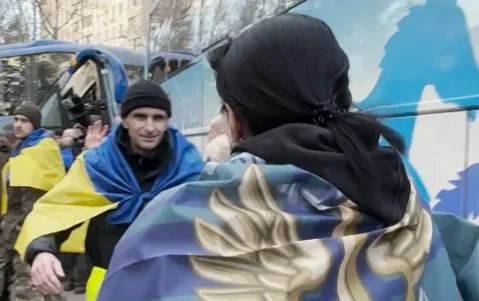
When a haggard marine stepped off a bus in Chernihiv, Anastasiia Savova’s hopes were realised.
A journalist’s camera caught the moment she gasped as she saw her father, imprisoned by Russian forces as a prisoner of war nearly three years before, and ran towards him to clasp him in embrace. But as she held him, Oleksandr Savov, 46, whispered a warning to his daughter: “Don’t hug me too close, I am sick.”


The two had an exceptional bond. Until he was captured in Mariupol in May 2022, Savov had raised his only child as a single parent. In turn Savova, now 26, had campaigned tirelessly for her father’s release, co-founding an advocacy group, the Marine Corps Strength Association, to highlight the plight of Ukrainian soldiers from the 36th Separate Marine Brigade held in Russian prisons.
In January 2025, Savova said she received occasional word of her captive father, passed on from other prisoners of war released in exchanges. “Dad got a message out saying that he loved me,” she had said. “I know that he has been electrocuted, beaten and at times starved. There are worse things I don’t know about.

“I focus on thinking about how he might be released. At night I pray that my dad will be saved.”
It seemed her prayers had been answered as she held her father tight after his release with more than 100 other PoWs in an exchange in March last year.
However, though her father was in many respects the same man who had once given her so much laughter, and taught her to walk on her hands as a child, in others he had changed irreversibly. “Dad had gone into prison as a super-fit marine,” Savova said this week. “That was not the man I got back.”

 Anastasiia Savova
Savov had lost more than 20kg, had contracted chronic TB in prison and was covered in scabies. An open ulcer was eating the skin of one calf. Repeated beatings had broken three ribs, some of his teeth and damaged the frontal lobe of his brain, causing him memory loss and hallucinations. Riven with illness, his body was broken by torture: his heart was weakened too.
As with so many released Ukrainian PoWs, the dark reach of Russia’s prisons was to stretch far beyond Savov’s day of freedom.
Captivity kills
According to the Organisation for Security and Co-operation in Europe, an estimated 6,300 Ukrainian prisoners of war remain in Russian custody, while nearly 6,800 others have been released and repatriated since the start of the full-scale invasion. The Ukrainian authorities’ figures are higher, estimating that more than 8,000 military personnel are in Russian custody.
According to the terms of the Third Geneva Convention, signed by Russia, Ukrainian PoWs are entitled to receive humane treatment including medical care, protection from harm, post from their families and visits from the International Committee of the Red Cross.
Instead, torture, starvation, humiliation, sickness and disease are the common experience of Ukrainian soldiers held in Russian prisons. Every former detainee interviewed by Human Rights Watch for a December 2025 report described a regime of beatings, sleep deprivation, stress positions, electrocution and attacks by dogs.
All but one of the former detainees interviewed “reported being subjected to sexual violence, including rape and the threat of rape, forced nudity, humiliation and the application of electrical shocks to the genitals”. The report also noted that all the interviewed PoWs could need years of rehabilitation to recover.
Many never get the chance.
“When you hear the phrase ‘captivity kills’ it means something real,” said Maryna Usenko, 37, head of the Families Union for the 36th Separate Marine Brigade, representing families of captured and missing marines. “We need to raise the question in Ukraine not just of what happens to our men in captivity, but after captivity too.”
Usenko’s husband, Bohdan, was a senior lieutenant who was captured, like Savov, during the battle of Mariupol. Released PoWs later described him, thin but otherwise in good health, being transferred through at least six Russian prisons during three years of captivity.
Yet in September last year his corpse was repatriated to Ukraine as little more than a skeleton, its chest cavity opened, the sternum cut out and with surgical incisions on its skull. He was 31. “I do not know exactly what happened to my husband,” Usenko said, “nor how a fit man is returned to his family from a Russian prison in that condition.”

The impact on the Usenko family has been devastating. The couple had two daughters, now seven and eleven. At first, when her husband was known to be a PoW, Usenko had told the two girls their father was away on the front with bad phone reception. After other children at school mentioned that their soldier fathers called home regularly, she had to tell them more. “I said that the Russians had caught Daddy and put him in prison,” she said.
Once his ruined corpse had been returned, she broke the news to their children in the company of a child psychologist. The girls greeted the information with silence.
Usenko spoke of at least 15 other Ukrainian marines captured in Mariupol who have since died in Russian captivity. Overall, the Coordination Headquarters for the Treatment of Prisoners of War — Ukraine’s official agency responsible for the search, negotiation for and return of Ukrainian PoWs — knows of at least 300 Ukrainian prisoners of war who have died in Russian prisons. Advocacy groups believe that at least 100 other PoWs have died within a year of their release.
‘Dad didn’t want to forget a thing’
As Savova nursed her father back to health in Kyiv after his release, she recorded everything he told her of his experiences in Russian prisons. They met daily. Rather than wishing to forget his time in captivity, he wanted to remember, hoping that one day his abusers might face justice.
 TIMES PHOTOGRAPHER Jack Hill
“He wrote down as many details of his experience in Russian prisons as he could, and asked me to record the names of the Russian guards he could recall, knowing his memory was going,” she said. “Dad didn’t want to forget a thing.”
Some of their conversations charted the depths of human depravity. Savov told his daughter that prison guards had once stripped him and forced him to simulate sex with another PoW as they filmed it and jeered.

The information was carefully filed. Already skilled in gathering testimony from her time running the marine advocacy group, Savova heads a newly launched project called “I Want To Tell”, run by the Coordination Headquarters for the Treatment of Prisoners of War. The project intends to bring those responsible for abusing Ukrainian PoWs to justice. As well as collating PoW testimony, the project has contacted Russian witnesses too.
“There are many Russians who are sick of their country’s system of torture,” Savova said. “There are many who want to break that system.”
Technically, any Russian wanted by Ukraine’s prosecutor-general’s office for the torture of PoWs could be arrested in Europe under the principle of universal jurisdiction. There are 18 EU member states that have opened up investigations for crimes committed in Ukraine using this principle, which is used to prosecute individuals found on EU territory believed to be guilty of war crimes in a third country.
In Finland last year a Russian, Voislav Torden, was sentenced to life imprisonment for committing war crimes in eastern Ukraine. Torden, 38, a senior member of the Russian far-right mercenary group Rusich, was arrested at Helsinki-Vantaa Airport in July 2023 at the request of the Ukrainian government.
However, the primary barrier to prosecution remains physical custody. Unless suspects leave Russia and enter territory where universal jurisdiction applies, they will never face justice.
Yet even naming prison torturers may bring Savova some relief.
“I want them brought to account!” she said in a flash of anger. “All those involved with torturing my dad and the others. At the very least I want their identities revealed. I want them to know that we know who they are, and that we know what they did.”
‘They said they’d make us sick for life’
Survivors describe the maltreatment of Ukrainian PoWs as being part of a deliberate policy designed to inflict maximum long-term damage on captured soldiers.
“Sometimes the prison guards told us that their task was to treat us so horribly that we’d never be able to go back to the army after release,” said Major Artem “Nikopol” Dubyna, 39. “They said they’d make us sick for life.”
An officer in the 1st Azov Corps, Dubyna was a captain when he was captured in Mariupol, already badly wounded by a bullet wound in the neck. He was imprisoned for two years and four months in three different prisons: Olenivka, Taganrog and Kamyshin.
In Kamyshin’s SIZO-2 prison — where PoWs had nicknamed one of the Russian guards “the welder” due to his delight in burning prisoners during electrocution — Dubyna endured seven hours of high-voltage electrocution in a single interrogation. He was bound and hooded with a pillow case stained with the blood of other detainees, then electric cables were attached to his skin with crocodile clips.
“The pain was such that it felt like my muscles were exploding, my flesh separating and my bones breaking,” he recalled. “I kept trying to beat my head on the floor to distract myself from the pain of the shocks.”


His interrogators supplemented the shocks by pushing electric cattle prods onto his genitals, into his armpits and between his buttocks.
Released during a prisoner exchange in September 2024, Major Dubyna spent six months in Ukrainian hospitals during a year-long rehabilitation. He is still medicated to help him cope with his nightmares, and attends weekly trauma therapy.
Since being electrocuted, the officer has developed speech problems and stutters in moments of anxiety. “In my mind I can build the sentence,” he said. “But I can’t utter it. I can’t pronounce a word. It becomes difficult to breathe and I start to stutter. The problems caused by captivity don’t go away. They stay inside you.”
Despite the horrors of Savov’s testimony, as his daughter tended to him she saw him begin a slow recovery. “Dad began to find small moments of joy again,” she said. “He appreciated sitting outside, among birdsong and in sunlight, and wanted to get a dog so he could walk in fresh air.”
Yet Russian prison still claimed him.
One morning last November, Savova awoke at 5am with unexplained anxiety, and called her father. He did not answer. She rushed to his room and saw him lying unnaturally still in his bed. Later a doctor told Savova that her father had died of heart failure brought about by the damage to his body in prison.
“I watched him for a few seconds hoping to see him breathe,” she added. “But he was still. Then I saw Dad’s hands were blue. I stayed with him for 30 minutes alone. I cried a lot. I told him everything I wanted to. I said goodbye. Then the emergency crew arrived and took away dad’s body. At least he died free.”