








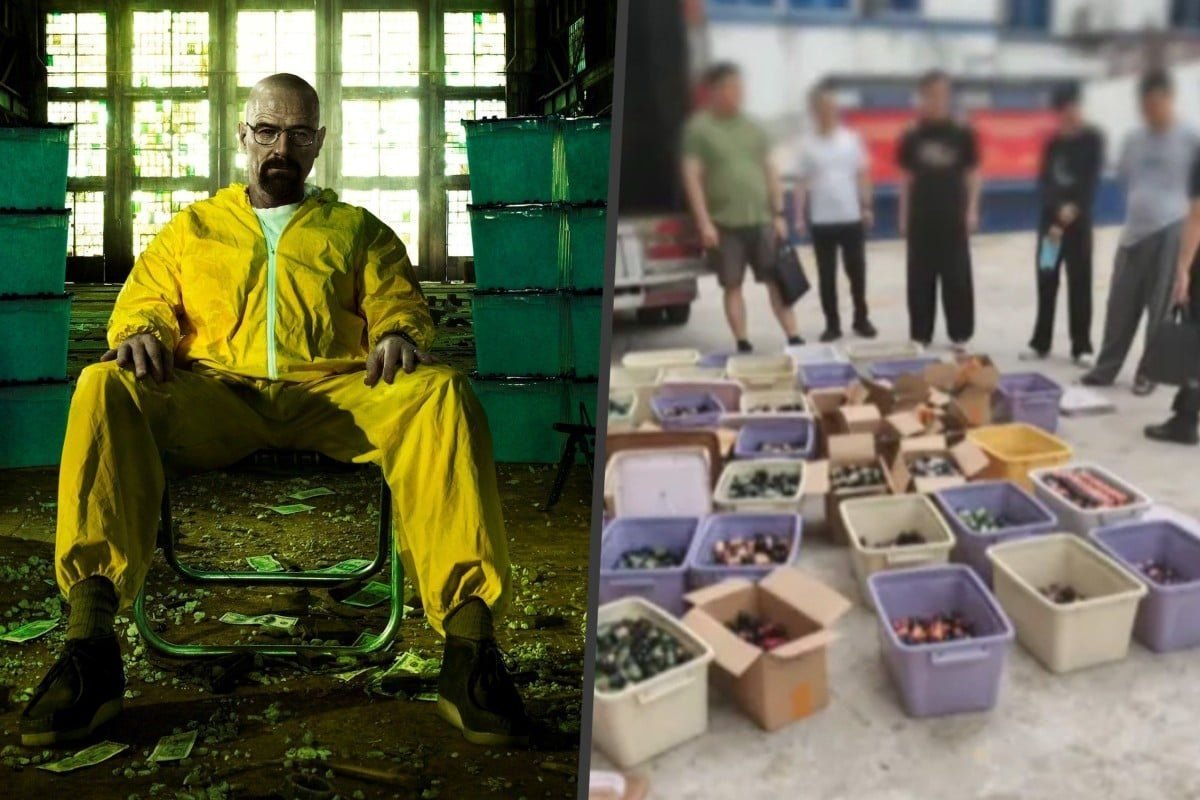
BEIJING – Authorities in eastern China have successfully dismantled a sophisticated, cross-border drug-trafficking syndicate, marking the conclusion of a two-year investigation that has gripped the nation. The case, which involves a retired chemistry professor and a highly educated accomplice, has been dubbed “China’s Breaking Bad” by social media users, drawing comparisons to the iconic American television drama.
The operation came to light in 2024 when police in Shandong province launched an investigation into a pharmaceutical technology company. A routine inspection revealed the purchase of unusually large quantities of six specific chemicals, all precursors for the production of etomidate. Since China officially moved to regulate etomidate in 2023, the substance has been frequently misused in illicit e-cigarettes, commonly referred to as “zombie vapes.”
At the center of the conspiracy were two men: a man identified as Huang, a chemistry master’s degree holder with experience in the e-cigarette industry, and Wu, a retired chemistry professor. Investigators found that the pair utilized their professional expertise to refine the drug-manufacturing process. Wu was instrumental in designing the chemical production methods and leveraging his professional network to secure laboratory space across five Chinese cities, masking the operation as legitimate medical research.
To circumvent local law enforcement, the gang employed a complex strategy. They produced only the precursor chemicals within China before smuggling them into Vietnam, Thailand, and Cambodia, where the final conversion into etomidate took place. A third key figure, identified as Wang, utilized his background in international logistics to move the materials and manufacturing equipment in small, discrete quantities to avoid detection.
Police faced a significant hurdle: to ensure a conviction, they needed to dismantle the entire international network simultaneously. Gathering evidence across borders required nearly two years of meticulous coordination between Chinese authorities and their counterparts in Southeast Asia.
The breakthrough finally came in March and April, when authorities executed a coordinated strike, dismantling seven production bases across Cambodia, Vietnam, and Thailand. The operation resulted in the arrest of 71 suspects and the seizure of 73 kilograms of finished etomidate, along with five tonnes of active chemical ingredients and specialized laboratory equipment.
Investigators estimate that the ringleader, Huang, accumulated over 5 million yuan (US$750,000) in illicit profits during the operation. The suspects are now awaiting trial. Under Chinese law, the penalties are severe; for sentencing purposes, courts have treated each gram of etomidate as equivalent to 0.4 grams of heroin. Given the scale of the operation, those involved face life imprisonment or, in the most extreme instances, the death penalty.
As the case continues to dominate headlines, Chinese netizens have expressed shock at the betrayal of academic integrity. “Zibo Heisenberg,” one user quipped on social media, while others lamented that the suspects’ intellectual gifts were squandered on a criminal enterprise.
Disclaimer: This content is auto-generated for informational purposes only.
Source: Read Original News