







Engineering a Combustion-Only Evolution
The automotive world often associates performance upgrades with the addition of complex hybrid systems, but the newly announced Ferrari 296 Challenge Stradale takes a daring step in the opposite direction. By stripping away the electric motors and battery pack found in the standard 296 GTB, Ferrari has successfully reduced the vehicle’s mass by 140kg. This mechanical purge results in a pure internal combustion engine (ICE) experience, signaling a shift in how engineers are approaching weight-to-power ratios in the modern era.
While the loss of the hybrid system results in a nominal decrease in total peak horsepower compared to its electrified counterparts, the internal combustion engine has been significantly refined. The unit utilizes high-performance components, including titanium connecting rods and a nitrided steel crankshaft, to push output to 670bhp. This power is delivered through an engine that is both smaller in displacement and cylinder count than its predecessors, yet it achieves power levels comparable to the iconic V8 supercars of a decade ago. The integration of a recalibrated sound tube and a performance-oriented exhaust system ensures that the acoustic experience remains a primary focus of the driving dynamics.
Aerodynamic Priorities and Exterior Geometry
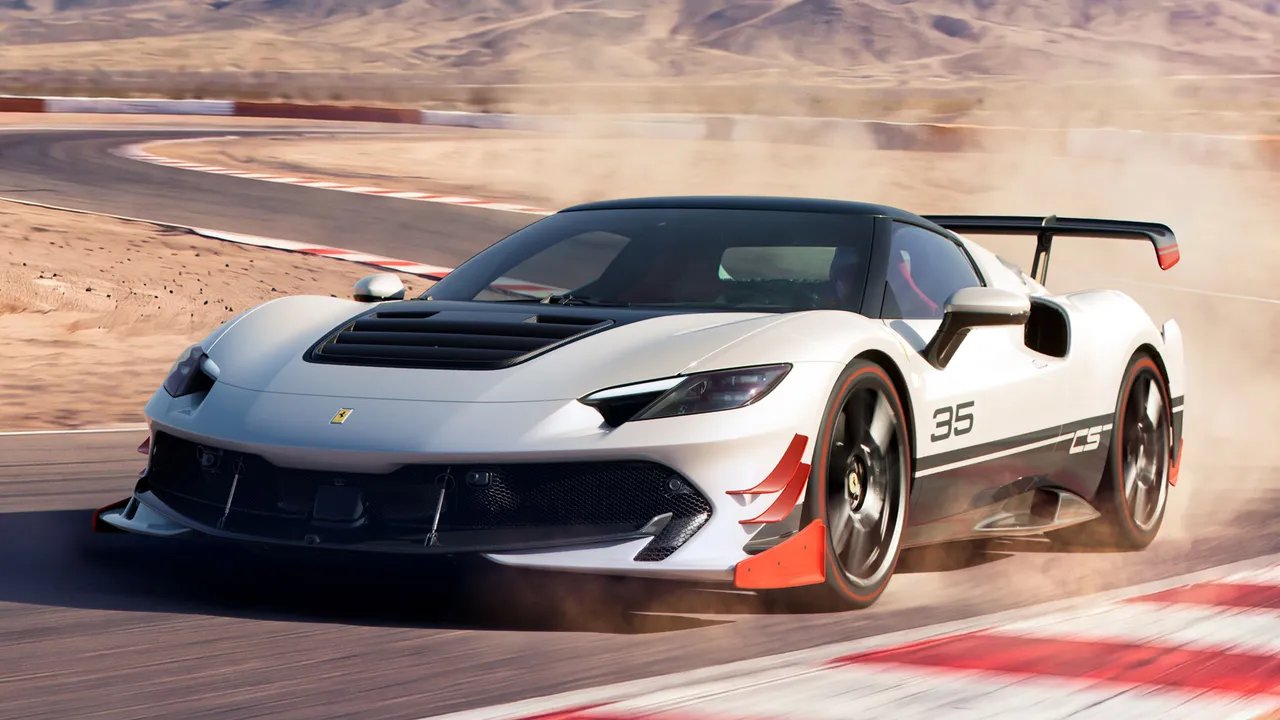
The visual language of the 296 Challenge Stradale is defined by its pursuit of downforce. Developing the vehicle alongside the 296 Challenge Evo race car has resulted in a chassis bristling with functional aerodynamic enhancements. The elegant, flowing lines of the standard GTB have been replaced by a suite of strategic bolt-on winglets, vents, and foils designed to manage airflow under high-velocity conditions.
The most prominent feature is the substantial rear wing, which serves as a critical component in the car’s stability profile, generating 270kg of downforce on its own. Total downforce for the vehicle is rated at 617kg at a speed of 155mph. While this sacrifices some of the aesthetic minimalism of the base model, it achieves a performance target essential for high-speed circuit work. Despite these aggressive modifications, Ferrari engineers have retained a functional, albeit diminished, front storage compartment. By channeling air through the bonnet via integrated radiator ducts, the design maintains a degree of daily usability that is often discarded in track-focused variants.
Technical Advancements in Suspension and Handling
To manage the significant weight reduction and aerodynamic load, the suspension geometry has undergone a rigorous overhaul. The primary springs are now nearly twice as stiff as those found on the standard 296, necessitating the use of helper springs—a configuration directly derived from Ferrari’s professional race program. This allows the vehicle to remain composed under extreme track conditions while maintaining enough compliance to be usable on public roads.
Damping is controlled through the latest iteration of the Magneride adaptive system. For the first time, this system includes two distinct settings specifically tuned for bumpy road surfaces, acknowledging that the increased spring rates could otherwise result in an unmanageable ride. The track width has also been increased by 13mm at the front and 22mm at the rear, providing a wider footprint that increases lateral grip. Buyers also have the option to fit carbon-fiber wheels, which provide a reduction of 2kg of unsprung mass per corner, further enhancing the responsiveness of the steering and braking systems.
Performance Metrics and Driver Interface
The 296 Challenge Stradale is not designed for the casual driver. The manufacturer has implemented a firmer brake pedal with reduced travel and a stiffer throttle spring to provide more granular control for experienced operators. The steering rack has been weighted to offer increased resistance, emphasizing precision over ease of use. This intentional increase in physical demand is matched by acceleration capabilities that place it among the fastest cars in its category, with a 0-62mph time of 2.8 seconds and a 0-124mph time of 7.9 seconds.
Inside the cockpit, the philosophy of weight reduction continues. Sound deadening has been largely removed, and the interior features exposed carbon fiber on the door panels and center console. Drivers are seated in lightweight carbon fiber racing seats, although the vehicle retains essential modern safety and convenience electronics, such as lane-keeping assistance and driver drowsiness detection, illustrating a tension between its hardcore track intentions and modern regulatory requirements.
Strategic Positioning in the Ferrari Lineup
The release of the Challenge Stradale represents a shift in Ferrari’s product strategy. By making this a full-production model rather than a limited-run collector’s item, the manufacturer is signaling a desire to compete more directly with high-performance road-legal track machines. It serves as a middle ground between the luxury-oriented Speciale models and the extreme, race-dedicated platforms.
For a brand that has faced recent market resistance, the 296 Challenge Stradale is positioned as a return to foundational engineering principles. By prioritizing weight reduction and mechanical engagement over the complexity of electrification, Ferrari is attempting to reconcile its heritage with the rigorous performance standards of the modern era. This model is engineered to serve as a high-performance anchor, providing a raw, high-revving alternative that caters to driving purists while stabilizing the broader 296 product line.
Disclaimer: This content is auto-generated for informational purposes only.
Source: Read Original News