







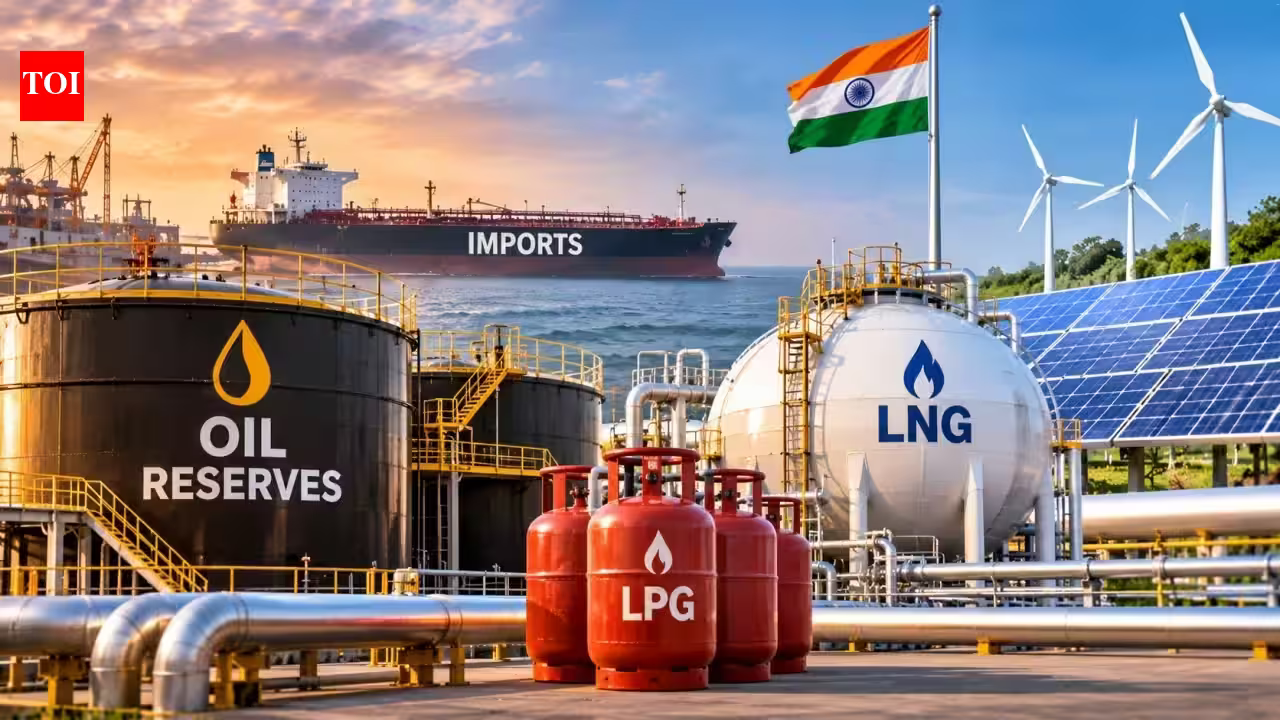
The pursuit of energy security is a cornerstone of India’s economic growth strategy, yet it is frequently misinterpreted as a mandate to eliminate imports entirely. For a rapidly expanding economy, attempting to achieve total energy self-sufficiency is not only economically impractical but also a potentially misleading objective. True energy security for India is defined by the resilience to remain functional during geopolitical volatility, commodity price fluctuations, and systemic shocks. By transitioning from a focus on individual infrastructure projects to a holistic, measurable resilience framework, India can protect its growth trajectory while navigating the complexities of a globalized energy market.
Oil: High Import Exposure and the Refining Hedge
Crude oil remains India’s most significant energy vulnerability. With import dependence hovering near 89%, the economy is directly exposed to global supply chain disruptions and price spikes. However, India possesses a critical strategic buffer: its massive downstream refining sector. With an installed capacity exceeding 250 million tonnes per annum, the nation acts as a global refining hub. This creates a dual-layered security dynamic where, despite reliance on external crude, the country maintains domestic control over product supply and export capabilities.
To mitigate upstream risk, government policy focuses on the Hydrocarbon Exploration and Licensing Policy. While increasing domestic production is necessary, it should be viewed as a hedge rather than a pathway to complete self-reliance, given the geological and economic constraints inherent in extraction. A more immediate security measure is supplier diversification. By sourcing crude from a broader geography, Indian refiners reduce their dependence on any single nation, though this comes with increased logistics costs. Resilience, in this context, must be viewed as a calculated insurance premium against the catastrophic costs of supply disruption. Furthermore, expanding strategic petroleum reserves is essential, but the policy focus must evolve to include clear, transparent triggers for stock releases and refined logistics for rotating these supplies without triggering market instability.
LPG: Balancing Infrastructure and Household Welfare
Energy security extends beyond industrial inputs to the social fabric of the country. Liquefied Petroleum Gas (LPG) is a vital commodity for household welfare, directly impacting the quality of life for millions. While the Pradhan Mantri Ujjwala Yojana has successfully expanded reach and access, long-term security requires ensuring that these households can afford continuous refills. Currently, more than half of India’s LPG demand is met through imports, leaving the retail price and the government’s subsidy burden highly sensitive to global market movements.
Effective management of LPG security involves a blend of infrastructure development and targeted fiscal support. Rather than suppressing prices across the board, which can distort market incentives and strain public finances, policy should prioritize protecting the most vulnerable segments. Simultaneously, improving the distribution network to ensure reliable last-mile delivery is as important as the physical import of the fuel itself. By maintaining regional storage buffers and diversifying import contracts, the government can shield the domestic consumer from the volatility of the international energy markets.
Natural Gas and the Necessity of Market Flexibility
India’s natural gas landscape reflects a transition phase where infrastructure is growing rapidly, but operational efficiency remains uneven. With significant regasification capacity and a vast pipeline network, the physical potential for a robust gas economy is in place. However, the utilization of this infrastructure is constrained by localized factors, such as the lack of anchor demand in certain regions and a lack of open-access frameworks.
For natural gas to function as a secure transition fuel, the procurement strategy requires a sophisticated balance. A heavy reliance on the spot market exposes buyers to extreme price volatility, whereas long-term contracts provide stability at the cost of flexibility. A balanced book—incorporating diverse pricing benchmarks, varying origins, and destination-flexible contracts—is essential. Additionally, the development of underground or depleted-field gas storage is a critical, missing component of India’s security infrastructure. Without seasonal buffers, the system remains vulnerable to winter demand spikes and sudden regional supply gaps.
Renewables: The Strategic Hedge Against Commodity Volatility
The shift toward renewable energy represents the most significant structural change in India’s energy security posture. Because solar, wind, and hydro power are domestic resources, they provide a natural hedge against international commodity cycles. With over 300 GW of non-fossil capacity already in the system and an ambitious target of 500 GW by 2030, the strategic importance of this transition cannot be overstated.
However, the intermittency of these sources necessitates a robust grid capable of handling variable loads. The rapid scaling of battery storage and pumped hydro is no longer optional; it is a fundamental requirement for system stability. As the grid integrates more renewables, the focus must shift from capacity installation to grid management, transmission expansion, and demand-side flexibility. Furthermore, India must be cautious not to replace one form of import dependency with another. While renewables eliminate the need for imported fuel, the supply chains for solar modules, battery minerals, and power electronics are currently concentrated in a few global markets. Building a circular economy through recycling and domesticating critical parts of the clean-tech supply chain is the next frontier of energy security.
A Measurable Framework for Future Resilience
The path forward for India’s energy sector requires a shift from singular project announcements to a comprehensive, outcome-based resilience dashboard. Policymakers should focus on tracking key metrics such as route concentration, average days of reserve cover, grid congestion levels, and the cost-effectiveness of various energy sources. This data-driven approach allows for dynamic policy adjustments that respond to real-world threats rather than static targets.
In the coming years, the prioritization of transmission projects and the completion of phase-two strategic storage facilities should be at the forefront of the agenda. Structural demand reduction through the electrification of public transport and the adoption of energy-efficient technologies will further lower the intensity of import reliance. Ultimately, the maturity of India’s energy strategy will be measured by its ability to absorb shocks—be they logistical, geopolitical, or environmental—without compromising the growth and social welfare of its citizens. By treating energy as a single, integrated system rather than a collection of silos, India can build a robust, affordable, and secure foundation for its future.
Disclaimer: This content is auto-generated for informational purposes only.
Source: Read Original News