








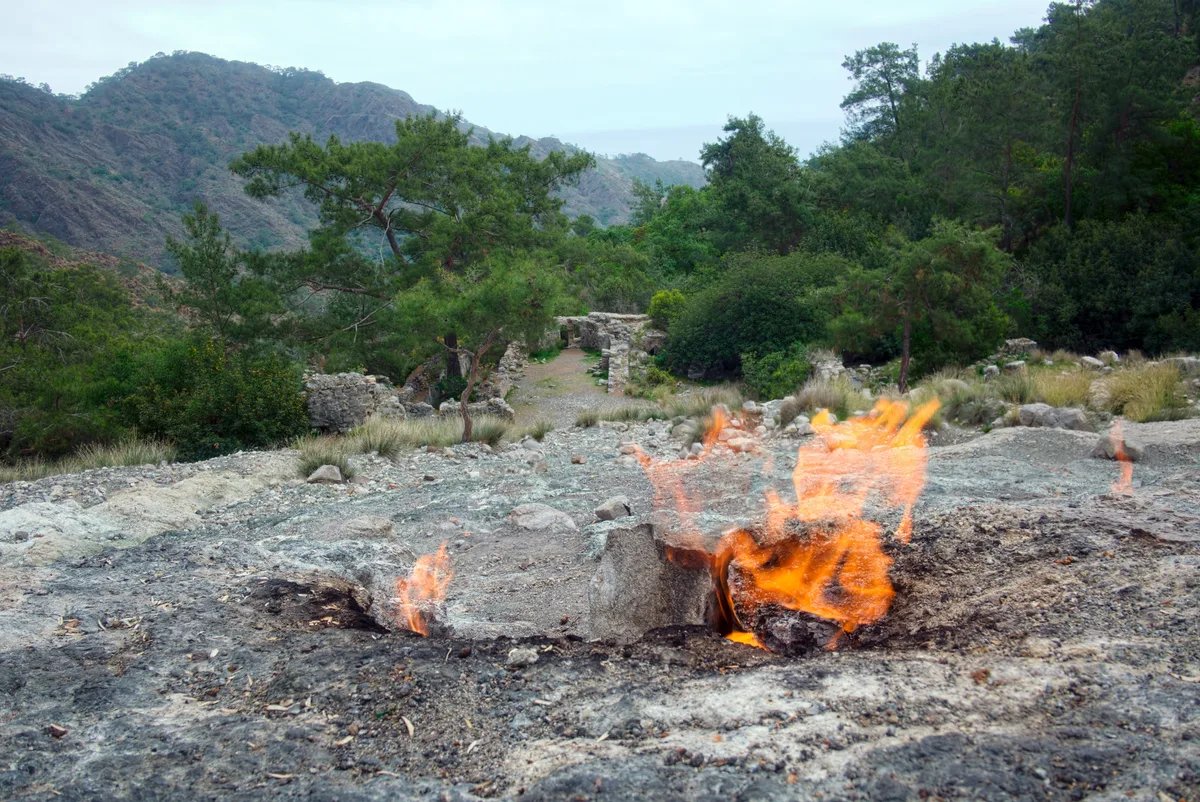
At the peak of Mount Chimaera on Turkey’s Mediterranean coast, flames continuously flicker from cracks in the rocky hillside. They’re fuelled not by wood or human intervention, but by natural gases escaping from deep underground.
Where is Mount Chimaera?
Located near the village of Çıralı in Antalya Province, Mount Chimaera is one of the world’s most remarkable geological phenomena as dozens of small fires emerge directly from the mountainside, creating an eerie spectacle that is particularly striking after dark.

How does it burn?
Known as Mount Chimaera, or Yanartaş (meaning ‘burning rock’ in Turkish), the flames at this extraordinary site are fed by methane and other gases seeping through fissures in the rock, where they ignite on contact with oxygen.
Unlike most fires, these flames require no fuel from the surface and have been burning continuously for more than 2,000 years.
What is the legend of Mount Chimera?
The mountain’s fiery reputation stretches back to classical antiquity. Ancient Greek and Roman writers described an eternal flame burning in the region, with the Roman naturalist Pliny the Elder noting that the fire never went out, either day or night.
Some historians believe these mysterious flames inspired the legend of the Chimera, the fearsome fire-breathing monster of Greek mythology. Part lion, part goat and part serpent, the beast was said to terrorise the ancient kingdom of Lycia until it was slain by Bellerophon, who rode into battle on the winged horse Pegasus.
What’s the science?
Researchers believe the gases originate from chemical reactions occurring deep within the Earth’s crust. Unlike fossil-fuel methane, which is produced from decaying organic matter, some of the methane at Chimaera may be generated through reactions between water and certain types of rocks.
This process can create hydrocarbons without any biological input, offering scientists valuable insights into geological systems.

Mount Chimaera is also an important archaeological site. The remains of ancient structures, including a sanctuary associated with Hephaestus, the Greek god of fire and metalworking, have been discovered near the flames. Byzantine churches were later built in the area, highlighting the mountain’s long-standing cultural and spiritual significance.
More wildlife stories: