








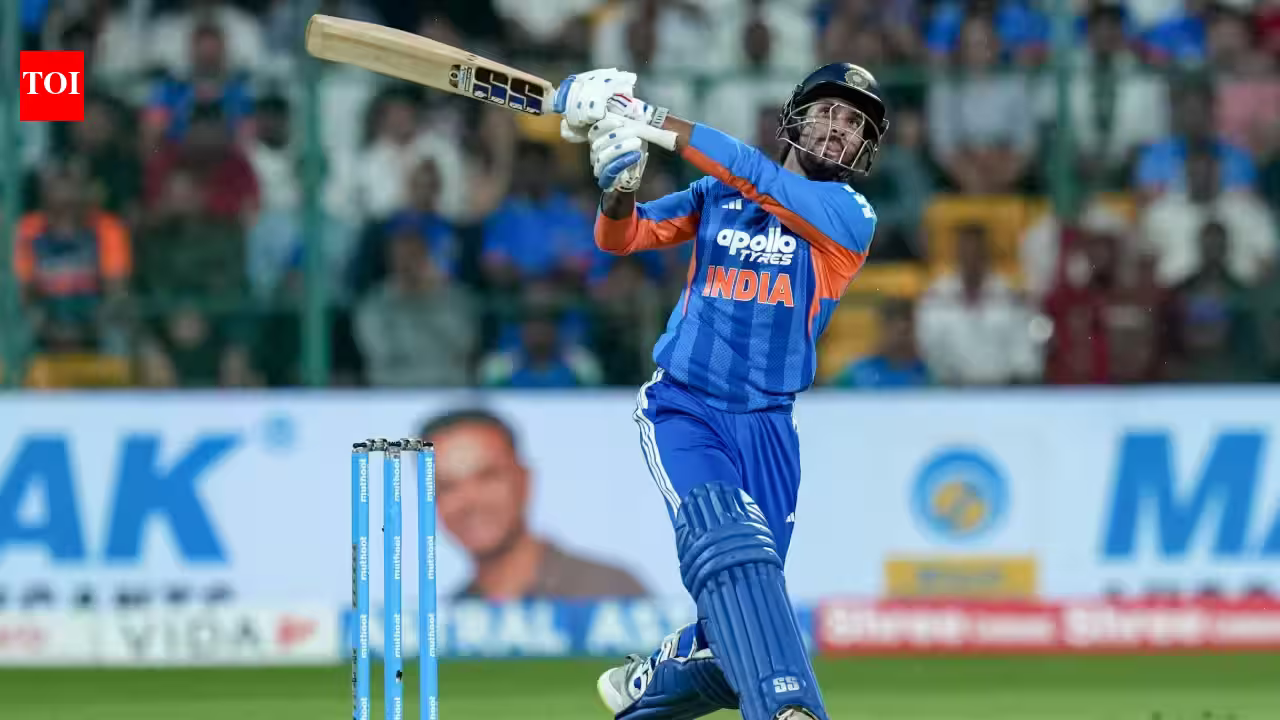
India vice-captain Tilak Varma has embraced the tactical evolution of the national T20I setup, publicly committing to his transition from a traditional top-order batter to a potent finisher in the middle order. As India continues to refine its batting hierarchy, the 23-year-old Hyderabad star has made it clear that while his heart may lie at No. 3, his professional focus is firmly fixed on mastering the high-pressure roles of No. 5 and No. 6.
Following the washout of the final T20I against the West Indies, Varma addressed the media with a refreshing blend of honesty and ambition. He acknowledged that while batting higher up the order offers a more natural flow, the current composition of the Indian XI necessitates a shift in his responsibilities.
Embracing the “Finisher” Identity
For many young batters, moving down the order is viewed as a demotion, but Varma views it as a specialized craft. With Ishan Kishan finding success at No. 3 and the presence of stalwarts like Shreyas Iyer at No. 4, Varma has been tasked with anchoring the death overs—a role he is increasingly making his own.
“It’s not that easy to change the numbers from 3 to 5 and 6. It will be slightly challenging. But I have been working on that. How can I finish the games? I have said that I love finishing the games for the country,” Varma stated.
His statistical output supports his confidence. Across nine matches batting at No. 6, Varma boasts a staggering average of 65.66 with an explosive strike rate of 195. Across his 26 combined innings at Nos. 5 and 6, he maintains an impressive average of 46 and a strike rate of 158. These numbers suggest that while the adjustment is indeed challenging, the transition is yielding high-impact results for the team.
“Kishan is batting at number 3 now, and he is batting really brilliantly there. So, for me now, I think there is no option but to bat at 5 and 6 and do the job for the team,” Varma added. “I am mentally prepared for that role.”
Tactical Adjustments in the Nets
Varma has been dedicating significant time in the nets to expanding his shot-making versatility. He noted that the specific demands of the late-innings game—where a player might only have five or six overs to create an impact—require a different mindset compared to building an innings from the top.
“When you go in to bat as a finisher, if a slower one comes into your arc, you should go for six,” Varma explained. “I have changed personally. I have been in this role in my childhood as well. I have got the shots going all over the ground. So, I am confident that if I bat at 3 or 5, I have got the technique to adapt.”
The vice-captain remains confident that his technical base is flexible enough to toggle between roles, emphasizing that a few days of specific practice are all he needs to pivot his game-day strategy.
The Mental Toll of a Grueling Schedule
The rigors of international cricket have been particularly testing for the Indian contingent recently, with a punishing itinerary that has taken the squad through the United Kingdom, Japan, and India. With an upcoming all-format tour of New Zealand on the horizon, fatigue is a legitimate concern for any rising star.
However, Varma brushed off the notion of schedule-related fatigue, framing it instead as a mandatory hurdle for any player aspiring to reach the elite level.
“As professional cricketers, we can’t give any excuse,” Varma asserted. “When we play back-to-back series, there will be different time zones and all those things. But again, you are playing for the country and at the highest level. You should be mentally strong enough to prepare for any challenge.”
Looking Ahead to New Zealand
Reflecting on the series against the West Indies, Varma highlighted several systemic positives that the management will look to build upon. Most notably, the team’s ability to consistently surpass 200-run totals in every game has provided a blueprint for success in the upcoming matches against the Black Caps.
Varma was quick to praise the contributions of his younger teammates, specifically pointing to the adaptability of Nitish Reddy and Shivam Dube, as well as Naman Dhir’s composure under pressure.
“Naman bowled well under pressure. As an off-spinner, bowling to right-handers, and that too against a big-gun team like the West Indies,” he said. “So, there are a few good points for us to take into the upcoming series. As a team, we have introspected a few things in the bowling as well. Hopefully, we will do well in the New Zealand series.”
As India prepares for the challenges in New Zealand, Varma’s willingness to subordinate his personal preferences for the greater good of the team’s composition serves as a testament to the culture within the current squad. For Tilak Varma, the number on his back is less important than the scoreboard at the final ball.
Disclaimer: This content is auto-generated for informational purposes only.
Source: Read Original News