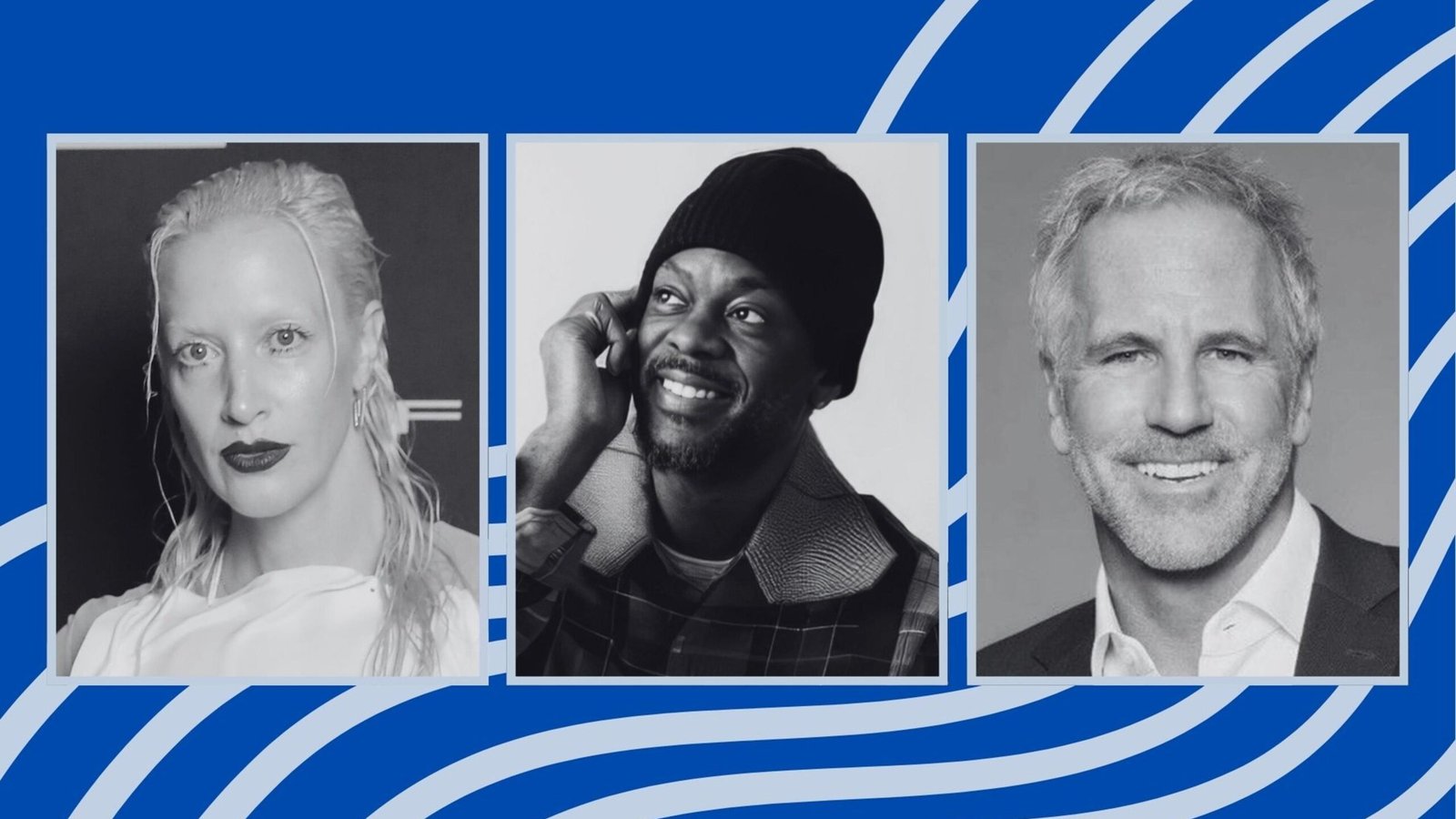
At the first-ever TIME100 AI Leadership Forum in New York City on Wednesday night, three leaders from music, fashion, and entertainment spoke during an onstage panel about how AI has changed how they worked creatively and the role they see for AI in the arts, moderated by TIME deputy editor Kelly Conniff.
Across the board, the panelists agreed that AI is best used as partner and collaborator and cannot replace the distinctly human parts of the creative process. However, they can help users gain deeper knowledge, and shorten the more tedious parts of the brainstorming and ideation process.
Christopher Brearton, partner at independent studio AGBO, said that using AI tools could look like leaving a story idea meeting with not only a rough plot and characters but also a quick mockup with images and videos of what it might look like.
“Having an AI tool to help open that aperture and expand and continue the creative momentum, and not have breaks in your creative process, has been really fundamentally changing what we do,” he said. “Ultimately, you still go back to the human storytellers, the human creators, the human actors and directors, just with a faster idea … It allows you to spend more time being creative and less time doing the routine tasks that used to take so much time.”
AGBO has also developed an AI-based “white space analytical tool,” which basically shows them everything that has already been done as well as what hasn’t been done, or what will appeal to a specific audience. But human decisionmakers still have the final say on the exact storyline or character they want to go with, based on all of this background information.
“We can generate a character set and a universe in a span of a couple of days, as opposed to a decade,” Brearton said. “Then we go back and iterate on it with the human touch. … Just because you have an AI tool doesn’t mean you can be a great storyteller.” For example, the upcoming Avengers movies, which AGBO worked on, will still be made largely traditionally, but creatives might have been inspired by what they learned with AI.
Leanne Elliott Young, founder and CEO of the IoDF platform, thinks that AI can actually enable the customer to have a closer conversation with fashion brands and deeper understanding of products, counter to the interactions that they normally have on short-form, dopamine-driven social media.
“I think the use of AI and how we’re using AI gives us the time and perspective to actually observe and hold up as a mirror of what it means to be human,” said Young. “We found that a lot of consumers of fashion want to know a lot more about the brand, they want to know where it was made, they want to know conversations that happened on the studio floor.”
In her view, AI could allow each garment to be a persistent carrier of information, from its inception to the next leg of its journey post-purchase and beyond. This technology layer will facilitate a deeper understanding of the craft and artisan behind each garment, she said, but the idea of being able to touch something and spend time with it and see the craft and artisan will never be lost.
For comedian King Willonius, his viral AI-made sample of “BBL Drizzy,” satirizing Drake, has not only received interest from the music community but from Drake himself, who resampled it, in a way, cementing its cultural value.
In response to the reception of his work, Willonius feels like it was a lot easier for him to create a piece of AI music as a comedian. “A lot of musicians probably wouldn’t have done what I did, because they didn’t want to get blackballed,” he said, “but I found since then, a lot of musicians, they want to kind of explore these tools … As a creative, you want to be able to make better art, and I think that these tools allow you to iterate really fast, whether or not you use what it creates. It’s a great collaborator, so if you’re stuck in a studio, or trying to figure something out, these tools allow you to do that.”
With how commonplace and accessible AI tools are becoming, Willonius thinks that taste will be the differentiator. “The challenge will be, if I can make 100 songs in an hour, then which song is the song that I actually put out? So, having good taste is actually going to be a premium, moving forward,” he said. “I always say that everybody knows how to fry chicken, but not everybody knows how to fry chicken. That’s how AI is. Because you can get the same prompt, and have the same ingredients, but each one of us is gonna have a completely different output based on our experiences and in our taste.”