






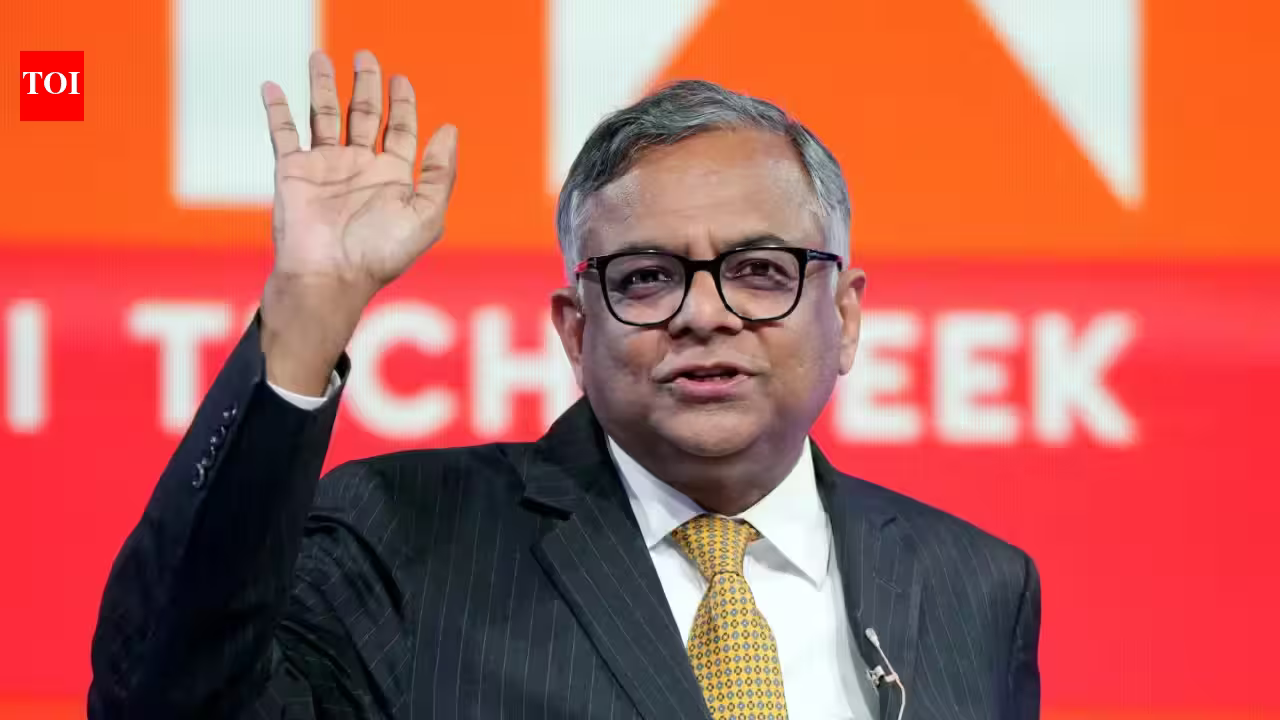
Mumbai, India – A significant leadership transition looms over Tata Sons, the holding company of India’s sprawling Tata Group, as Chairman N. Chandrasekaran has signaled his intent not to seek another term when his current tenure concludes on February 20, 2027. This development, confirmed by sources close to the matter, sets the stage for a critical board meeting in mid-September, where directors are expected to formally acknowledge Chandrasekaran’s decision and initiate the complex process of succession.
Chandrasekaran’s nine-year tenure has been largely lauded for transforming the scale and breadth of one of India’s most influential conglomerates. However, the decision to step down appears to be intricately linked to a reported standoff with Noel Tata, Chairman of Tata Trusts and a pivotal member of the Tata Sons board, over his reappointment.
The upcoming mid-September board meeting follows an anticipated adjournment of Tuesday’s Annual General Meeting (AGM) for Tata Sons. The adjournment is necessitated by a regulatory freeze imposed on the Sir Ratan Tata Trust (SRTT), a key shareholder, preventing its participation in the proceedings. This regulatory hurdle also complicates the succession process, which cannot formally commence until the ban on SRTT is lifted.
Sources emphasize that Chandrasekaran’s announcement on August 12 should not be misconstrued as a resignation. Instead, it is an advance intimation to the board that he does not wish to be considered for an extension beyond 2027. "It is an intimation in advance," one insider explained. "The directors could choose to ask him to reconsider, or begin the formal process of identifying his successor." The practicalities of either path remain uncertain, particularly given Noel Tata’s reported disinclination to support Chandrasekaran’s continuation.
The internal dynamics within the Tata Sons board were brought to light during a February 24 meeting, where four of the six-member board endorsed Chandrasekaran’s chairmanship extension. Notably, Noel Tata was the sole dissenting voice. Chandrasekaran, adhering to ethical guidelines, recused himself from the discussion due to a conflict of interest. In the absence of unanimous support, he conveyed his decision to not pursue another term.
The regulatory freeze on SRTT, which has barred it from both the succession process and the AGM, is a significant impediment. Tata Sons’ Articles of Association mandate a representative jointly nominated by the Sir Ratan Tata Trust (SRTT) and the Sir Dorabji Tata Trust (SDTT) for the AGM. While SRTT has petitioned the public charities regulator to lift the ban, SDTT has cited its inability to jointly nominate a representative with SRTT for the AGM.
Under the Companies Act, if quorum, including the SRTT-SDTT joint representative, is not met within 30 minutes of the appointed time, the AGM stands adjourned. However, the subsequent re-convening of the AGM would still require the presence of this joint nominee, with the possibility of the meeting being adjourned until December.
A crucial agenda item at the AGM is the reappointment of Chandrasekaran as a director. While his chairmanship extends until February 2027, it is contingent upon his continued directorship. A failure to secure reappointment at the AGM would effectively terminate his chairmanship prematurely.
The selection of a new chairman is also governed by stringent protocols. The selection committee is mandated to comprise five individuals, with at least three jointly chosen by SRTT and SDTT. Consequently, despite SDTT having initiated the succession process, its progression is stalled until the regulatory order against SRTT is lifted.
This complex interplay of regulatory challenges, internal disagreements, and crucial procedural requirements means that the leadership transition at Tata Sons will be a closely watched event, with profound implications for the future direction of the venerable Tata Group. For further details on this developing story, you can read more here.