



A devastating train derailment near Lewes railway station in East Sussex has left multiple individuals with serious injuries. The incident, which occurred around 3:55 PM, involved a Southern service traveling from London Victoria to Eastbourne, carrying an estimated 150 passengers. Emergency services swiftly responded to the scene, urging the public to avoid the area due to the severity of the situation.
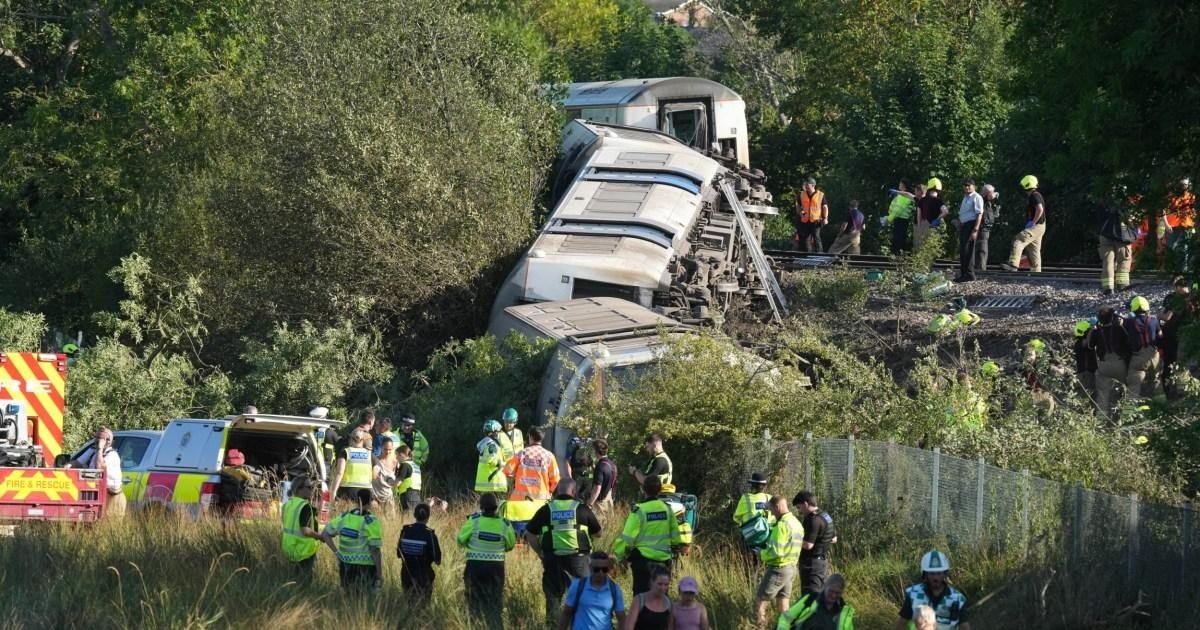
Reports indicate that three of the eight carriages on the 14:24 service overturned, trapping numerous passengers inside. Distressing images and videos circulated on social media show the catastrophic aftermath, with carriages lying on their sides in a rural landscape. Eyewitness accounts describe the terrifying moments leading up to the derailment, including a carriage swaying violently and passengers being thrown from their seats.
South East Coast Ambulance Service confirmed that two people sustained serious injuries, while Eastbourne’s MP, Josh Babarinde, reported that one constituent suffered rib injuries. In total, British Transport Police later stated that nine additional passengers received less serious injuries. Medical teams assessed and treated patients at the site, transporting those requiring further care to local hospitals. Passengers who did not require immediate hospitalization were relocated to a community center for support from various agencies, as the incident developed into a complex and ongoing multi-agency response.
Assistant Chief Constable Ian Drummond-Smith announced by 7:30 PM that all passengers had been safely evacuated from the derailed service. Despite the successful evacuation, a “major incident” declaration remained in effect, highlighting the extensive emergency operation underway.
Passengers recounted their harrowing experiences. Rob Bradley, traveling with his six-year-old daughter Mabel, described feeling the train accelerate and begin to rock before a sudden vertical jump indicated a derailment. He recalled the emergency brakes engaging, causing everything to be thrown forward, followed by the sight of smoke and dust billowing into their carriage from the rear, where the fifth carriage had completely overturned. Bradley noted the presence of head injuries, blood, and cuts among the passengers, and described the initial aftermath as “pandemonium” during the hour and a half they remained on the train. Similarly, Yana Ludwig, 56, traveling alone, recounted a loud bang before everything “just went topsy-turvy,” leaving her “pretty banged up.” She observed that it took approximately 20 minutes for emergency services to arrive, noting the challenging terrain they faced.
A BBC reporter at the scene described a significant presence of emergency personnel, including ten fire engines, a command support unit, technical rescue teams, and three helicopters. The reporter observed the rear carriage completely overturned at the base of a small embankment. Passengers were seen being escorted away from the train along a dusty track and into a nearby housing estate, with photographs showing individuals assisting each other with ladders to exit the carriages.
Southern Rail confirmed the derailment occurred on the track stretch between Lewes and Haywards Heath. Consequently, all train services between Lewes and Brighton, Haywards Heath, Seaford, or Eastbourne were suspended, with a “do not travel” advisory issued for the affected area for the remainder of the day. Significant disruption is anticipated to continue until 10 PM.
Transport Secretary Heidi Alexander expressed her deep concern via X, thanking emergency services for their support. James MacCleary, MP for Lewes, also acknowledged the “very serious and developing incident” on Facebook. A transport trade union emphasized the immediate priority of ensuring the safety and wellbeing of the many passengers involved.
The Rail Accident Investigation Branch (RAIB) has dispatched a team to the site to commence an investigation into the cause of the derailment, collecting evidence. While the exact cause remains unknown, photographs showing what appears to be a buckled track have raised questions. Investigators will examine whether this track deformation predated the incident or was a consequence of the derailment itself. The exceptionally high temperatures experienced that day, reaching 38°C and making it the hottest day of the year, have been highlighted as a potential contributing factor, given that steel tracks can warp under such extreme heat.