



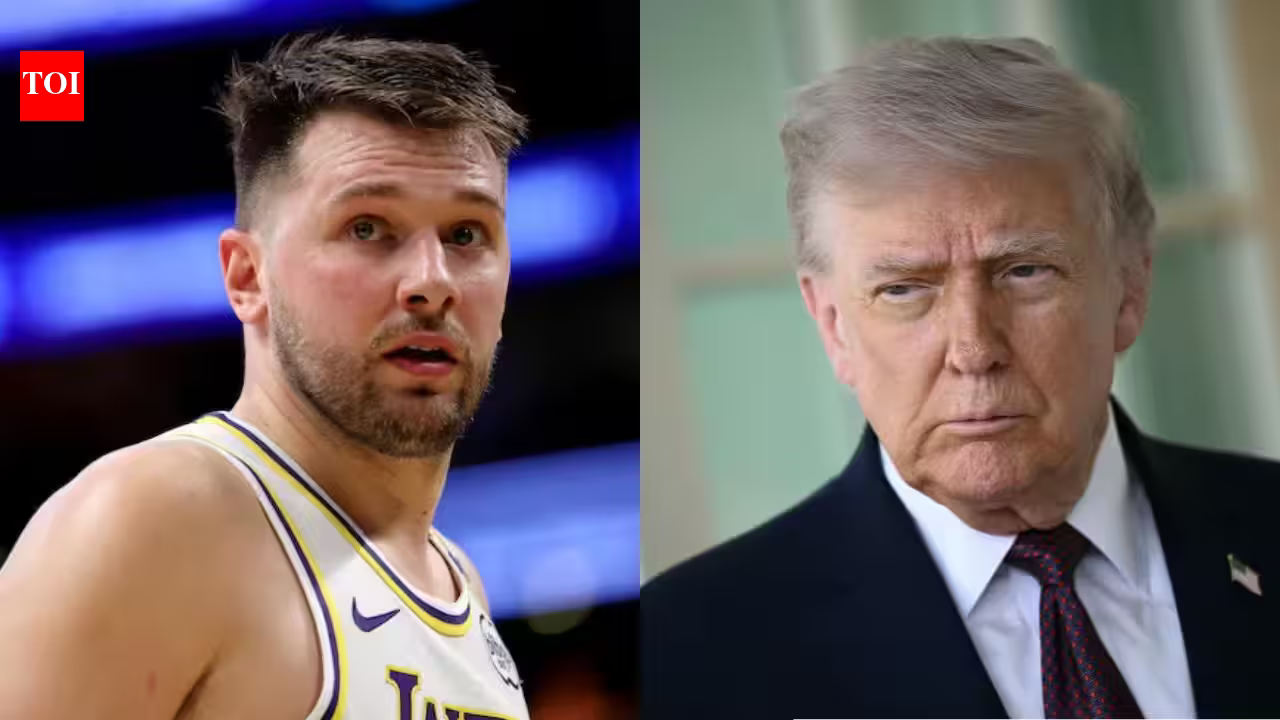
DALLAS — The echoes of the 2025 blockbuster trade that sent generational talent Luka Doncic away from the Dallas Mavericks have refused to die down, even 19 months later. On Wednesday night, the conversation reached the highest office in the land, as Donald Trump took to the stage at the American Airlines Center to deliver a scathing critique of the move that fundamentally altered the trajectory of the Mavericks’ franchise.
The event, which served as the opening night of the Republican National Committee’s midterm convention, saw the former president stray far from political discourse to address the lingering resentment surrounding the Dallas front office’s decision-making. While the arena was packed with political delegates, Trump—a self-proclaimed dealmaker—could not resist weighing in on a transaction he views as a historic blunder.
A Presidential Critique of Front-Office Logic
Taking the stage to the iconic swells of “God Bless the USA,” Trump wasted little time in pivoting to the sport that defines the city’s heart. Despite a modest disclaimer regarding his expertise in the nuances of basketball, his verdict was as blunt as it gets.
“This is a big Dallas Mavericks team, which is going to be hopefully good,” Trump told the energized crowd. “I must tell you, I don’t understand the trade. What do I know about basketball? I would say it’s not going to go down as the greatest trade in the history of sports. It might go down as the worst trade in the history of sports.”
The former president, who famously frames his political career through the lens of high-stakes negotiations, appeared genuinely confounded by the internal logic of the deal. He went as far as to invoke the legendary 1919 sale of Babe Ruth from the Boston Red Sox to the New York Yankees—a transaction that famously cursed a franchise for decades.
“Babe will always be the worst trade,” Trump remarked. “But is it Luka? Maybe we could redo that trade. I redo deals all the time. We gotta redo that deal. I don’t get that deal. Some deals you understand; I understand deals. But that one I didn’t quite get.”
Anatomy of a Historic Deal
To understand the weight of the criticism, one must look at the cold, hard mechanics of the February 2, 2025, transaction. The three-team deal, which also involved the Utah Jazz, saw Dallas ship their franchise cornerstone to the Los Angeles Lakers. In exchange, the Mavericks received Anthony Davis, Max Christie, and a 2029 first-round draft pick.
The aftermath was immediate and chaotic. The trade signaled a total collapse of the existing front-office philosophy, leading to the eventual firing of General Manager Nico Harrison just nine months later. The team transitioned power to Michael Finley and Matt Riccardi, before ultimately bringing in Masai Ujiri to oversee a massive organizational overhaul.
For the Mavericks, the immediate results were dismal. The team limped to a 26-56 record, and the return on the trade—Anthony Davis—lasted a mere 20 games before being shipped to Washington in February 2026. While Max Christie proved to be a serviceable piece, shooting a respectable 40.4 percent from beyond the arc over 77 games, the loss of Doncic’s output proved irreplaceable.
The Aftermath: A Franchise in Flux
While Dallas has spent the last year and a half in a state of perpetual rebuilding, Doncic has continued to thrive in Los Angeles. Boasting averages of 31.9 points, 7.8 rebounds, and 8.1 assists over 92 games, the Slovenian superstar has only validated the frustration felt by the Dallas faithful.
In the wake of the trade, the Mavericks attempted to pivot toward a new era. They utilized the lottery luck that followed their abysmal season to select Cooper Flagg with the first overall pick. Flagg has been a bright spot, posting a stellar rookie campaign with 21.0 points and 6.7 rebounds per game, eventually securing Rookie of the Year honors. However, despite the infusion of young talent, the team remains in the nascent stages of finding an identity under the leadership of new head coach Dusty May.
The irony of the situation is not lost on the NBA community. The trade was met with massive protests from a scorned fanbase the moment the ink dried. Nearly two years later, with the organization under the stewardship of Masai Ujiri and Mike Schmitz, the shadow of the Doncic trade remains the primary obstacle to the team’s narrative.
Whether the deal is truly the “worst in the history of sports” remains a subject of intense debate among analysts and historians. However, for a city that watched a generational icon depart in his prime, the political weight of the former president’s words serves as a stark reminder: in the world of professional sports, bad deals don’t just fade away—they define an era.
Disclaimer: This content is auto-generated for informational purposes only.
Source: Read Original News