








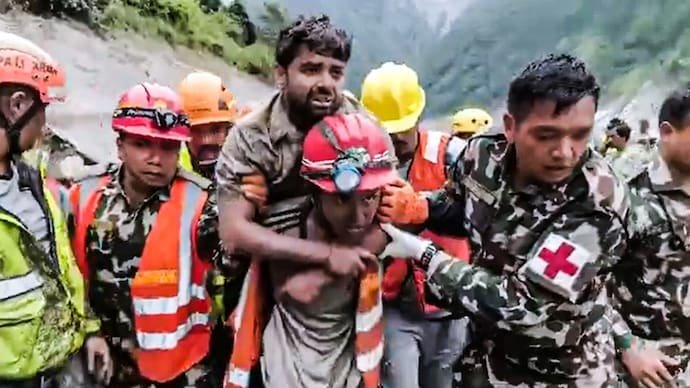
The recent devastating floods in Nepal have sent shockwaves across the Himalayan region, bringing significant challenges to infrastructure and human life in areas bordering Tibet. Amidst the chaos and destruction, a glimmer of hope emerged last Friday when two workers, Sanjay Sah and Kabir Maharjan, were pulled alive from a tunnel at the Trishuli-3A hydropower project site. Their survival after nine days of being trapped underground has been described as a medical and logistical miracle, providing a focal point for ongoing rescue efforts in the region.
A Complex Rescue Operation
The rescue mission was a collaborative effort involving the Nepali Army and specialized teams from India. These Indian experts brought advanced search-and-rescue equipment to the rugged terrain of the Trishuli River basin. The operation was fraught with danger, as the structural integrity of the tunnels had been compromised by the massive influx of floodwaters and debris.
Rescuers had been working around the clock to clear the mud and wreckage that blocked the tunnel entrances. According to reports from regional authorities, the searchers were encouraged when they heard faint voices emerging from the deep recesses of the underground structure. This auditory evidence prompted the teams to focus their efforts on specific segments of the tunnel, ultimately leading to the discovery of the two survivors at a depth of approximately 170 metres. The sight of the workers emerging from the darkness, caked in mud, served as a stark reminder of the harsh conditions they endured for over a week.
Surviving Against the Odds
The ordeal faced by Sanjay Sah and Kabir Maharjan is a testament to the resilience of the human spirit. With no access to food or water for nine days, their survival is attributed to the presence of air pockets within the tunnel structure. Mechanical engineer Sanjay Sah, who was instrumental in directing his colleagues to safety when the floods first breached the site, remained composed throughout his confinement.
Sah later recounted that the environment inside was extremely precarious, with the tunnel extending deep into the mountainside. His survival strategy was rooted in mental discipline; he noted that he sustained his resolve by repeatedly chanting the ‘Hare Krishna Mahamantra.’ This period of isolation was marked by profound uncertainty, as he and Maharjan waited for signs of help while the water levels fluctuated around them. The successful retrieval of these two men has reignited efforts to comb the remaining stretches of the tunnel, where it is feared that other workers might still be trapped.
The Broader Impact on Infrastructure
The scale of the disaster is vast, with the flooding affecting over a dozen hydropower sites along the Trishuli River. These projects are vital to the energy security of the region, and their destruction has significant economic and social implications. Reports indicate that over 900 workers were feared trapped or affected across these various sites when the floodwaters first surged.
For many in the region, including workers who migrated from different parts of Nepal and surrounding countries, these hydropower projects represent essential livelihoods. The catastrophic damage to the tunnels and powerhouses signifies a long road ahead for recovery and reconstruction. With over 1,250 lives lost across the affected areas, the focus remains on recovery, but the disaster also raises critical questions about climate preparedness and the engineering standards of infrastructure in high-risk zones near the Himalayas.
A Beacon of Hope for Families
For the families of the rescued men, the return of their loved ones has been a source of immense relief. Hira Shobha, wife of Kabir Maharjan, described the nine-day wait as an agonizing period of uncertainty that made it nearly impossible to maintain a sense of normalcy. The reunion at the rescue site was a profound moment, marking the conclusion of a harrowing wait that kept entire communities in a state of suspense.
The narrative of this rescue serves as a rallying point for the families of the hundreds of workers who remain missing. Legislator Ram Neupane has emphasized that as long as there is a possibility of survival, the search operations will continue with the same level of intensity. The success in the Trishuli-3A tunnel provides a tangible reason for these families to hold onto hope, as teams continue to navigate the debris-filled tunnels in search of further survivors.
Looking Toward Future Resilience
The tragic events in Nepal serve as a sobering reminder of the vulnerability of mountain ecosystems to extreme weather events. As rescue teams continue their work, experts are likely to initiate a comprehensive review of safety protocols for tunnel construction and emergency evacuation procedures in mountainous terrains.
The cooperation between India and Nepal in this rescue operation underscores the necessity of shared expertise in disaster management. As the region moves past the immediate emergency phase, the focus will inevitably shift toward how such infrastructure can be better protected against future flash floods. For now, the focus remains firmly on the search for the missing and the support for those who have survived the disaster. The resilience shown by Sah and Maharjan continues to inspire search teams, reminding them that even in the most dire circumstances, persistence and coordination can yield life-saving results.
Disclaimer: This content is auto-generated for informational purposes only.
Source: Read Original News