





Singer since 1943’. That is how Asha Bhosle succinctly — but profoundly — described herself in her bio on social media. Over 12,000 songs in 20 languages over eight decades defined the icon, whose every song told a story of mastery over melody and musicality. t2 spotlights 20 unforgettable Asha Bhosle solo numbers that have formed a staple on playlists through generations.
Aaiye meherbaan (Howrah Bridge, 1950)
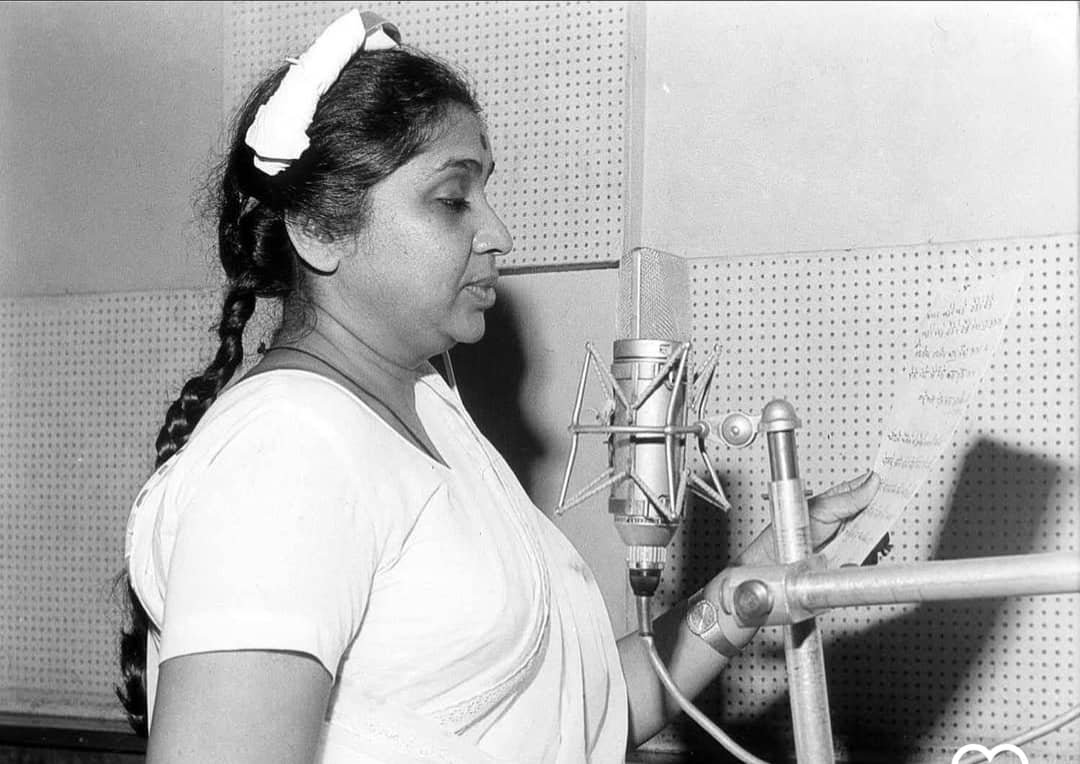
A song that truly heralded the arrival of Asha as a seductive, romantic voice with both vibe and versatility, this timeless number from the “Golden Era” of Bollywood has been made enduring by the presence of Madhubala, with O.P. Nayyar’s lilting score and Qamar Jalalabadi’s words like: “Aaiye meherbaan, baithiye jaane jaan/ Shauk se lijiyegi ishq ki imtihaan” lifting it several notches. Asha’s prolonged emphasis on “Aiyeeeee” remains unmatched.
 Asha Bhosle recording Aaiye meherbaan from the 1950 film Howrah Bridge in the studio
Jaaiye aap kahan jayenge & Yeh hai reshmi zulfon ka andhera
(Mere Sanam, 1965)
The magical jugalbandi of Asha and O.P. Nayyar produced yet another musical gem in the form of Mere Sanam. Asha’s melodious voice lent a special romance to Jaaiye aap kahan jayenge, picturised on Asha Parekh, beautifully capturing a young woman expressing her ardent feelings for her beloved. A number that spelt both grace and allure, with the singer’s wholesome vocals matching the scenic frames perfectly.
Asha’s remarkable range was on full display in Mere Sanam, as it was in countless other films she lent her voice to, switching from the playful innocence of Jaaiye aap kahan to the teasing and hypnotic tone of Yeh hai reshmi zulfon ka andhera. Her iconic rendition of the song lent it an air of romance, seduction and a hint of mystery, bringing meaning to the poetic metaphor of a lover being enchanted by a woman’s presence, particularly her dark, flowing tresses. This is a classic example of a singer ‘acting’ through her voice.
 Jaaiye aap kahan jayenge from Mere Sanam (1965)
Aage bhi jaane na tu (Waqt, 1965)
Overtly different from the seductive feel of many of her other numbers in a similar setting, this song from Waqt shows a restrained and subtle side of the singer, with the haunting and reflective quality of her voice lending depth to and skilfully gliding through Sahir Ludhianvi’s meditative words about the here and now. “Aage bhi jaane na tu, peechhey bhi jaane na tu/ Jo bhi hai, bas yahi ek pal hai.”
 Insatiable energy and a spirit of joie de vivre marked Asha Bhosle’s presence on stage and in the studio
Paan khaaye saiyan hamaro (Teesri Kasam, 1966)
This spirited, folk-inspired song from Teesri Kasam had Waheeda Rehman bringing alive Asha’s playful, perky, rhythmic style, drawing inspiration from the nautanki aka folk theatre style which is central to the setting of this 1966 film for which the music was scored by Shankar-Jaikishan and the words written by Shailendra.
Jhoomka gira re (Mera Saaya, 1966)
This mystery thriller about two sisters (both played by Sadhana) had Asha and sister Lata Mangeshkar on the album credits. Jhoomka gira re, sung by the former, became an instant hit for its mischievous tone and upbeat tempo, with the trio of Asha, composer Madan Mohan and lyricist Raja Mehdi Ali Khan spelling collaborative gold. Asha’s slightly exaggerated vocal expressions, befittingly used to convey a woman’s mock distress over losing her earring, put Bareilly (and its bazar) on the map. The song has featured in many a remix and tribute over the decades — while Asha herself remixed the song in the late ’90s, a recent version was What jhumka? from 2023’s Rocky Aur Rani Kii Prem Kahaani.
 Jhoomka gira re from Mera Saaya (1966)
Raat akeli hai (Jewel Thief, 1967)
Asha, aided by a lithe Tanuja on screen, shifted effortlessly between the seductively slow tempo and the lively spirited energy of this S.D. Burman-scored number, with the singer displaying amazing versatility, even hiding a sultry laugh beneath the low notes. Given its subtly sensuous tone (and that famous visual of Tanuja draping a curtain around her while wooing Dev Anand), Raat akeli hai stood out from the other cabaret-styled numbers of the time.
Parde mein rehne do (Shikar, 1968)
A silken, flowing sonority defines Asha’s vocals in this Shankar-Jaikishan composition that has a teasing, mysterious quality to it. Asha cranks up the kittenish charm, almost seeming to smile behind the mic as she brings alive words like “parda”, “raaz” and “tauba”. Sister Lata, first approached for the song, reportedly refused it, citing Hasrat Jaipuri’s lyrics as derogatory. The assignment went to Asha — and as history shows, she ran with it.
Aao huzoor tumko (Kismat, 1968)
The first minute-and-a-half of this much played and replayed number from Kismat is in direct contrast to the rest of the song, with Asha seamlessly gliding from its almost-ghazal-like tone to a intoxicated paean of the heroine, played by Babita, promising the stars (and beyond) to the leading man (Biswajeet). Smooth note slides, a playful and airy texture and some remarkably controlled breathing define this number from Asha. The drunk ‘hic’ is made melodious in the way only she could have.
Piya tu ab toh aaja (Caravan, 1971)
One of the many celebrated songs that defined the Asha and R.D. Burman partnership behind the mic (and in life), Piya tu ab toh aaja, of course, had Burman iconically going “Monica, o my darling” (and hence isn’t really an Asha solo number), but we had to pick this one for the sheer magic that she brought to it. Unafraid at that time to take up songs that others would potentially stay away from, Asha plunged into this Caravan number, with Helen in front of the camera. From the dramatic breathing to the lingering play on “Piya tuuuu” to the whisper-singing, everything spells Asha, making it not only one of her most memorable songs, but also perhaps the most iconic cabaret number in Bollywood history. We are still making (inferior) versions of it.
 Piya tu ab toh aaja from Caravan (1971)
Dum maro dum (Hare Rama, Hare Krishna, 1971)
Kishore Kumar had reportedly described this cult 1971 song as being so powerful that it could “bring a dead man to life”. There is, frankly, no other way to describe Dum maro dum, bringing together the iconic duo of Asha and R.D. Burman and adding the iconic words of Anand Bakshi to the mix. No one could have brought the kind of smoky, sensuous, trance-like quality that Asha did to Dum maro dum, with the memorable touches she lent to it — the hush at the beginning, the protracted emphasis on “dum” and gham”, the hypnotic push-and-pull effect — making this Zeenat Aman-picturised number a pop-culture phenomenon for the ages.
 Dum maro dum from Hare Rama, Hare Krishna (1971)
Aao na gale laga lo na (Mere Jeevan Sathi, 1972)
Yet another Bhosle-Burman collab that hit instant gold, this Mere Jeevan Sathi song — once again picturised on Helen and inspired by the Western lounge and jazz club music trends of the 1960s–70s — has the singer excelling in transitioning between a heavy-breathing seductive tone to a high-energy tempo, with Majrooh’s Sultanpuri’s playful, flirtatious words being matched by Asha’s melodic vigour.
Sajna hai mujhe sajna ke liye (Saudagar, 1973)
This light, demure, romantic number about a young woman expressing her desire to dress up for the eyes of her beloved, has a joyful vibe of the heady feeling that comes with love, rendered by Asha in a way that made it an instant clutter-breaker. “Sajna hai mujhe sajna ke liye/ Zara uljhi latein sanwar doon/ Har ang ka rang nikhaar doon/ Ke sajna hai mujhe sajna ke liye” assumed a playful yet inviting tenor, courtesy the purity, innocence and the feel of anticipated excitement that her voice brought to it.
Koi sehri babu (Loafer, 1973)
After her passing, a video of Asha and Mumtaz — on which this song from Loafer was picturised — dancing to Koi sehri babu at a house party, went viral. It showcased the joyful, timeless spirit of Asha’s immortal voice, something which was also evident in this pre-wedding number with a dance-oriented quality, composed by Laxmikant-Pyarelal and making for a perfect blend of charm, rhythm and melody.
 Koi sehri babu from Loafer (1973)
Yeh mera dil (Don, 1978)
Asha once again spun melody magic, a cat-eyed Helen on screen, in this cabaret-styled, disco-influenced song from Don. Winning fans across generations, Yeh mera dil has the versatile singer becoming the personality of the character — mysterious, charming, coquettish yet elegant — making the song a memorable audio-visual experience. It gained international fame when The Black Eyed Peas sampled it in 2005, with the remake of Don a year later bringing back the number, sung by Sunidhi Chauhan. But nothing really comes close to the original.
 Yeh mera dil from Don (1978)
Jab chhaye mera jadoo (Lootmaar, 1980)
Music director Rajesh Roshan tapped heavily into Asha’s jazz-influenced style for this song from Lootmaar that carried a playful cabaret energy, but was much more. Rhythmic precision and sensual softness, both Asha markers, remain the pull factors of Jab chhaye mera jadoo, which is still a staple on many a pep-powered playlist.
 Asha Bhosle with R.D. Burman
Dil cheez kya hai & In ankhon ki masti (Umrao Jaan, 1981)
Ghazal singing in Hindi cinema playback is at its best in Dil cheez kya hai, in which Asha adapts her normally high-energy, uptempo voice to sing this Khayyam-composed gem from Umrao Jaan with a soft, flowing delivery and with emphasis on the pronunciation of the lines written by Shahryar. There is a measured sensuality in her voice which perfectly matches the grace that Rekha, playing the titular character, brings to the screen. Asha won a National Award for this song.
Another standout from Umrao Jaan is In ankhon ki masti, once again sung by Asha with Rekha as the face of the number. The singer, displaying immense skill and range, lends both power and poignancy to the voice of a woman talking about her eyes — about its thousands of admirers, its thousands of stories… and everything in between.
 In ankhon ki masti from Umrao Jaan (1981)
Jawaani jaaneman (Namak Halaal, 1982)
Disco-era cool came alive once more in this ageless number composed by Bappi Lahiri, with Asha playing to her strengths — energetic delivery, semi-conversational style of singing, cabaret flair and controlled sensuality. That “ah-ha!” rendered in signature Asha Bhosle style is a masterclass.
Mera kuch saamaan & Katra katra (Ijaazat, 1987)
Asha’s ability to deliver a conversational yet emotionally-rich style of singing was evident in Mera kuch saamaan, a winner of a number scored by R.D. Burman and written beautifully by Gulzar. Praised widely for its free-verse lyrics that touched upon nostalgia, separation and the baggage of emotional memories, Asha earned her second National Award for the song, that she made her own in a deeply intimate way. No Asha Bhosle playlist is complete without this one.
In direct contrast is Katra katra, also from Ijaazat, in which the singer used a double-voice effect (Burman made her sing it twice to capture its layering) to create a sort of an echo, melding her soft, intimate vocals with deeply resonant emotional delivery. Gulzar’s lyrics about longing and vulnerability find a brilliant match in Asha’s intimate and breathy style, with the legend reportedly delivering the song in one take.
 Mera kuch saamaan from Ijaazat (1987)
Rangeela re & Tanha tanha (Rangeela, 1995)
Marking A.R. Rahman’s first full-fledged Hindi film soundtrack, the album of Rangeela is a landmark, made all the more special by the presence of Asha, who, then in her early 60s, lent incredible youthful vigour to the title track, which mixed modern beats with semi-classical fusion, lending a free-flowing, playful tone to the song, in which the rendition of the “Rangeela re” bit remains especially memorable.
The other Asha solo standout in this film is, of course, Tanha tanha whose unforgettable visuals — Urmila Matondkar, Jackie Shroff, the sprint on the beach, the pose atop a bike — is made all the more iconic by Asha (and her “ageless voice”, as Rahman has often described it). The sensuous nature of the song benefits from Asha’s highly expressive style. Breezy, frothy and lightly seductive, Tanha tanha earned Asha Bhosle a few awards and reinforced the fact that she could pick any number at any age and make it pure gold. Often, for the ages.
 Tanha tanha from Rangeela (1995)
Le gayi (Dil Toh Pagal Hai, 1997)
Asha shifts between soft and soothing, electric and energetic in this Karisma Kapoor-powered dance number composed by Uttam Singh. Masterfully blending the high and semi-high notes, the singer adds such zing to Le gayi le gayi that we wouldn’t be surprised if she was dancing in the studio while recording it — in the way that we have always known her to be. Iconically, irresistibly, Asha.
 (L-R) Dev Anand, Asha Bhosle, Kishore Kumar and R.D. Burman