






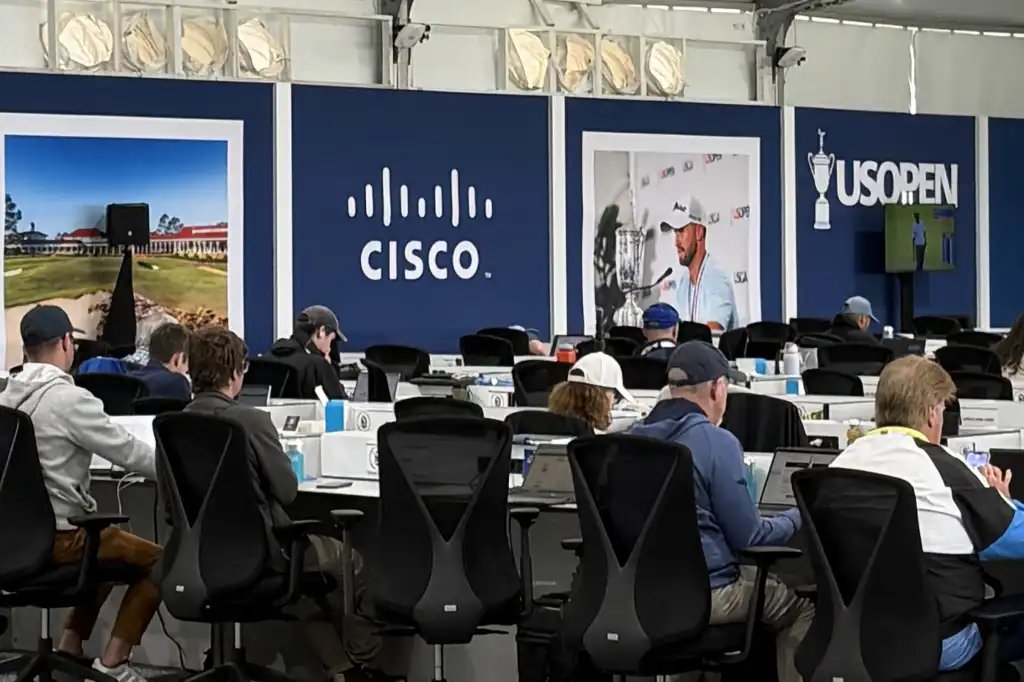
Environmental conditions add another layer of complexity. Anthony Santora, managing director of IT for the USGA, describes the championship network as a data center without the usual comforts. There’s dust, rain, wind, and wide temperature swings instead of clean, controlled air. Hardware resides in trailers and weatherproof enclosures, not in racks behind raised floor tiles. For network engineers who spend most of their time on office campuses and in colos, that’s an important reminder: Critical infrastructure increasingly sits in places that look nothing like a traditional wiring closet.
User behavior is just as hostile. The U.S. Open has its own term — the “Tiger effect” (though one could argue it’s now the Scottie effect) — for what happens when tens of thousands of fans follow a single golfer. The hot spot moves with the group, and the RF design must cope with a dense, moving cluster of devices. That pattern should sound familiar to anyone who supports large conferences or festivals; it’s the same phenomenon, just under a different name.
Building an AI‑ready, fault‑tolerant course network
Cisco’s answer to this environment is a fully redundant, mobile core design. Instead of a single large core in a building, the network collapses into dual trailers that serve as cores on the go, typically anchored at the NBC broadcast compound and another central location. Each core hosts Cisco Secure Firewall appliances, FMCs, core Catalyst switches, DHCP, UPS, and generators, all in pairs. Rodriguez was matter-of-fact about the philosophy: “We do everything in pairs as much as we can.” If one fails, its twin picks up the load.