







Evaluating the graphics prowess of high-performance desktop systems involves a multifaceted approach, encompassing both synthetic benchmarks and real-world gaming scenarios. For synthetic testing, industry-standard tools like UL’s 3DMark suite are employed, offering a comprehensive assessment across various graphical APIs and workloads. This includes tests like Wild Life (1440p) and Wild Life Extreme (4K), which leverage the Vulkan graphics API to gauge raw GPU speeds. Further insights into gaming geometry and particle effects are provided by Steel Nomad’s regular and Light subtests, which utilize APIs more common in game development. To specifically measure ray tracing capabilities, Solar Bay is used, subjecting 3D scenes to increasingly demanding ray-traced workloads at 1440p. This benchmark is particularly versatile, utilizing Vulkan on Windows and Android platforms, and Metal on Apple devices.
Beyond synthetic measurements, a crucial aspect of assessing graphical performance lies in real-world gaming simulations. Our methodology incorporates in-game benchmarks for three popular titles: Call of Duty: Modern Warfare 3, Cyberpunk 2077, and F1 2024. These games are meticulously chosen to represent a diverse range of genres: a competitive shooter, an expansive open-world experience, and a sophisticated simulation game, respectively. Each title is benchmarked at three common resolutions – Full HD (1080p or 1200p), 2K (1440p or 1600p), and 4K (2160p) – and configured to high detail or the highest available settings to truly push the hardware. Performance is quantified in frames per second (fps).
The specific settings for each game are tailored to provide maximum insight. For Call of Duty: Modern Warfare 3, the Extreme graphics preset is utilized. This aggressive setting allows for the evaluation of high-frame-rate performance, even on systems capable of triple-digit frame rates on less demanding presets. Cyberpunk 2077, renowned for its graphical intensity, is tested using the demanding Ray Tracing Overdrive preset, intentionally disabling performance-boosting technologies like DLSS or FSR to measure the raw power of the GPU. F1 2024, with its intricate car models and richly detailed environments, serves as an excellent benchmark for a GPU’s ability to render complex polygon counts and high-fidelity textures.
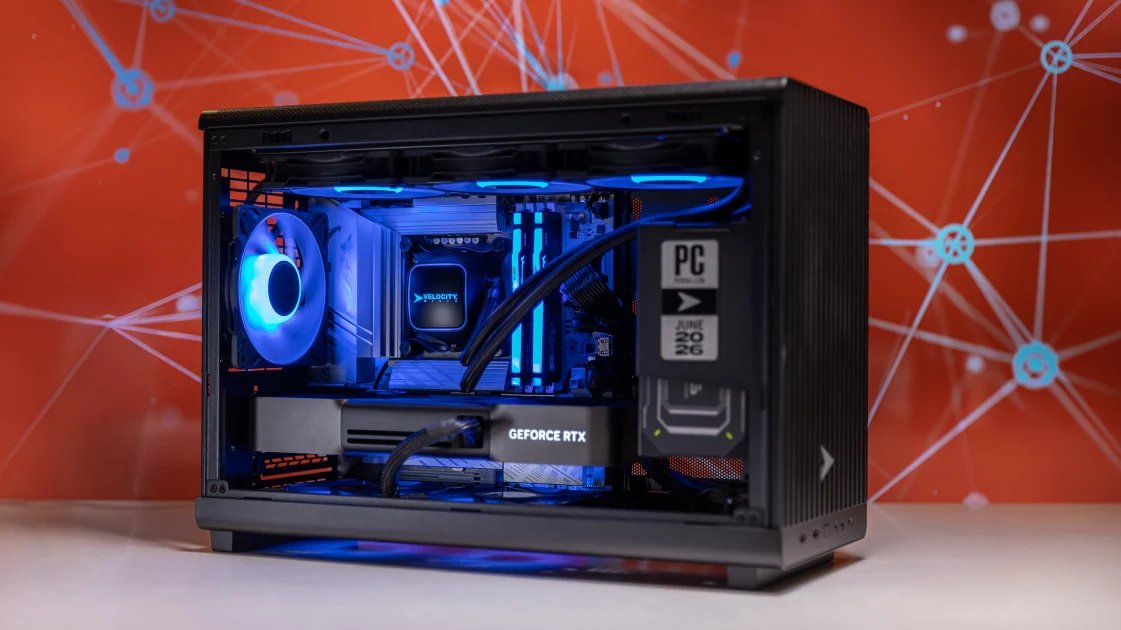
In a recent performance comparison, the Raptor Z55i demonstrated exceptional graphical prowess, finding its closest competitor in the Maingear MG-1 MK. II. Both systems were equipped with the formidable RTX 5090 graphics card. However, a key differentiator was the Maingear’s inclusion of AMD’s X3D2 chip, a silicon specifically engineered to enhance 1080p and 1440p frame rates in gaming. This architectural advantage allowed the MG-1 to slightly outperform the Raptor in four out of five 3DMark tests. The Raptor, however, managed to secure a victory in the Solar Bay ray-tracing benchmark, showcasing its strength in that particular workload.
When it came to actual gaming, the systems posing the most significant challenge to the Raptor Z55i were those featuring AMD’s 3D V-Cache chips, specifically the Origin and Maingear models. In 1080p gaming, a resolution often more dependent on CPU performance, the Raptor experienced a slight dip in F1 2024, even when compared against systems equipped with the RTX 5080. However, it quickly regained its competitive edge in other game titles at this resolution. This CPU-centric bottleneck at 1080p entirely dissipated when ray tracing was enabled or resolutions were increased to 4K, at which point the performance became overwhelmingly dictated by the GPU’s silicon and memory resources.
At these higher graphical demands, the Raptor’s only true rival was the Maingear tower. The two systems engaged in a fierce competition, ultimately resulting in an effective draw. The performance differences observed in Call of Duty and Cyberpunk at sharper resolutions were negligible, typically within a mere 15 frames per second. It’s important to note that even at these demanding settings, many games were still delivering highly playable 4K frame rates. The overarching conclusion from this evaluation is that the Raptor Z55i maintained an incredibly competitive performance profile despite being priced over $1,500 less than its closest competitor, making it a rare and compelling value proposition within this high-performance tier.