







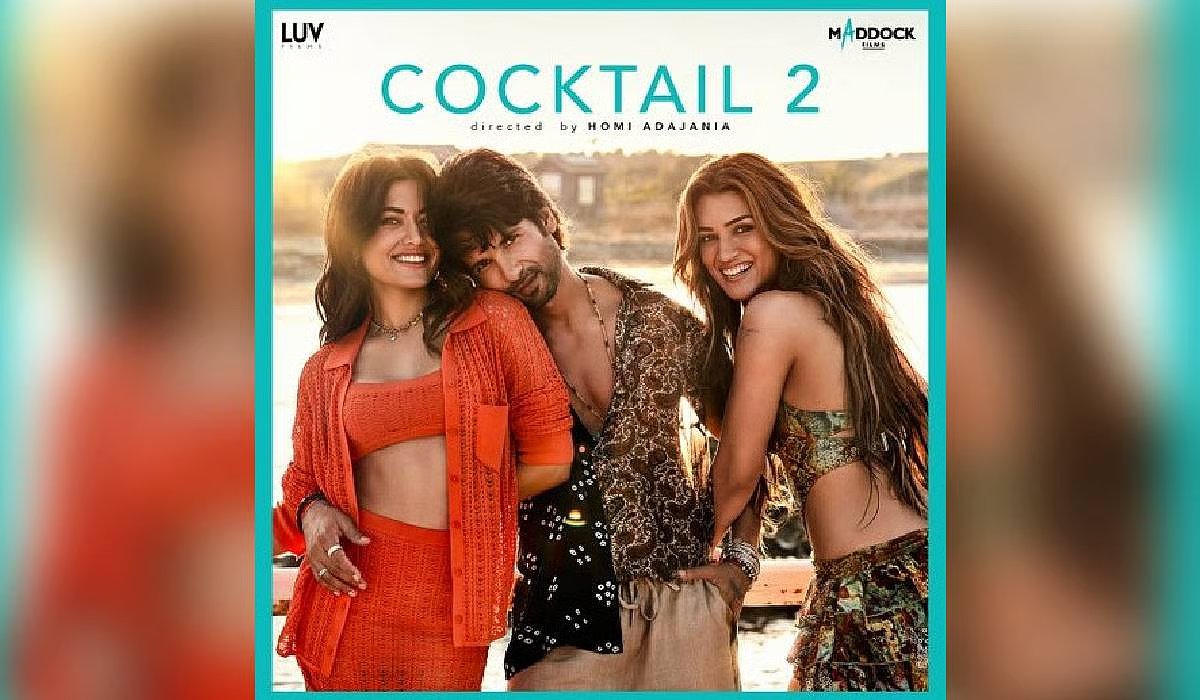
Is the Indian rom com dead? Watching the odious beach song, Jab Talak, from the forthcoming Cocktail 2, said to be the spiritual sequel of the 2012 hit Cocktail, which made Deepika Padukone a born-again cool girl, one could sense the whiff of emotional decay.
The director, Homi Adajania, is the same, and the beach song has Kriti Sanon and Rashmika Mandana trying desperately to out smile, out hair flip and out oomph each other, only to look as boring as Shahid Kapoor’s expression.
The trailer promises friendship, love, madness. It also says the perfect cocktail is returning.
Shudder.
That alone would make one go in for a cinematic summer detox but we are being promised yet another romance, this time from Dharma Productions, called Chand Mera Dil, where a barechested Lakshya is sharing screen time and it seems his shirts, with Ananya Panday. Our love story is legendary, says the heroine to the hero in the trailer. But all legendary love stories have tragic endings, says the hero, after screaming into the void and riding a bike while kissing the girl a la Saaiyaara.
Rounding up this charmless trio is Ek Din, which is based on a well-known Korean film One Day (2016). Now anyone familiar with Sai Pallavi’s work will know it takes a lot to make anything with her underwhelming but this film with Junaid Khan looks dead on arrival. It is supposed to be the story of a woman who has short term amnesia (or transient global amnesia to give it the correct medical term, or so we are told) and the man who is utterly in love with her. It is the kind of film that can only make you want you to live in a time machine.
It is not that India doesn’t know how to make romantic dramas. Look around and other cinemas seem to be quite up to the task, whether it is the recent Marathi film Tu Ani Ti Fuji, also set in Japan like Ek Din, or Premalu in Malayalam, released in 2024, and starring Mamatha Baiju and Naslen. Both have themes and actors who are contemporary and relevant.
Hindi cinema itself has a history of making memorable romances. All three Khans established their stardom across India by playing lovers, whether it was Aamir Khan in Qayamat Se Qayamat Tak (1988), Salman Khan in Maine Pyaar Kiya (1989) or Shah Rukh Khan in Dilwale Dulhaniya Le Jayenge (1995). Every other major star who followed has chosen romances to surge ahead, from Hrithik Roshan in Kaho Naa Pyaar Hai (2000) to Ranbir Kapoor in Saawaariya (2007) to Ranveer Singh in Band Baaja Baaraat (2010).
Yet Hindi cinema has such little faith in the genre. Could it be misogyny, as Luke Thompson, the star of Bridgerton, has said about the lack of respect for what is seen as a female favourite (as if women don’t go to theatres)? Or could it be that the overwhelmingly male masters of movie magic don’t want women to get power either behind or in front of the camera?
One Saaiyaara doesn’t make a summer. Yet the success of last year’s romance has spurred a revival of interest in romances, most immediately in a reuniting of the team of directors and actors reunited by the same production house to make a spiritual sequel (o how that term makes my teeth grate).
The west wisely continues to make romances, at least in period costume, and at least in streaming with many Bridgerton seasons, a forthcoming revival (yes another) of Pride and Prejudice, and delightful adaptation of The Other Bennett Sister on BBC One based on a novel by Janice Hadlow, chronicling the life of the most ignored Bennet sister, Mary. Those of us starved of the pleasures of watching slow burns and meet-cutes have to live in the past, and wait for the wet shirts and the hand flexes, all romantic tropes established by Pride and Prejudice (1995) and Pride and Prejudice, the movie. in 2005.
And even if they get it wrong like Emerald Fennell’s heavy breathing adaptation of Charlotte Brontë’s Wuthering Heights, at least they tried.