








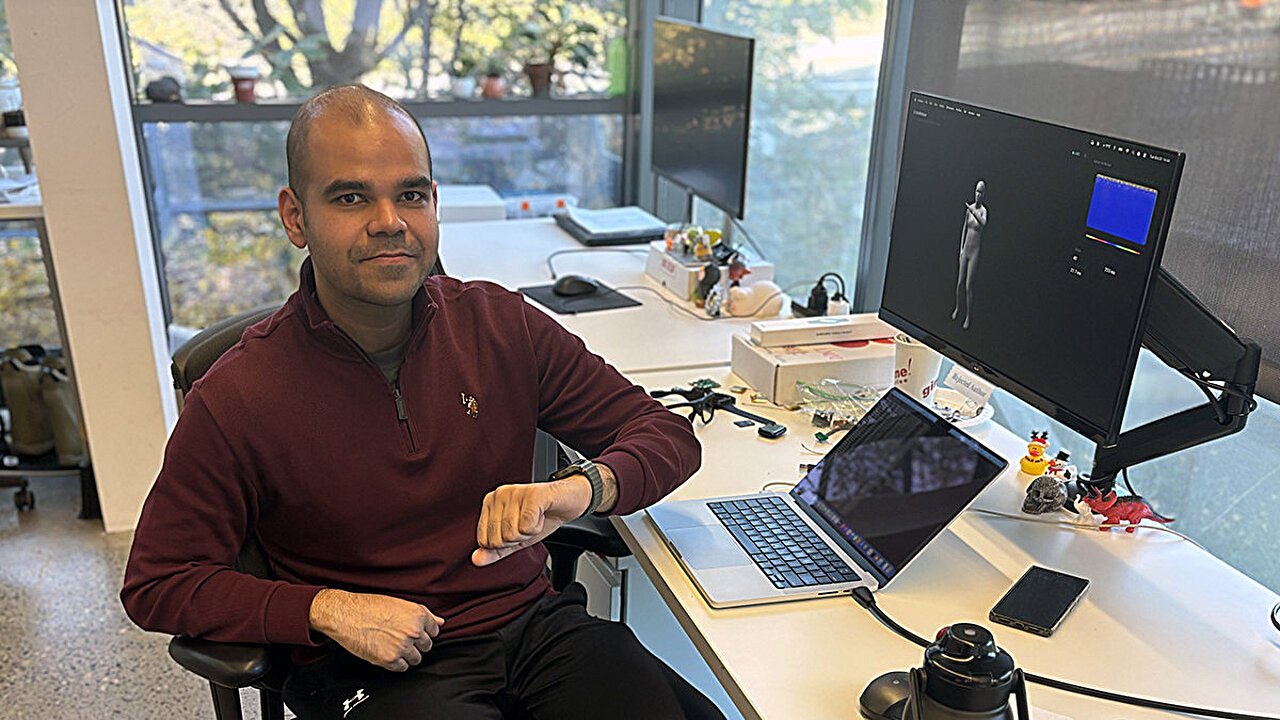
Transforming Wearable Sensing Through Ultrasonic Waveform Tracking
The landscape of human-computer interaction is undergoing a significant transition as researchers move away from reliance on expensive, external camera arrays and motion-capture suits. A recent breakthrough by a team of scientists has introduced a novel method for full-body tracking that utilizes the modest hardware already present in consumer smartwatches. By leveraging ultrasonic sound waves and a lightweight artificial intelligence framework, this technology enables high-fidelity motion tracking without the need for bulky sensors or high-energy consumption.
The system works by emitting inaudible ultrasonic signals from the watch’s speaker. These sound waves bounce off various parts of the user’s body and are subsequently captured by the device’s microphone. As the user moves, the reflected echoes undergo subtle shifts in frequency and timing, known as the Doppler effect. The integrated artificial intelligence model processes these high-frequency reflections to reconstruct the spatial coordinates of the entire body in real time. This innovation effectively turns a standard wearable device into a sophisticated radar-like sensor, bridging the gap between basic activity tracking and advanced skeletal animation.
The Mechanics of Ultrasonic Spatial Mapping
At the core of this technology is the ability to interpret acoustic signatures. Unlike optical cameras, which struggle with privacy concerns and occlusion, ultrasonic waves provide a non-invasive way to map a user’s silhouette. When the watch emits a pulse of ultrasound, the sound travels through the air, hits limbs or the torso, and returns to the microphone. Because the speed of sound is constant, the time-of-flight measurements provide an accurate representation of distance.
The complexity of this data is immense, as a single microphone captures a chaotic blend of echoes. To translate these raw sound waves into meaningful skeletal data, the researchers developed a streamlined neural network. This model is designed specifically to run on edge hardware, meaning the heavy computational lifting happens directly on the smartwatch or a paired mobile device. By utilizing a process of signal processing that filters out ambient noise, the AI maintains a stable lock on the user’s body position even when the environment is not perfectly quiet.
Advantages Over Traditional Optical and Inertial Systems
Current motion tracking methods largely fall into two categories: optical systems like those used in film production, and inertial measurement units (IMUs) found in current wearables. Optical systems require multiple cameras placed in fixed locations, making them unsuitable for everyday movement. Conversely, IMUs—which measure acceleration and angular velocity—suffer from “drift,” where the cumulative errors in measurement lead to inaccurate tracking over time.
The ultrasonic approach offers a distinct advantage: it does not accumulate positional error in the same way as IMUs, nor does it require a fixed field of view like a camera. By keeping the sensing mechanism localized to the wrist, the system maintains a continuous frame of reference. Furthermore, since the system does not record actual video, it bypasses the significant privacy risks associated with optical sensors in public spaces. This enables a form of “privacy-preserving motion capture,” where the digital representation of the user is stored, but their visual likeness is never captured.
Versatility and Practical Use-Cases
The potential applications for this technology extend far beyond simple fitness monitoring. In the realm of virtual and augmented reality, the primary hurdle for widespread adoption is the lack of seamless body tracking. Current VR systems often require handheld controllers or external base stations to track a user’s limbs. An ultrasonic system built into a watch would allow users to engage in immersive digital environments without installing external hardware.
Beyond entertainment, healthcare represents a significant area for integration. Physiotherapists could use this system to monitor the range of motion of patients recovering from surgery. Because the tracking is precise enough to detect shifts in posture and limb positioning, it provides an objective dataset for clinical progress that a patient can track from their own home. Similarly, for the elderly, this technology could detect sudden changes in gait or posture that might precede a fall, providing a passive safety net that works continuously throughout the day without requiring the user to wear specialized sensors on every limb.
Future Outlook and Technical Integration
While the current iteration of this technology is a major milestone, the researchers are continuing to refine the algorithm to improve its robustness in cluttered environments. Future iterations aim to increase the sampling rate of the ultrasonic pulses to ensure that even fast-paced movements, such as those found in competitive sports, are captured without blur or lag.
The integration of this software into existing operating systems would likely require minimal hardware modifications, as most modern smartwatches already contain the necessary high-fidelity speakers and microphones. As artificial intelligence models continue to become more efficient, the energy drain associated with constant ultrasonic pulse emission will likely decrease, allowing for battery life that remains competitive with current standards. By transforming the smartwatch from a passive health monitor into an active spatial tracker, this advancement sets the stage for a new era of natural, intuitive human-machine interaction, moving us closer to a future where our devices understand the full context of our physical presence.
Disclaimer: This content is auto-generated for informational purposes only.
Source: Read Original News