








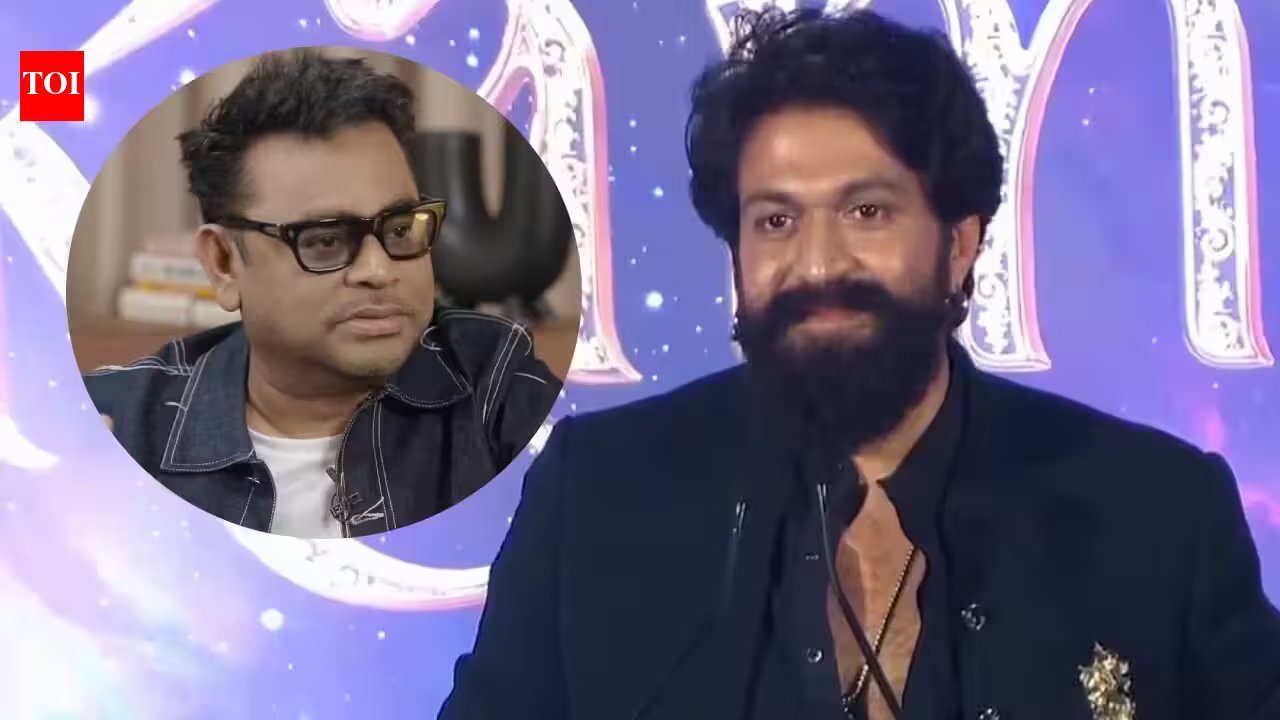
The air in Bengaluru was thick with anticipation this week as the team behind the most ambitious project in modern Indian cinema, Ramayana: Rise of a Legend, took to the stage. While the film’s massive scale and the star power of Yash—who is set to inhabit the complex, brooding persona of Ravana—would be enough to command any headline, it was a moment of profound personal reflection that stole the show. Standing before an electrified crowd, the KGF superstar didn’t just talk about the magnitude of the epic; he spoke about the surreal nature of destiny, specifically concerning the man responsible for the film’s sonic landscape: the legendary A.R. Rahman.
For Yash, this isn’t just another marquee project; it’s a full-circle moment that bridges the gap between a wide-eyed fan dancing to radio hits and a global icon shaping the future of Indian storytelling.
A Childhood Dream Synchronized with a Masterpiece
The sentiment was palpable as Yash addressed the audience in Kannada, reflecting on the long road from his formative years to his current standing in the industry. “We used to dance to A.R. Rahman’s songs when we were young,” the actor shared, a modest grin breaking through his trademark rugged exterior. “Today, he is composing music for my film.”
There is a specific kind of magic in hearing a superstar admit that their hero has become their collaborator. For a generation of Indians who came of age during the 90s and early 2000s, Rahman’s discography wasn’t just a collection of songs; it was the soundtrack to their lives. To see that same musical titan now tasked with scoring an adaptation of the Ramayana—a project that requires immense gravitas and spiritual resonance—is a testament to the weight this film carries. For Yash, the experience is clearly grounding. He isn’t just working with an industry veteran; he is working with the architect of his own youthful nostalgia.
The Bengaluru Connection: Building a Legacy
Beyond the glitz of the film’s massive production budget, Yash shared a revealing anecdote that grounded the mythic status of the Oscar-winning composer. During the production process, Rahman recounted a deeply personal chapter of his early life, one that is intrinsically tied to the very city where the event was held.
Yash relayed how Rahman spoke about his early, struggling days and the pivotal support he received from the people of Karnataka. “He told me that he built his first studio with the money given by Kannadigas,” Yash explained. According to the actor, Rahman used to travel to Bengaluru to take on part-time work, funneling every earned rupee into his dream. That humble studio, funded by the faith of local supporters, eventually became the launchpad for a career that would redefine world music.
This story serves as a poignant reminder that even the most stratospheric icons are built on the foundations of local community and grit. For the audience in Bengaluru, the revelation felt like a homecoming, tightening the bond between the music legend and the city that helped him find his rhythm.
A Global Sonic Collision: When East Meets West
Perhaps the most talked-about element of Ramayana—aside from the casting—is the unprecedented pairing of A.R. Rahman and Hans Zimmer. To have the melodic genius of India collaborating with the titan of Hollywood’s blockbuster soundscapes is a move that signals the production’s intent to play on a truly global stage.
Yash emphasized that this isn’t merely a gimmick to inflate the budget or grab headlines. Instead, he framed the collaboration as a purposeful, artistic collision of worlds. The goal is to distill the essence of the Indian epic through a lens that resonates with international audiences without sacrificing the cultural authenticity that gives the Ramayana its soul. By marrying Zimmer’s ability to create vast, atmospheric sonic architectures with Rahman’s unrivaled ability to tap into the emotional pulse of a narrative, the film is poised to set a new benchmark for cross-cultural filmmaking.
Rewriting the Rules of Epic Storytelling
Under the direction of Nitesh Tiwari, Ramayana: Rise of a Legend is being positioned as a cultural export. Yash, who has become an unlikely architect of the “Pan-India” movement, is acutely aware of the platform he stands on. During the event, he spoke at length about the necessity of bringing international talent into the Indian fold, not as a replacement for our local expertise, but as a complement to it.
“We want to reach audiences around the world,” Yash noted, his conviction clear. He envisions a future where Indian narratives are not just consumed by the diaspora but are central to the global cinematic conversation. This project represents the realization of that ambition: high-concept, high-stakes storytelling that leverages the best of what the global film industry has to offer while remaining firmly rooted in Indian identity.
The Weight of the Crown
As the event drew to a close, the focus returned to the man at the center of the storm. Portraying Ravana is a daunting task for any actor—it requires a performance that balances arrogance, tragedy, and immense intellect. For Yash, having the support of someone like Rahman—someone who understands the emotional undercurrents of the epic—seems to provide a steadying influence.
The excitement in the room was contagious, signaling that while the film has a long road of production ahead, the team has already won the battle of public imagination. Between the legendary soundtrack in the works and the sheer ambition of the script, Ramayana feels less like a movie and more like a cultural event waiting to happen. For now, the takeaway is clear: the man who once danced to Rahman’s music is now the one setting the tempo for the next great Indian epic, and if the early energy is any indication, he’s ready to make the world dance along with him.
Disclaimer: This content is auto-generated for informational purposes only.
Source: Read Original News