







As the global elite of badminton converge at the Indira Gandhi Indoor Stadium, India is not simply reprising its role as a host for the World Championships; it is celebrating an extraordinary transformation. Seventeen years after Hyderabad first welcomed this prestigious event, the tournament returns to a nation where the sport has experienced exponential growth, evidenced in its surging popularity, widespread participation, remarkable elite success, and significant commercial expansion.
The profound shift in India’s relationship with badminton is strikingly evident in the data. An impressive 43% of the Indian population actively follows badminton, while 32% engage in the sport directly, positioning it as the country’s second-most played sport and its undisputed leader among racket sports. This burgeoning interest extends to major international events; a YouGov poll revealed that for the recent Paris Olympics, badminton emerged as the most-followed sport among Indian consumers, with 21% expressing their intention to tune in. While India has long held a passionate connection to badminton, its current footprint in the sport dwarfs what it was in 2009.
India has evolved from a host nation to a pivotal market within the global badminton landscape. The country now proudly stages four BWF World Tour tournaments annually, underscoring its indispensable role in the international calendar. The India Open, for instance, in 2024 alone, captivated a potential audience of 403 million households across both broadcast and digital platforms, highlighting the sport’s immense reach and commercial viability. This financial ascendancy has been paralleled by an increasingly profound Indian presence at the sport’s highest echelons.
Historically, India’s inaugural World Championships medal was secured by Prakash Padukone in 1983. However, a truly remarkable era began in 2011, marking the start of an unbroken 15-year streak where an Indian player or pair has consistently claimed a medal at every single edition of the World Championships. This impressive run showcases the sustained excellence and burgeoning depth within Indian badminton.
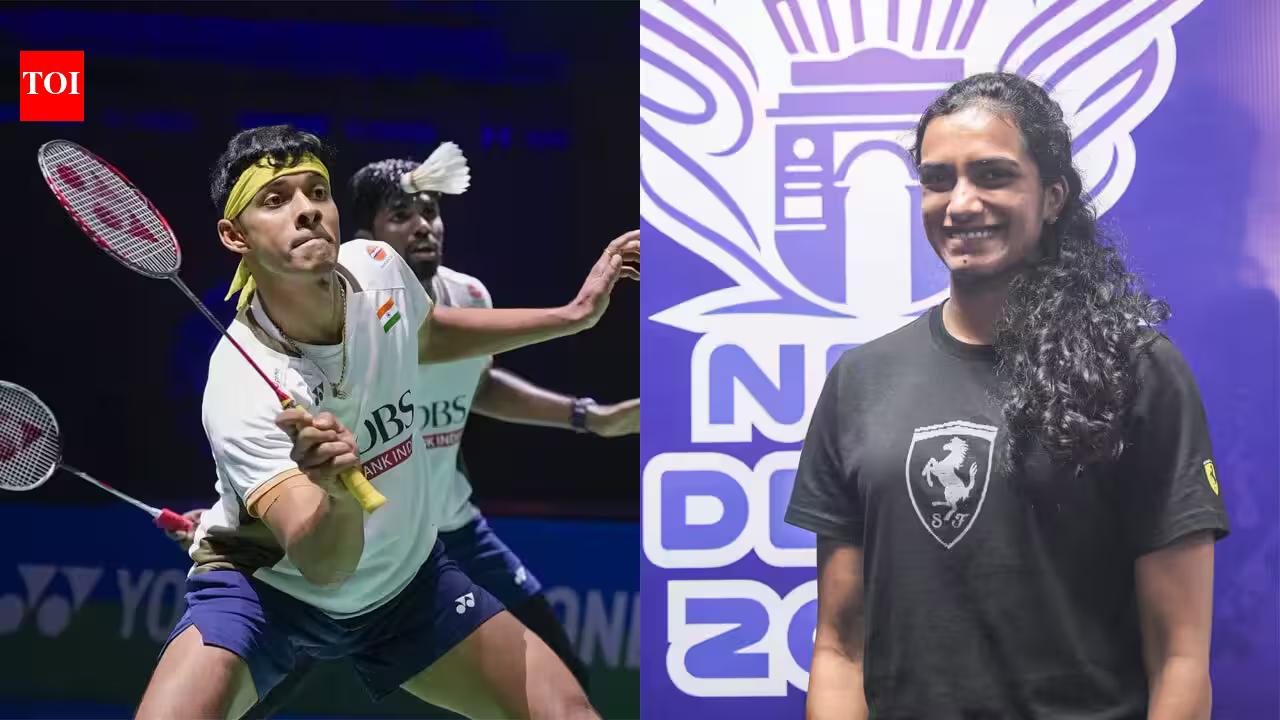
The evolving roster of Indian medallists vividly illustrates how the nation’s strength has broadened across different generations and various disciplines. Saina Nehwal, a trailblazer, earned a silver in 2015 and a bronze in 2017, paving the way for PV Sindhu, who ascended to become India’s most celebrated World Championships athlete. Sindhu clinched an astonishing five medals, including the country’s first and only gold in 2019. The men’s singles category has also seen significant success, with Kidambi Srikanth securing a silver and Lakshya Sen a bronze in 2021. HS Prannoy added another men’s singles bronze in 2023. In men’s doubles, the formidable pair of Satwiksairaj Rankireddy and Chirag Shetty have firmly established India as a dominant force, securing medals in both 2022 and 2025. These achievements are further complemented by three Olympic medals won by Indian badminton players: Saina’s bronze at London 2012, and Sindhu’s silver at Rio 2016 and bronze at Tokyo 2020, all of which underscore the nation’s ascendance in the sport.
Perhaps the most compelling indicator of the sport’s expanding ecosystem is the burgeoning field of para-badminton. India now boasts over 1,000 athletes enrolled in national training programs and 302 internationally classified players. Indian para-badminton athletes have amassed an astounding more than 1,200 international medals over the past decade, including nine Paralympic badminton medals, with gold medals achieved at both Tokyo 2020 and Paris 2024. These achievements underscore a profound and inclusive growth across all levels of the sport within the nation.
The contrast between the current landscape and the last time India hosted the World Championships is stark. Hyderabad in 2009 saw China dominate the competition, capturing four out of the five gold medals. A significant indicator of the concentrated power within the sport at that time was the fact that three of the five finals featured players or pairs from the same country. Since then, the global badminton landscape has become considerably more competitive and diversified, a transformation in which India has played a crucial role. Nations like Japan, Chinese Taipei, and Thailand, along with India, have solidified their positions as consistent contenders, while countries such as France, Canada, and Singapore have also celebrated major breakthroughs. World champions have emerged from nations that previously had a minimal presence at the sport’s apex, including Thailand, Spain, Singapore, and Malaysia. India, in particular, has transitioned from being primarily represented by individual stars to becoming a formidable multi-discipline medal contender.
The return of the World Championships to New Delhi is more than just a 17-year homecoming; it is a powerful testament to the remarkable journey of the sport within the country since the Hyderabad event. The statistics eloquently narrate this success story: a colossal participation base, an immense fan following, four annual World Tour events, a rapidly expanding commercial footprint, and an unbroken streak of Indian medals at every World Championships since 2011. Furthermore, a vibrant new generation is poised and eager to carry this extraordinary legacy forward.
If Hyderabad 2009 presented India as an enthusiastic host observing the world’s best, New Delhi 2026 confidently arrives with India firmly established as one of badminton’s major global markets and an undeniable competitive force. Seventeen years ago, India hosted the World Championships; this time, it hosts them as a bona fide badminton powerhouse, poised to inscribe yet another glorious chapter in its remarkable ascent in the world of sports.