








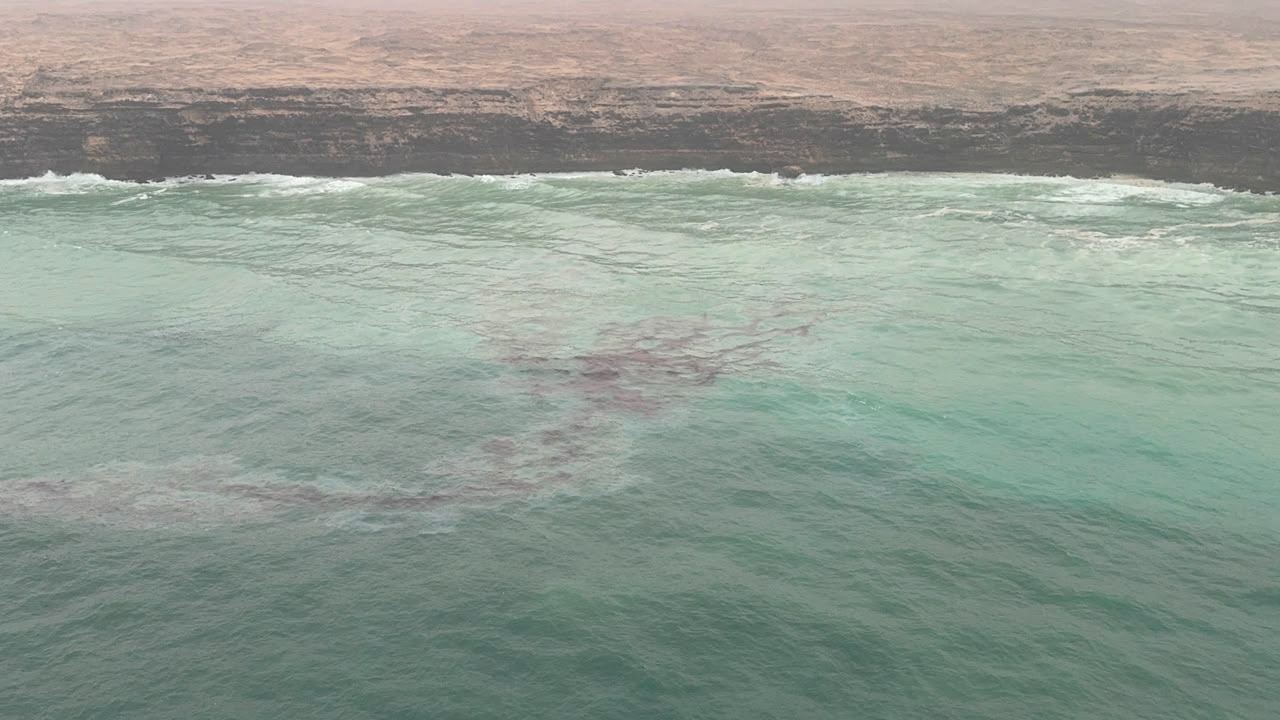
The oil spill from the grounded tanker Caroline Bezengi is expanding off Oman’s southeastern coast, posing a significant threat to remote and ecologically sensitive areas that lack adequate resources for a spill response. Oman’s environment agency issued a warning on Wednesday that the crude oil is expected to reach the shores of small settlements at Ras Madraka and Masirah Island.
The Caroline Bezengi, a sanctioned shadow fleet tanker associated with the Russian oil trade, passed through the Suez Canal and Red Sea in late May, carrying 800,000 barrels of Novorossiysk-origin crude destined for eastern markets. On June 8, while off southern Yemen, the tanker reportedly suffered damage consistent with a limpet mine blast, a method of attack previously seen in shadow fleet incidents and potentially linked to Ukrainian interests. Losing propulsion, the vessel drifted until June 30, when it ran aground on Al Qibliyah Island, a rocky wildlife sanctuary located approximately 25 nautical miles off mainland Oman. For six weeks, the tanker has remained aground without pollution abatement efforts, partially submerged and exhibiting extensive hull damage.
Independent assessments of the spill’s surface area suggest that tens of thousands of barrels have already leaked from the Caroline Bezengi. However, the majority of the cargo remains on board, and the vessel’s precarious position on a shallow, hard bottom, combined with wave action from the ongoing monsoon season, continues to grind the hull against the rocks. Such conditions in an exposed grounding significantly complicate salvage operations and escalate the potential for environmental catastrophe, as evidenced by incidents involving the Rena and Wakashio. A spokesperson for the International Maritime Organization (IMO) informed Reuters that monsoon conditions have so far prevented any salvage efforts.
Should the entire cargo be released, the resulting spill would surpass the combined scale of the Exxon Valdez and Prestige events. Greenpeace has warned that wildlife will be severely impacted, estimating that the spill currently covers approximately 600 square kilometers and is on course to affect coral reefs, seabirds, sea turtles, and the rare Arabian Sea humpback whale. Several of the remote areas now threatened by the spill are vital nesting grounds for birds and turtles. For more information on marine pollution and its effects, visit our Environment section.
External resources for pollution abatement appear to be scarce. The vessel’s owner has not responded to requests for assistance. The tanker’s insurer is an unidentified entity claiming offices in Kyrgyzstan, rather than a London-based IUMI member. Russia-linked shadow fleet tankers often operate with questionable insurance due to their inability to access Western coverage under sanctions. The International Oil Pollution Compensation (IOPC) Funds, an intergovernmental organization funded by oil cargo buyers to manage major spill costs, informed Reuters that it would not contribute to the response, citing the incident as an "act of war," which falls outside its coverage.
Source: Original Source