







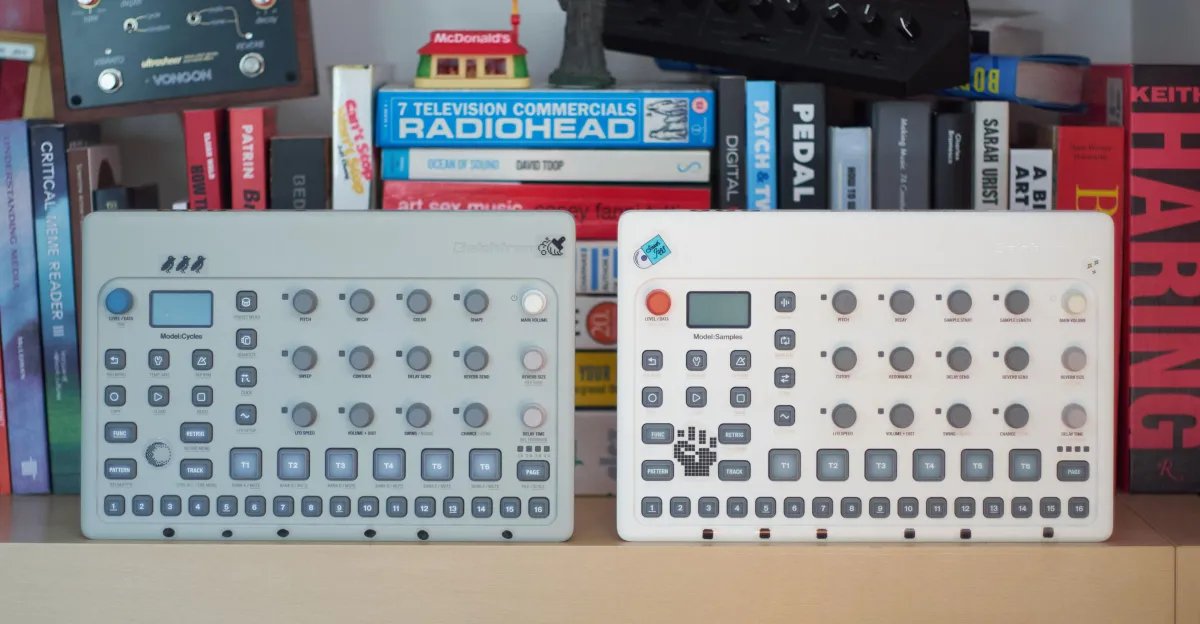
For individuals venturing into the exciting realm of electronic music production, the Elektron Model:Samples and Model:Cycles grooveboxes present themselves as highly commendable entry points. While they may not garner the same widespread attention as offerings from brands like Teenage Engineering or Telepathic Instruments, or even Elektron’s own high-end gear such as the Digitakt or Octatrack, their value for aspiring producers remains undeniable. Despite the acquisition of more sophisticated and costly instruments over time, many seasoned music makers, including the author, frequently return to the intuitive and powerful Model series.
Often, those seeking their inaugural groovebox gravitate towards more mainstream brands like Korg or Roland. The Novation Circuit Tracks also frequently appears in online discussions, particularly on platforms like Reddit, as a recommended beginner device, though some find it to be confusing and lacking in sound quality. This inclination towards more familiar names, coupled with Elektron’s historical reputation for complex workflows, often leads to the Model series being overlooked. More experienced producers who are undeterred by intricate systems might opt for powerful Elektron machines like the Digitone or Syntakt, leaving the Model lineup in an unfortunate position of being underestimated.
The core distinction between the two Model instruments lies in their sound generation: the Model:Cycles utilizes FM synthesis, while the Model:Samples, as its name implies, plays pre-loaded samples. It’s crucial to note that the Model:Samples isn’t a true sampler as it cannot record audio directly; samples must be loaded via USB.
The Model:Cycles draws its sonic capabilities from a simplified version of the powerful engine found in the Digitone, a synth renowned for its sound quality. This modern approach to FM synthesis allows the Model:Cycles to produce a diverse range of sounds, from the classic cold bells and icy pads reminiscent of iconic instruments like the DX7, to contemporary glassy keys and aggressive, turn-of-the-millennium EDM basslines.
Despite their fundamental difference in sound generation, both Model instruments share significant similarities. They are both six-track grooveboxes, equipped with six velocity-sensitive pads and an abundance of knobs for tactile control, and their physical appearance is nearly identical. Crucially, they both incorporate Elektron’s legendary step sequencer, but in a significantly less intimidating format compared to the company’s more expensive and notoriously complex offerings.
The sequencer’s functionality revolves around “trigs” and “locks.” Trigs are essentially events, typically initiating a note, while locks represent step-specific settings. This seemingly straightforward concept dramatically enhances the instruments’ capabilities beyond initial impressions. With only six tracks, producers might feel constrained, especially after allocating tracks for essential drum elements like a kick, snare, and hi-hat. However, the ingenious implementation of sound locks allows for dynamic changes to samples or presets on a per-step basis. This means that, as long as they don’t play concurrently, a kick and snare can share the same track, freeing up other tracks for hi-hats, additional percussion, basslines, and melodic elements. This exemplifies how locks significantly expand the creative possibilities of what might otherwise appear to be a limited system.
The sequencer can be used in a basic manner, such as programming a straightforward four-on-the-floor kick and a backbeat snare. However, its true power unfolds as a producer’s skills advance, enabling the creation of intricate and complex tracks. Features like trig conditions allow users to define rules for when specific steps are triggered. For instance, a trig might only activate every third loop, only when a fill button is pressed, or only if a preceding trig condition has been met. This level of control facilitates the generation of immense variation within a single 64-step pattern. These patterns can then be chained together, allowing for the creation of sophisticated and evolving arrangements that are often unattainable with other gear in this price range.
Beyond their technical prowess, the Model boxes are inherently enjoyable to use. In stark contrast to the often menu-diving intensive nature of other Elektron equipment, the Model:Samples and Model:Cycles are instantly accessible and designed with live performance in mind. Initiating a drum fill with a single button press, manipulating a knob to open a bassline’s filter, or momentarily drenching a lead melody in delay are all fluid and intuitive operations.
A particularly engaging feature is “control-all,” which, as its name suggests, enables simultaneous control over all tracks. This allows for dramatic sound manipulation, such as submerging an entire track in reverb while simultaneously increasing distortion and lowering the pitch of all samples to create a distorted, chaotic breakdown. The ability to instantly undo these changes and drop the beat again with a simple button combination encourages spontaneous experimentation and jamming, a characteristic often lacking in much electronic music gear. This emphasis on immediate, hands-on control makes the Model:Samples and Model:Cycles an absolute delight to operate.
Despite their many strengths, these instruments do possess minor drawbacks. The velocity-sensitive pads are considered mediocre by some users, and the inability to record samples directly, instead relying on USB loading, is a slight inconvenience. The lack of polyphony, where each sequencer track can only play a single note at a time, can also be a limitation for certain musical styles. However, considering their accessible price point of $349, and the fact that they can often be found used for as little as $200 on marketplaces like Reverb or Craigslist, these criticisms become less significant. Ultimately, the Elektron Model:Samples and Model:Cycles represent exceptional value in music hardware, serving as an outstanding starting point for anyone embarking on their journey into electronic music production.