







Mecca Joint Defense Agreement: A New Regional Power Dynamic and India’s Strategic Calculus
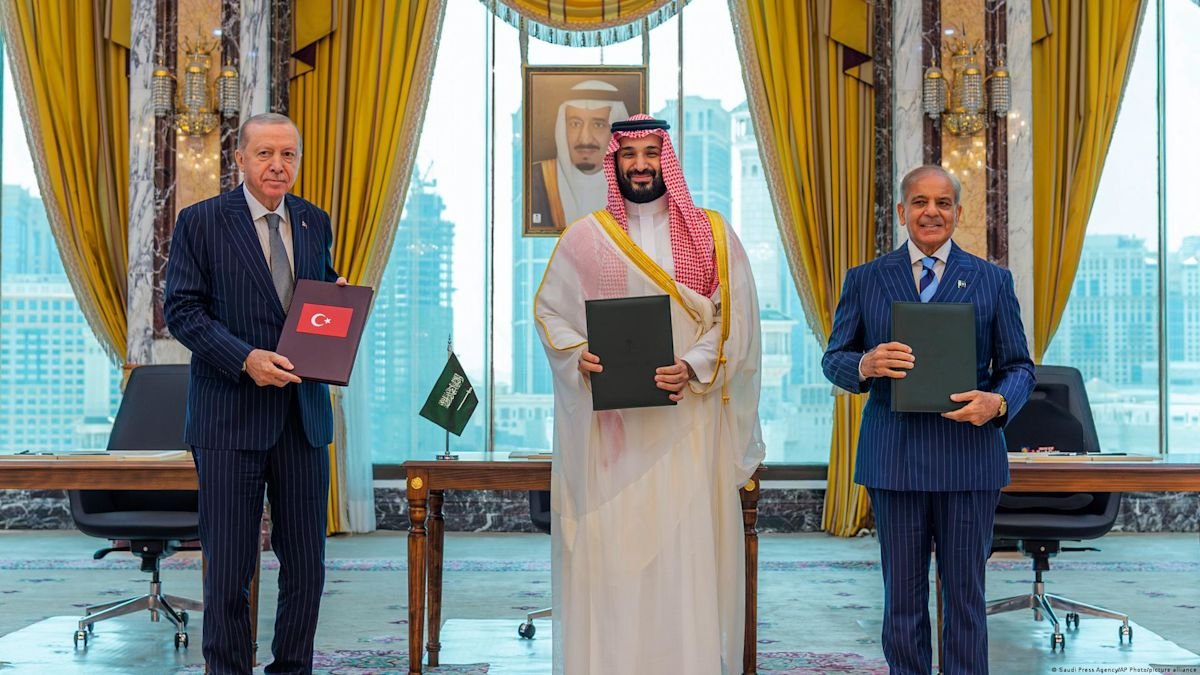
Mecca, Saudi Arabia – A significant geopolitical shift is underway in the Middle East with the signing of the "Mecca Joint Defense Agreement" on August 7th by Saudi Arabia, Turkey, and Pakistan. This trilateral pact, formalized amidst the ongoing Iran war and a re-evaluation of regional security paradigms, signals a concerted effort by these nations to bolster their collective defense and redefine their roles on the global stage. The agreement, which explicitly states that an armed attack on one member will be considered an attack on all three, has sent ripples across the international community, particularly prompting scrutiny from India, a key regional player with significant interests in the Gulf.
The motivations behind this alliance are multifaceted. Saudi Arabia, grappling with uncertainties surrounding the reliability of the US security umbrella, is actively seeking additional security partnerships to safeguard its interests. Turkey, under President Erdogan, is keen to expand its regional influence and assert itself as a formidable power. Pakistan, a long-standing military ally of Riyadh, views this agreement as an opportunity to transform its bilateral defense ties into a broader strategic engagement within the region.
While the agreement presents itself as a new formalization, it largely codifies existing relationships. Pakistan has a decades-long history of training and assisting Saudi forces, and its defense cooperation with Turkey has steadily grown through military exchanges and joint ventures. However, the elevation of these bilateral ties to a trilateral defense pact introduces a new dimension to regional security.
India’s Perspective: Concern or Indifference?
For India, the immediate question revolves around the potential for its archrival, Pakistan, to gain a deeper strategic footprint in a region vital to Indian economic and energy security. The Gulf and the Red Sea are crucial arteries for India’s trade and energy imports, making any shifts in their security landscape a matter of profound interest to New Delhi.
Indian analysts offer a mixed assessment of the pact’s implications. Some believe it will have minimal immediate impact on the regional balance of power. Others, however, see it as a cautionary signal for India to strengthen its security presence in a region where its economic interests have expanded considerably.
Ajay Bisaria, former Indian High Commissioner to Pakistan, expressed skepticism regarding the pact’s long-term efficacy. "The Mecca pact is not worth the paper it’s written on," Bisaria told DW. He argues that it merely reiterates the signaling value of the previous Saudi-Pakistan defense pact, aimed at Iran, the US, and Israel, rather than fundamentally altering regional dynamics. Bisaria does not anticipate the agreement to significantly sway Saudi Arabia’s position in the event of a future India-Pakistan crisis, suggesting Saudi Arabia would more likely offer mediation services than directly intervene militarily. "For India, this is a pact to be monitored, not one to be unduly concerned about," he advised.
Tara Kartha, a former member of India’s National Security Council Secretariat, echoes this sentiment, urging India not to overstate the agreement’s significance. "India doesn’t need to be overly concerned about the Mecca pact. Saudi Arabia and Turkey hardly see us as a strategic competitor or an ‘enemy’," she stated. Kartha points out that much of the Pakistan-Turkey military relationship, including joint development projects like the Kaan aircraft, predates this agreement. While acknowledging that increased funding for Pakistan’s defense budget through the pact could be a concern, she believes the core dynamics remain largely unchanged.
Potential Challenges and India’s Response
Despite some assessments of limited immediate impact, a key concern for India is the long-term strengthening of Pakistan’s military capabilities through Saudi resources and Turkish technology. The potential for enhanced access to Turkish drones, missiles, and electronic warfare systems for Pakistan could fundamentally alter India’s western security calculations.
Beyond the India-Pakistan rivalry, the Mecca pact also prompts questions about India’s robust relationship with Saudi Arabia, encompassing energy, investment, trade, and political ties. Riyadh’s diversification of security partnerships, analysts suggest, does not necessarily imply a preference for Pakistan over India.
Harsh Pant, Vice President at the Delhi-based Observer Research Foundation, advises India to respond cautiously but not passively. He suggests that the diverse strategic interests of the three member states might limit the pact’s cohesion. However, he emphasizes that New Delhi should leverage its existing strong ties with Riyadh to deepen security, intelligence, and economic cooperation. Such bilateral engagement could prevent Pakistan’s new role from translating into disproportionate influence in the Gulf.
Randhir Jaiswal, spokesperson for India’s Ministry of External Affairs, confirmed that New Delhi is actively examining the pact’s implications from the perspective of India’s national security and regional peace and stability. He reiterated India’s commitment to safeguarding its national interests and taking all necessary measures.
A Wake-Up Call for India?
Strategic expert C. Raja Mohan views the trilateral agreement as a significant "wake-up call" for India, highlighting a potential imbalance in its approach to the Gulf. Mohan argues that while India’s economic dependence on the region has grown substantially, its security presence has remained comparatively limited. "For India, this should be a warning that New Delhi cannot remain primarily a diplomatic and economic player in the Gulf. It needs greater military reach in the region and deeper, practical security and defense relationships with individual Middle Eastern countries," Mohan asserted.
He sees a widening mismatch between India’s burgeoning economic interests and its somewhat constrained military-security footprint in the region. Mohan advocates for India to deepen defense and intelligence cooperation with Saudi Arabia and other Gulf states, bolster maritime security in the Arabian Sea and Red Sea, and closely monitor Pakistan-Turkey military collaboration.
Ultimately, Mohan interprets the Mecca Joint Defense Agreement as an effort by Saudi Arabia to diversify its options and hedge against the perceived unreliability of the US security umbrella. It underscores the ongoing challenges for Arab states in building a truly dependable regional security system. For India, the pact, while not an immediate existential threat, serves as a powerful reminder to proactively reassess and strengthen its strategic engagement in a dynamically evolving Middle Eastern landscape. The full implications of this new alliance will undoubtedly unfold over time, shaping the future of security and power dynamics in a critical global region.