







Russia Issues Stark Warning to UK Over Drone Supplies to Ukraine, Threatening "Consequences"
Moscow, Russia – Russia has delivered a sharp rebuke to the United Kingdom, warning of severe "consequences" for its continued supply of drones to Ukraine, which Moscow claims have been instrumental in long-range attacks deep within Russian territory. The escalating rhetoric signals a deepening rift between the two nations and raises concerns about a potential broadening of the conflict.
The Russian embassy in London issued a strongly worded statement on Monday, asserting, "London’s actions will inevitably carry consequences for which it will have to answer. The deeper its involvement in the conflict and the greater its support for Kyiv’s terrorist machinery, the higher the price it will pay." The embassy further accused the UK of "deliberately opting for an escalation of the Ukraine crisis, while hypocritically professing a desire for peace," labeling the UK as an "accomplice and co-perpetrator of the bloody crimes and terrorist attacks."
These warnings come amidst growing reports that Ukrainian forces have been utilizing long-range drones to strike critical Russian targets, including oil refineries and logistics facilities. An investigation by The Times newspaper in the UK specifically identified drones produced by two British companies as being involved in several of these attacks.
Former Russian Deputy Foreign Minister Andrei Fedorov, speaking to the BBC on Tuesday, suggested that the "consequences" could extend to the possibility of direct attacks. Fedorov claimed that many military experts advising the Kremlin believe NATO would not respond forcefully to such actions, with Donald Trump, whom he described as "still the keeper of the keys in NATO," preventing a strong alliance reaction. "Trump will not allow NATO to answer," Fedorov stated.
The Russian warning follows a significant drone assault on Moscow overnight Monday into Tuesday, with the city’s mayor reporting at least 637 drones launched towards the Russian capital, of which 197 were intercepted by Russian air defenses. This incident underscores the increasing frequency and scale of drone attacks targeting Russian territory.
Despite Russia’s escalating threats, the UK government remains defiant. Prime Minister Andy Burnham, responding to the Russian embassy’s warning, reiterated the UK’s unwavering support for Ukraine, stating that the government would continue to support Ukraine "100 percent" against "this illegal war led by [Russian President] Vladimir Putin." Burnham emphasized the UK’s consistent position of providing support for Ukraine’s self-defense, asserting, "We are not fair-weather friends." Work and pensions minister Lilian Greenwood further affirmed the UK’s resolve, telling Sky News, "The Russians should be clear that our resolve remains completely steadfast in backing our friends in Ukraine and providing them with the equipment that they need."
UK’s Extensive Military Aid to Ukraine
The United Kingdom has been a leading provider of military assistance to Ukraine since the onset of the conflict in February 2022, consistently warning Moscow that providing long-range weaponry would be seen as an escalation.
In April, Britain’s Defence Ministry announced its largest-ever drone package for Ukraine, comprising at least 120,000 drones, including "thousands of long-range strike drones, intelligence and reconnaissance drones, logistics drones and maritime capabilities." This was followed by a £752 million ($996m) funding package in June, slated to deliver 150,000 drones to Ukraine by the end of 2026. This significant commitment followed a meeting in June 2025 between Ukrainian President Volodymyr Zelenskyy and then-Prime Minister Keir Starmer, where the two nations agreed to co-produce long-range drones.
Beyond drones, the UK has been pivotal in equipping Ukraine with advanced weaponry. It was the first country to pledge modern Western battle tanks, the Challenger 2 models, to replace Ukraine’s aging Soviet-era fleet. Furthermore, the UK was the first to supply Kyiv with Storm Shadow long-range cruise missiles, enabling Ukrainian forces to strike Russian positions behind the front lines. The UK has also funded and supplied thousands of air-defense missiles, anti-armor missiles, artillery systems, and armored and support vehicles, alongside providing crucial training to Ukrainian soldiers.
UK-Made Drones in Action: Targeting Russian Facilities
Ukrainian attacks inside Russia have intensified this year, primarily targeting military industrial and energy facilities. The objective is to disrupt Moscow’s oil revenues funding the war and to make Russian citizens feel the impact of the ongoing conflict.
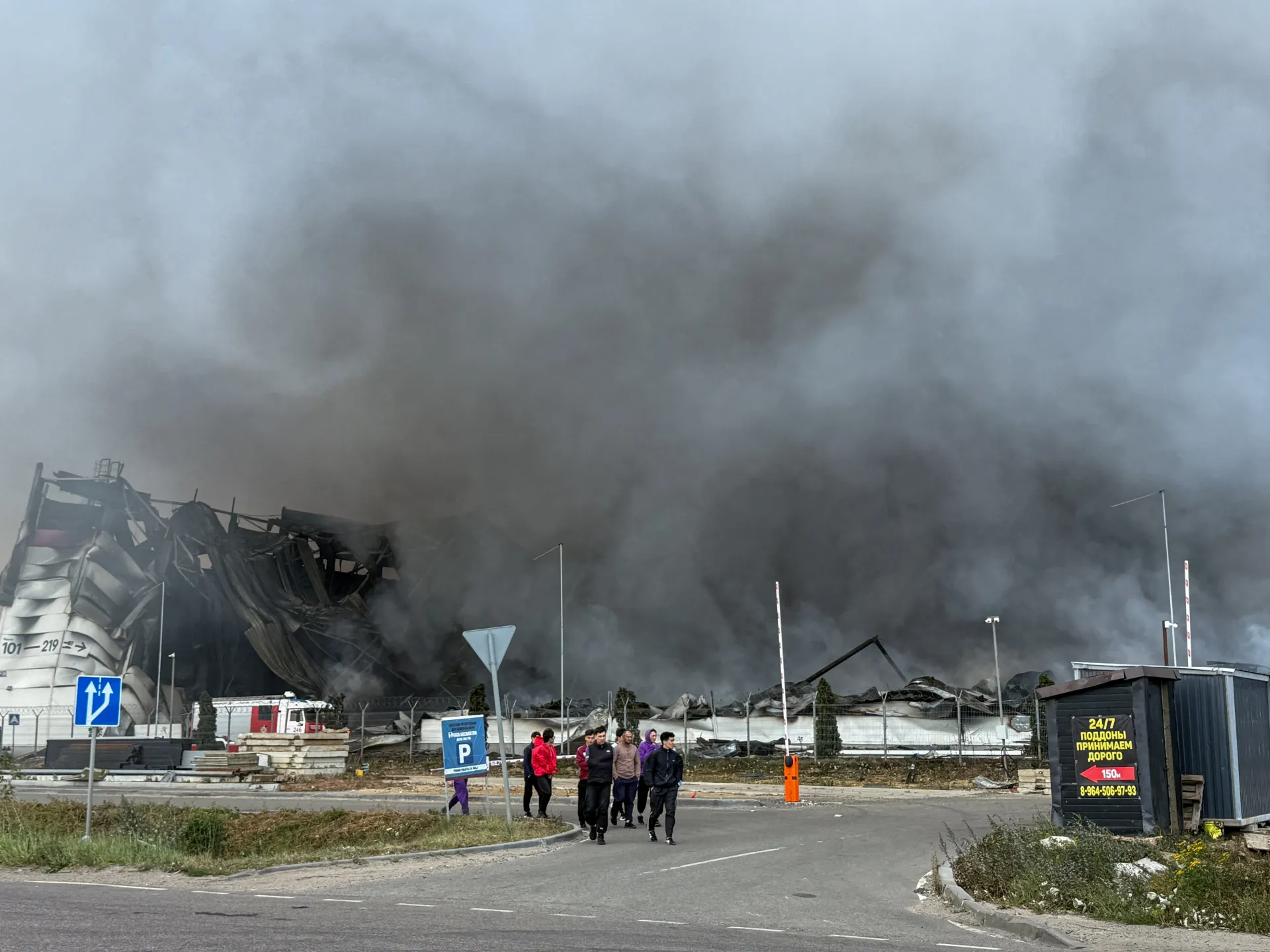
Maria Zakharova, spokeswoman for the Russian Ministry of Foreign Affairs, specifically cited the use of drones containing UK components or configurations in attacks on targets within Russia, including the Kamensky Plant, a key Russian military-industrial facility in the Rostov region. The BBC also reported that these drones have struck military and industrial targets, including refineries and warehouses belonging to the Russian retail giant Wildberries, often referred to as Russia’s Amazon.
In recent weeks, Ukraine has repeatedly targeted Wildberries warehouses, alleging they are used to supply Russian military components – a claim denied by both the company and the Kremlin. A warehouse in Yekaterinburg, 2,087km (1,297 miles) from the Ukrainian border, was hit last week, forcing the company to limit orders. Another Wildberries warehouse east of Moscow was damaged in a drone assault on Tuesday.
The war’s physical manifestations have also become increasingly prominent in the Russian capital region. On Saturday night and early Sunday, Ukraine launched one of its largest aerial assaults on Russia, involving 822 drones that resulted in seven fatalities. Moscow’s regional governor described the event as "one of the most massive drone attacks in recent memory."
Unpacking Russia’s "Consequences" and the Risk of Broader Confrontation
While the UK government has affirmed its unwavering support for Ukraine, Russia’s embassy in London has not explicitly detailed the nature of the "consequences" London might face. Speculations range from cyberattacks and other forms of hybrid warfare to direct military targeting of British interests overseas. The European Union and the UK recently announced coordinated sanctions against Russia following reports of digital sabotage across Europe, highlighting the existing tension in the digital sphere.
However, Russia’s threat also raises a more profound question: would President Putin be willing to directly attack Britain, thereby risking intervention from NATO?
Fedorov’s comments to the BBC on Tuesday suggest a dangerous line of reasoning within Moscow. He indicated that Russia might "interpret that the UK is part of the war," and therefore "Russia has the right to strike the country which is supporting Ukraine." Fedorov added, "Nothing can be excluded, from my personal point of view," noting that some in Moscow believe "all the enterprises that are linked to Ukraine could be struck by Russia because they are legal targets."
Crucially, Fedorov highlighted the belief among some military experts in Moscow that "Russia can strike the UK and NATO will do nothing. Trump will not allow NATO to answer." He suggested that given the current instability within NATO, the alliance might only issue a statement or invoke Article 4, which involves consultations among member states when security is threatened, rather than Article 5, which mandates collective defense in response to an armed attack against any member.
This sentiment underscores the perceived vulnerability of the transatlantic alliance, particularly given former President Trump’s past criticisms and strained relationship with NATO, which he has accused of not doing enough to support the US-Israel war on Iran. The potential for a less unified NATO response, as envisioned by some in Moscow, could embolden Russia to take more aggressive actions against Western nations supporting Ukraine.
The current geopolitical climate, coupled with Russia’s increasingly explicit warnings and the UK’s steadfast commitment to Ukraine, sets the stage for a period of heightened tension and uncertainty, with the specter of broader confrontation looming large.