








India’s Global Identity Rooted in Service, Not Power: RSS Chief Mohan Bhagwat
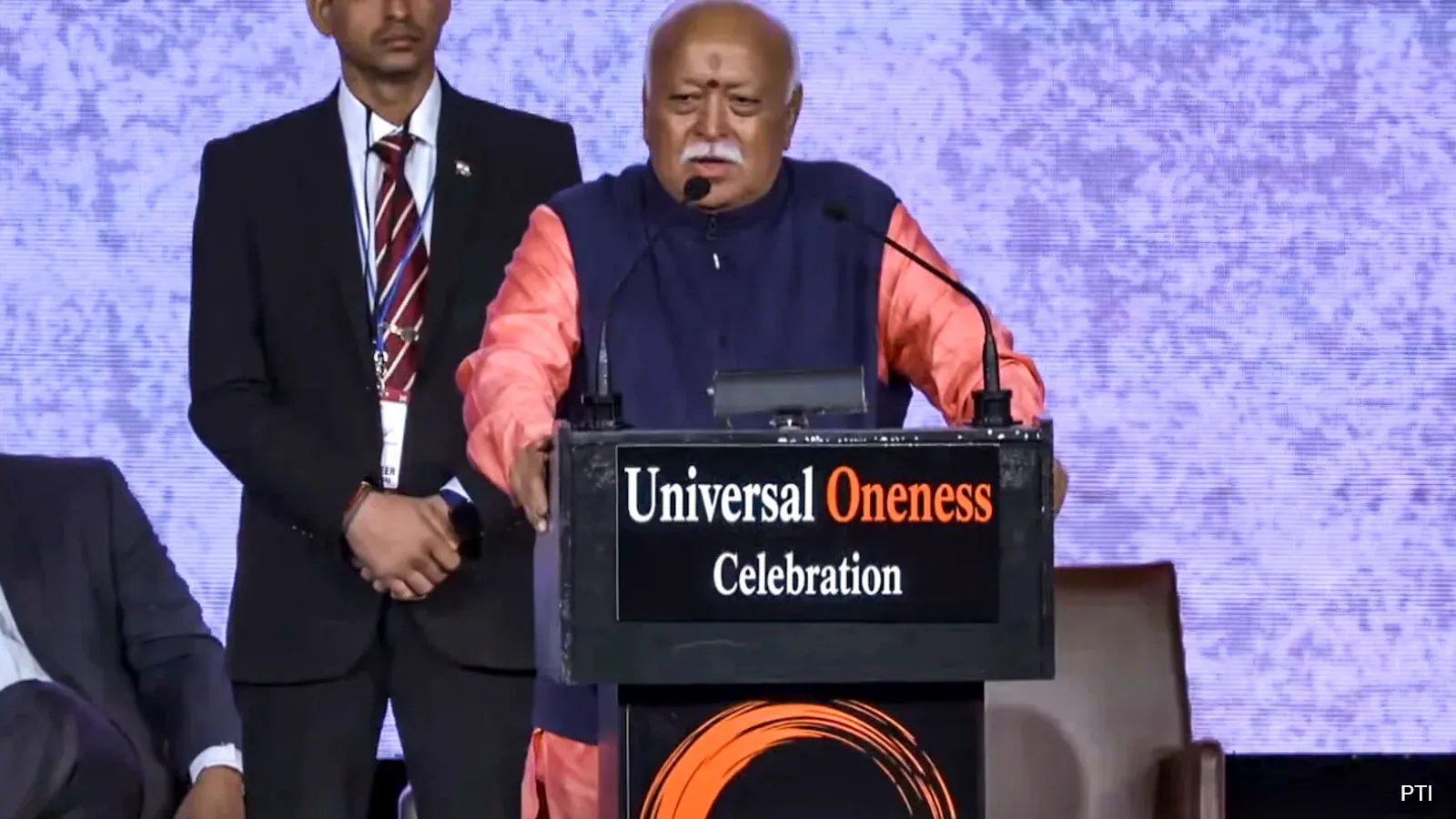
Toronto: Addressing a distinguished audience at the “Hindu Vishwa Bandhu – Embrace the World in Friendship” gathering in Toronto, Rashtriya Swayamsevak Sangh (RSS) Chief Mohan Bhagwat articulated a vision of India that prioritizes humanitarian service over geopolitical dominance.
Bhagwat emphasized that the nation’s historical and civilizational identity is defined by its role as a “Vishwaguru” (world teacher) rather than a “Mahashakti” (superpower). According to the RSS leader, India’s “civilizational DNA” is fundamentally grounded in universal friendship, the provision of sanctuary, and an intrinsic respect for diverse cultures.
A Legacy of Refuge and Assistance
Refuting the notion that India’s global influence stems from imperialistic expansion, Bhagwat pointed to the nation’s long history of welcoming those fleeing persecution. He highlighted that throughout history, followers of various faiths—including Muslims, Christians, Jews, and Parsis—have historically sought and found peaceful refuge in India.
“One may call Bharat a superpower, but it was not one. It served the world and by its own character, it became ‘Vishwaguru’, not Mahashakti,” Bhagwat stated.
To illustrate this ethos, he drew upon both historical and contemporary examples, such as the Maharaja of Jamnagar, who famously provided shelter to Polish refugees during the Second World War. Moving to modern times, he cited the recent evacuation efforts in the Middle East, where Indian military aircraft rescued not only its own citizens but also nationals from seven other countries, underscoring a consistent tradition of humanitarian aid.
Spreading Knowledge, Not Dominance
The RSS chief contrasted India’s global outreach with the historical patterns of empire-building. He noted that while Indian ancestors traveled extensively—crossing the Himalayas and navigating seas to reach Southeast Asia—they did so to share knowledge in fields such as astronomy and Ayurveda rather than to conquer land.
“Our ancestors… conquered no country. They gave knowledge, ayurveda, imparted civilizational values,” Bhagwat said, noting that even today, the influence of these ancient values remains a source of respect for Indians abroad.
Defining the Hindu Identity
During the event, Bhagwat addressed the philosophical essence of the term “Hindu,” clarifying that it transcends narrow linguistic, religious, or sectarian constraints. He argued that the philosophy is rooted in the concept of Vasudhaiva Kutumbakam—the ancient Indian belief that the entire world is one family.
“When I say Hindu, the word Hindu cannot be defined by any specific language, through any specific worship, or through any living style,” he noted, adding that the tradition encourages people to celebrate diversity. “We have to serve, accept, respect this diversity because it is an expression of unity.”
Bhagwat concluded by reinforcing that in the Indian worldview, while external appearances may vary, the essential reality of humanity remains one. This belief, he argued, transforms the act of serving others from a mere choice into a fundamental duty, providing a path toward enduring global harmony and personal satisfaction.
The address served as a call to embrace a global outlook, asserting that India’s Vishwaguru status is a direct result of its selfless service to the global community.