








Satellite Radar Reveals Secrets of Emperor Penguin Colonies Through the Antarctic Winter
For decades, tracking the movements and well-being of emperor penguins in the harsh, dark, and frozen Antarctic winter has been a daunting challenge for scientists. However, a new study has unlocked a breakthrough by demonstrating that these iconic birds can be monitored year-round using Sentinel-1 synthetic aperture radar (SAR) imagery.
While researchers have traditionally relied on optical satellite imagery—which is limited by daylight and frequent cloud cover—the use of radar signals provides a vital new tool for remote sensing. Because radar instruments like those on Sentinel-1 are active sensors, they do not require sunlight and can penetrate the persistent darkness of the polar winter.
A New Perspective from Space
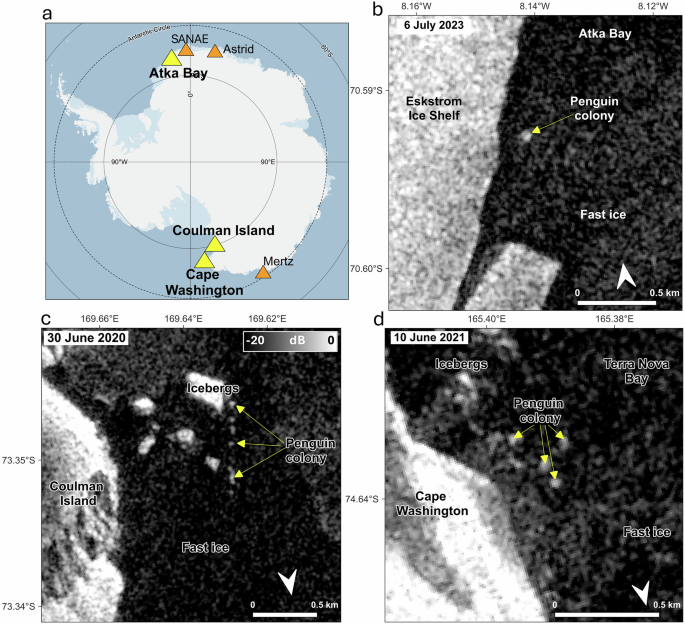
The research highlights that emperor penguin colonies are clearly observable in radar imagery due to the way their bodies scatter radar waves. Researchers believe the penguins’ physical presence—standing over a meter tall—creates a “roughness” on the flat expanse of the sea ice that reflects the radar signal back to the satellite, distinguishing the colony from the background ice.
“Significantly, and unlike medium-resolution optical imagery, the winter SAR signal from the colony on fast ice appears to be from the colony itself,” the researchers note. By observing these unique radar signatures, the team was able to track colony movements across three key locations: Atka Bay, Coulman Island, and Cape Washington.
Unraveling Colony Behavior
The study revealed complex patterns in how these flightless birds navigate their changing environment. During the harsh winter months, colonies were found to be relatively stationary, typically staying within 0.5 kilometers of their initial location. This stability is critical as the birds huddle to protect their eggs and chicks from extreme temperatures.
However, as spring arrives, the behavior shifts. The colonies become increasingly mobile, with some groups traveling over 5 kilometers from their winter sites. Perhaps most interestingly, the study observed colonies consistently moving onto ice shelves—a behavior that researchers suggest is likely a response to shifting wind patterns rather than just ice stability.
Implications for Conservation
This ability to conduct year-round remote sensing of penguin populations is more than just a technological feat; it is a vital step toward protecting the species. As the Antarctic climate enters a potential “new state” with record-low sea ice levels, the stability of the fast ice that emperors rely on for breeding is increasingly threatened.
By providing a way to monitor colonies during the winter and summer alike, this radar-based approach allows scientists to better understand how emperor penguins respond to environmental disruptions, such as early ice breakouts or glacier calving. Such data will be instrumental in designing effective conservation strategies, including the potential establishment of exclusion zones to protect these vulnerable populations as they adapt to a rapidly changing continent.
While the current findings rely on manual analysis, the researchers believe these results pave the way for automated, machine-learning-driven monitoring. As new radar missions like the NASA-ISRO NISAR satellite come online, the capacity to protect and understand these “kings” of the Antarctic will only continue to grow.