








Tesla’s “Robotaxi” Gamble: A High-Stakes Vision Facing an Uphill Battle
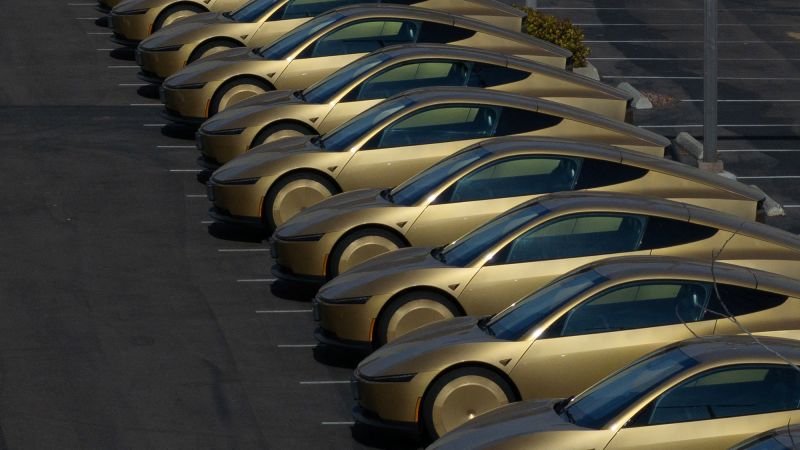
For Tesla, the future is increasingly pinned to a single, ambitious vision: the autonomous robotaxi. As the company prepares for a high-profile event showcasing its Cybercab service, it faces a stark reality. Despite the glitz of Hollywood unveilings and years of prototypes appearing in cities across the United States, Tesla is playing catch-up in a sector where profitability remains a distant, elusive goal for even the most established players.
Behind the Curve: Tesla vs. Waymo
Elon Musk has staked much of Tesla’s long-term value on the success of the Cybercab. Last year, the CEO predicted that his robotaxi service would be accessible to half of the American population by 2025. He has also told investors that Tesla would eventually produce more Cybercabs annually than all other vehicle models combined.
However, the reality on the ground tells a more modest story. Tesla currently offers unsupervised rides in just six cities across Texas and Florida. Furthermore, in terms of sheer scale, the gap between Tesla and its primary rival, Alphabet’s Waymo, is cavernous.
Waymo has aggressively expanded its footprint, providing 500,000 paid driverless rides per week as of March. The company currently operates in 14 cities and has logged over 220 million miles of driverless travel since 2018. In contrast, Tesla reported in July that it had completed just 380,000 cumulative miles of unsupervised robotaxi rides—less than 0.2% of Waymo’s total.
The Economic Roadblock
Beyond the technological hurdles of achieving full autonomy, Tesla faces a looming question of financial viability. Experts suggest that the challenge is shifting from “can it be done?” to “is it worth it?”
“Investing is about betting on the future,” says Bryant Walker Smith, an expert in autonomous vehicles and a scholar at Stanford Law School. “Tesla is very good at selling that future. But at least with respect to automated driving everywhere and all the time, the company has been far less successful at actually delivering it.”
Even if the technology is perfected, operational costs remain a significant concern. Unlike a human rideshare driver who absorbs the costs of vehicle maintenance and cleaning, autonomous fleet operators must cover those expenses themselves.
“How do you compete with a Uber driver who might be making under minimum wage to provide and maintain their own car, to clean it and do all the other services that Waymo and Tesla may ultimately have to pay real people real money to do?” Smith added.
A Murky Path to Profitability
Financial transparency in the industry remains thin. Neither Waymo nor Tesla has reported profits from their autonomous ventures. Waymo continues to operate under Alphabet’s “Other Bets” division, which reported $3.9 billion in losses during the first half of this year against $793 million in revenue.
Tesla argues it possesses a distinct cost advantage. By relying exclusively on cameras rather than the expensive suite of lasers and radar (LiDAR) used by Waymo, Tesla believes its hardware will eventually be cheaper to manufacture and maintain. However, that cost-cutting approach has also made it more difficult to clear the regulatory hurdles required to scale operations.
As Anthony Townsend, author of Ghost Road: Beyond the Driverless Car, points out, the industry faces both a regulatory maze and a saturated market. Whether consumers are willing to abandon personal car ownership in favor of robotaxis remains an open question, and for investors, the path to a sustainable business model remains obscured.
With Tesla’s stock facing pressure—closing Wednesday down more than 20% year-to-date—the pressure is mounting for Musk to prove that the Cybercab is more than just a futuristic promise, but a viable, profitable machine.