








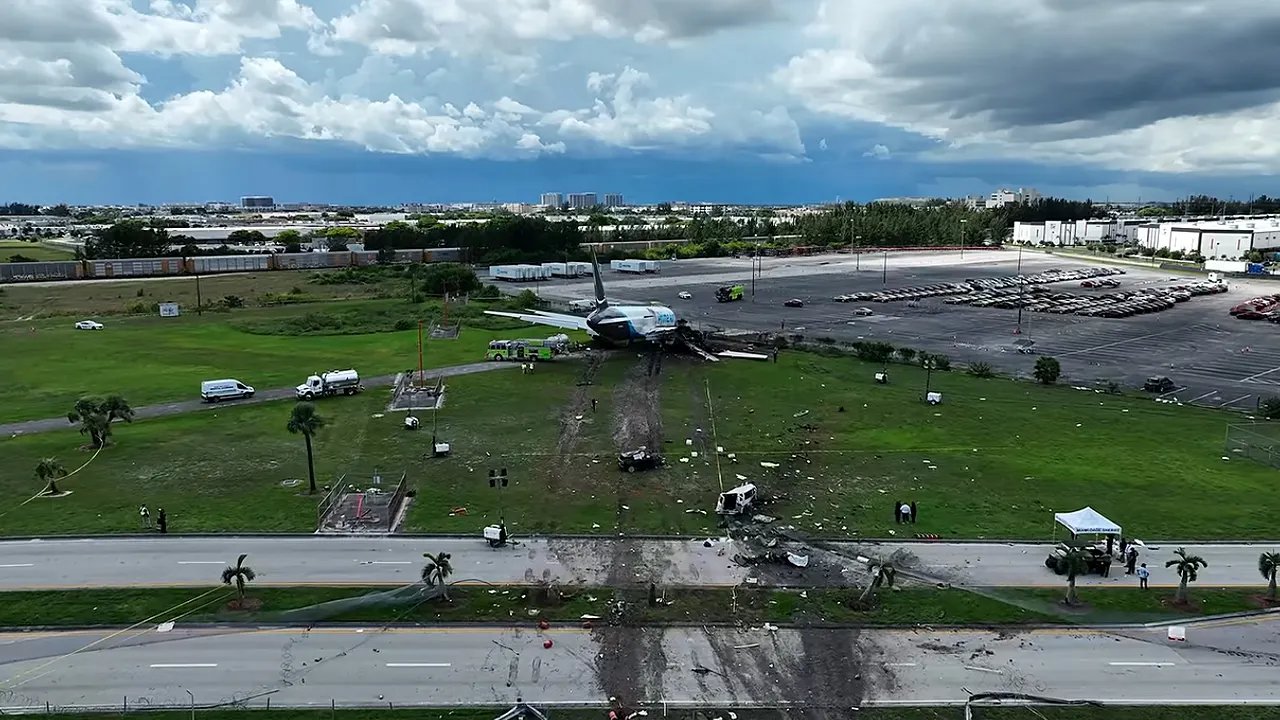
The widow of a victim involved in the recent, catastrophic Amazon cargo jet crash at Miami International Airport has launched a high-stakes legal battle, filing a wrongful death lawsuit that targets the e-commerce giant and its aviation partners. The complaint, centered on the tragic loss of Yoel Rodriguez Naranjo, alleges that systemic negligence and operational failures, rather than an unavoidable accident, led to the disaster that claimed five lives.
### Allegations of Pilot Error and Operational Negligence
The lawsuit outlines a series of critical lapses occurring during the final moments of the flight. According to the court filings, the Boeing 767 involved in the crash landed significantly outside of the safety parameters. Specifically, the pilots allegedly touched down 4,000 feet past the intended target zone while traveling at speeds roughly 46 mph faster than recommended.
Perhaps most damaging to the operators is the claim that the flight crew failed to perform a necessary nose-flare maneuver—a standard procedure used to slow an aircraft’s rate of descent. Furthermore, the suit suggests that the flight crew ignored clear signs of an unstable approach, failing to initiate a go-around or declare an emergency despite hazardous thunderstorm activity in the immediate vicinity. The resulting overrun sent the massive jet 1,300 feet past the runway, where it struck vehicles and ignited.
### NTSB Findings and Technical Failures
The legal action follows preliminary reports from the National Transportation Safety Board (NTSB), which confirmed that the aircraft’s critical braking systems—including thrust reversers and speed brakes—failed to deploy during the landing sequence. While the NTSB continues to lead a comprehensive investigation into the exact cause of the crash, the plaintiff is using these technical details to support claims that the aviation operators were knowingly flying an unairworthy aircraft.
The suit also levels serious accusations against the flight operator, 21 Air, claiming that the company fostered a toxic and dangerous work environment. Allegations include the suppression of safety complaints from former employees, the systemic exhaustion of flight crews, and the hiring of pilots with insufficient language proficiency or training.
### Amazon’s Defense and the Broader Tech Logistics Ecosystem
As Amazon faces mounting scrutiny, the company has distanced itself from the direct operation of the aircraft. In a statement, the retail titan emphasized that it operates within standard industry practices, utilizing independent, FAA-certified carriers to manage its cargo fleet. Amazon maintains that the responsibility for safety programs, maintenance schedules, and crew training rests with these individual air carriers, which are subject to rigorous oversight by federal regulators.
The situation has sparked a wider conversation about the risks associated with the rapid expansion of “last-mile” and air logistics. In the modern era of on-demand commerce, tech companies like Amazon increasingly rely on complex webs of third-party contractors to maintain their lightning-fast delivery promises. This incident highlights the vulnerabilities inherent in the digital-physical supply chain, where the drive for speed often intersects with complex regulatory and mechanical requirements.
As the litigation proceeds, the case will likely focus on whether the level of oversight provided by massive logistics platforms—which leverage AI-driven demand forecasting and automated logistics—is sufficient to account for the safety protocols of their contractors. For now, both Atlas Air, the owner of the 32-year-old freighter, and 21 Air, the operator, have expressed their condolences while cooperating with the ongoing NTSB probe. The legal fallout will serve as a stark reminder of the human cost that can occur when the pressures of global supply chain logistics collide with human and mechanical error.
Disclaimer: This content is auto-generated for informational purposes only.
Source: Read Original News