








The Unspoken Verse: Revisiting Dharmendra’s Lost Childhood Love Before the Partition
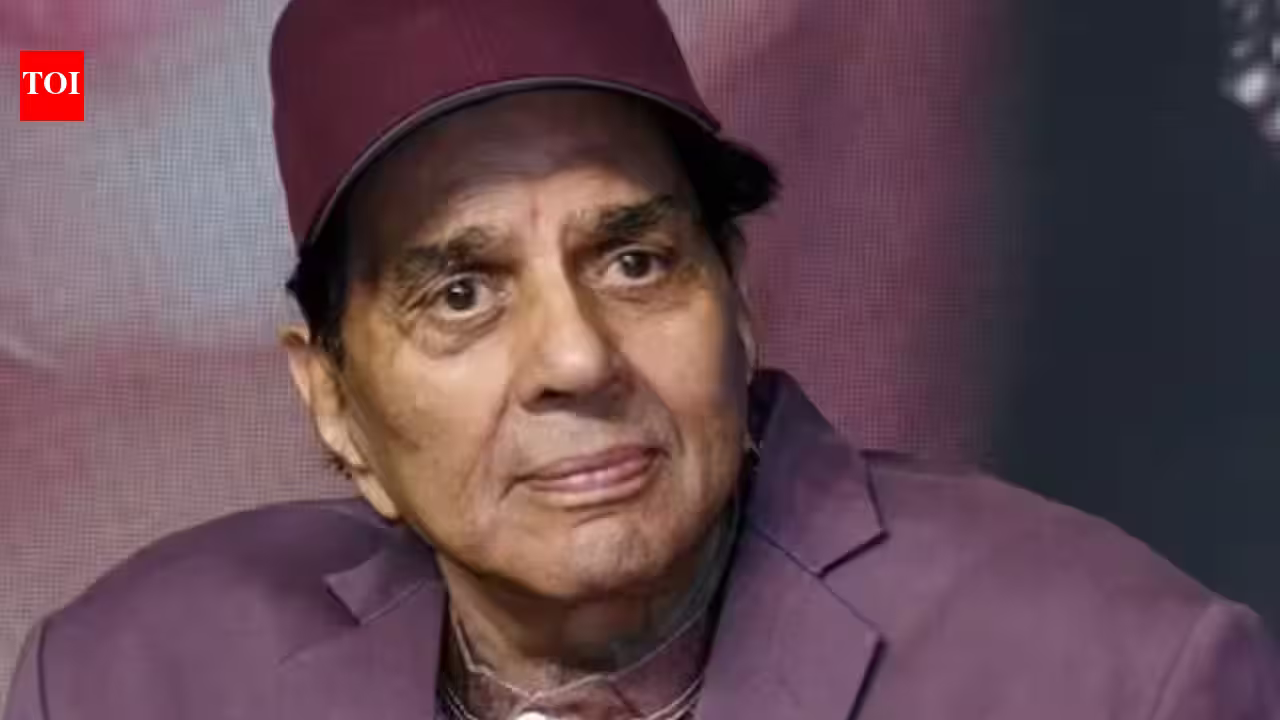
In the glitz and glamour of Bollywood, we often view our legendary stars through the prism of their greatest romances. For Dharmendra, that often means the enduring, headline-grabbing narrative of his life with Hema Malini. Yet, beneath the veneer of the “He-Man” of Hindi cinema and the towering screen icon, there exists a quiet, fragile history—a story of a sixth-grade boy in pre-Partition Punjab, pining for a girl named Hamida.
Long before the flashbulbs of Mumbai or the sprawling fame of his cinematic career, Dharmendra lived a life defined by the simple, dusty joys of a Punjabi village. It was there, amidst the innocence of early schooling, that the actor experienced his first brush with the bittersweet nature of affection—a memory so potent that it remained etched in his heart long after the world he knew was fractured by the trauma of 1947.
A Boy’s Silent Longing in Pre-Partition Punjab
Dharmendra’s recollection of his childhood during an appearance on Salman Khan’s Dus Ka Dum provided a rare, unscripted glimpse into the man behind the persona. Accompanied by his son, Bobby Deol, the veteran actor spoke with a vulnerability that caught many off guard. It was a simpler time, a landscape of school bells, dusty courtyards, and the quiet, heavy atmosphere of a classroom where a young Dharmendra found himself spellbound by the daughter of his schoolteacher.
Hamida was older, a student in the eighth grade, while young Dharam was still finding his way in the sixth. In the hierarchy of a schoolboy’s world, she was a figure of distant grace. He never approached her with grand declarations; he was too shy, too paralyzed by the sheer weight of his budding emotions. Instead, his love lived in the silence of stolen glances and the desperate, quiet wish to simply exist within her orbit. As he famously recounted, “Hum man hi man mein kehte rehte the. Thandi aahen bharte rehte the.” (I used to keep expressing my feelings silently in my heart. I would sigh with longing, while the person I loved had no idea.)
The Poem That Captured Innocence
Often, the most profound artistic expressions come from the ache of unfulfilled desire. For the young Dharmendra, the inability to speak his mind forced his emotions onto paper. During the show, when the topic of his early school days surfaced, Bobby Deol nudged his father to share a poem he had penned decades ago.
Dharmendra obliged, reciting verses that transported the audience back to a world that no longer exists. The poem wasn’t complex, but it was raw—a confession of a sixth-grader wanting to sit next to the girl who had captivated his young imagination. Reciting the lines, the actor’s voice carried the weight of a man reflecting on his own ghost. He spoke of the “maasoom” (innocent) nature of his age and the simple, burning desire to be near the daughter of his teacher. It was a window into a time when his world was small, contained, and entirely focused on the brief, fleeting moments Hamida walked through his life.
When History Shattered a Childhood Romance
The tragedy of this budding affection was not just the typical cruelty of unrequited love, but the sweeping, violent tide of history. The Partition of 1947 stands as a scar on the collective consciousness of the subcontinent, and for young Dharmendra, it was the abrupt end of his quiet, schoolboy romance.
As families were uprooted and lives were scattered, Hamida and her family moved across the newly formed border into Pakistan. Dharmendra’s family remained in India. In the chaos of mass migration and the closing of borders, the two were never reunited. There were no dramatic goodbyes or promises of a future; there was only the permanent silence of a separation enforced by geography and political upheaval. Yet, the memory remained. While his career would eventually take him to heights unimaginable, this lost chapter of his youth served as a permanent reminder of how fleeting, and how fragile, the things we hold dearest can be.
Fumbling Through the Smiles of Youth
One of the most touching aspects of Dharmendra’s recollection was the awkwardness that defined his interactions with Hamida. He remembered her smile—a casual, perhaps even pitying, gesture that would send the young boy into a frenzy of nerves. He would approach her, only to lose his train of thought the moment she looked his way.
He recalled how she would try to comfort him, mistaking his melancholy for exam-related anxiety. “Udaas mat ho, Dharam. Abhi waqt hai, tere imtihaan mein sab theek ho jaayega,” (Don’t be sad, Dharam. There’s still time; everything will be fine in your exams) she would tell him before walking away. Left alone in the hallway, watching her fade into the distance, Dharmendra would be struck by his own inability to communicate. He would stand there, paralyzed by the mystery of her, wondering what he had meant to say and why he couldn’t find the words. It is a universal feeling—the agony of youth where every missed opportunity feels like a tragedy of epic proportions.
Legacy of the “He-Man”
Dharmendra’s life, much like his films, was a sprawling epic. From his days as a struggling actor to his status as the “He-Man” of Hindi cinema, he redefined the archetype of the leading man. Yet, his legacy is not just one of action sequences and blockbuster hits. It is a legacy of humanity.
By sharing the story of Hamida, Dharmendra invited us to look past the star-studded resume. He reminded us that beneath every legend is a person who once sat in a classroom, heart pounding, waiting for a smile from a girl who was destined to vanish into history. Following his passing in November 2025 and the release of his final project, Ikkis, in early 2026, these stories carry even more weight. They serve as a final bridge between the icon we saw on screen and the boy from a Punjabi village who, once upon a time, wrote a poem about his first love and kept it in the vault of his heart forever.
Disclaimer: This content is auto-generated for informational purposes only.
Source: Read Original News