






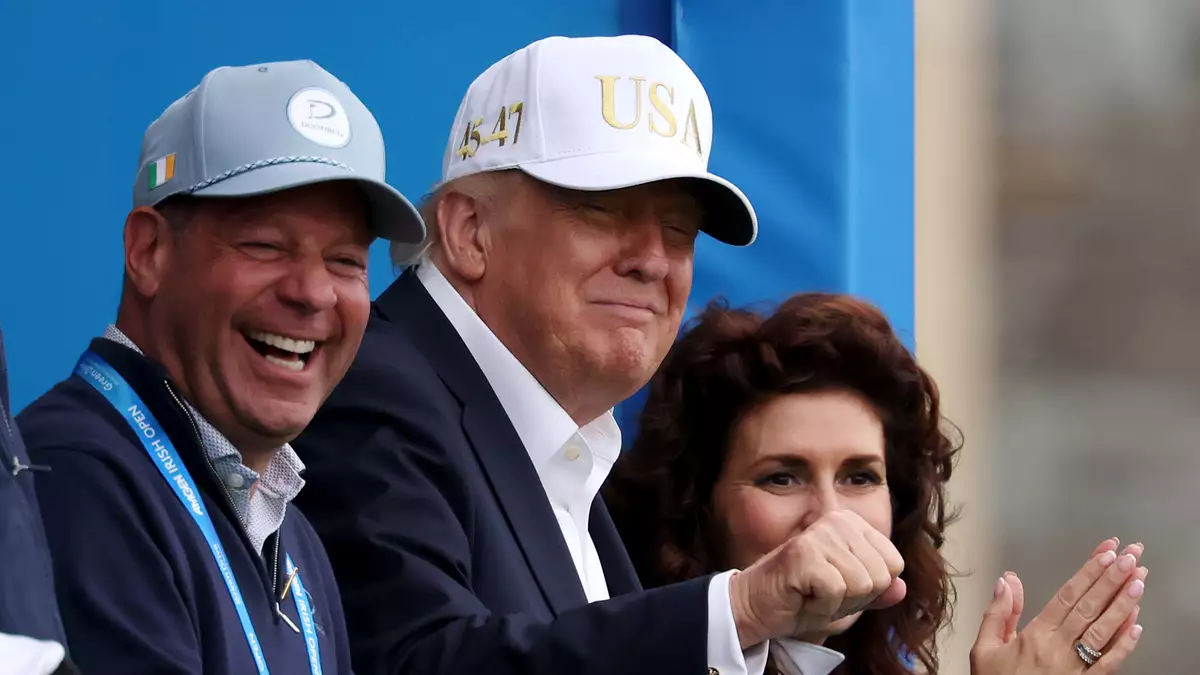
President Donald Trump’s weekend visit to Ireland has become a flashpoint of international diplomacy and local tension. Following his attendance at commemorations marking the 25th anniversary of the 9/11 attacks in the United States, the former president arrived in Dublin for a series of high-level meetings and a concluding appearance at the 2026 Irish Open, which is being held at his own golf course in Doonbeg.
The visit has unfolded against a backdrop of significant public discourse, as thousands of protesters gathered across the country to demonstrate against his arrival.
A Diplomatic Push for Unity
The primary focus of Trump’s political agenda in Dublin was a bilateral summit with Irish Prime Minister Micheál Martin. While the two leaders touched upon traditional pillars of the U.S.-Ireland relationship, including trade and economic cooperation, the conversation took a sharp turn into the sensitive territory of Northern Irish politics.
In a move that caught many observers by surprise, Trump publicly advocated for the reunification of Ireland. Addressing the press following his meeting with Martin, Trump characterized a united Ireland as a potential outcome that would be “fantastic” and stated his belief that it is “going to happen eventually.” These remarks arrived at a delicate time; only days prior, British Prime Minister Andy Burnham had explicitly rejected calls for a new referendum regarding Northern Ireland’s constitutional status within the United Kingdom. Trump’s endorsement of a unified Ireland is expected to add layers of complexity to ongoing discussions between London and Dublin regarding post-Brexit stability.
Escalating Tensions and Domestic Protest
The visit was met with a robust security operation, with the Gardaí enforcing road closures and high-security cordons around key locations in Dublin and the west of the country. Despite these precautions, opposition to the trip was palpable. In the capital, an estimated 10,000 protesters marched to voice their disapproval, specifically citing U.S. foreign policy and the humanitarian crisis in the Israel-Gaza conflict as primary points of contention.
Similar protests occurred in Doonbeg, where demonstrators gathered near the tournament site. Trump’s meeting with Irish President Catherine Connolly also reflected the heightened state of tension. Known for her vocal stance on Middle Eastern affairs, President Connolly reportedly used the meeting to deliver a stern message from the Irish public, criticizing U.S. policies regarding the region and calling for an end to what she described as the “normalization of war and genocide.”
Economic Ties and Future Engagements
Despite the volatile atmosphere, Trump was keen to emphasize the durability of the U.S.-Ireland partnership, repeatedly describing the bilateral relationship as “stronger than ever.” Throughout the trade-focused segments of his visit, he sought to reassure Irish officials that the U.S. remains a committed economic ally, regardless of his stance on the island’s internal political geography.
The security presence, characterized by a heavy Garda presence, highlights the extreme measures required to facilitate such a high-profile visit. Looking ahead, it appears this will not be the last time Irish authorities face such challenges. Reports indicate that Trump has confirmed his intent to return to the country next year, specifically to attend the 2027 Ryder Cup. For now, the Irish government continues to manage the fallout of a visit that has highlighted the persistent friction between the U.S. executive and local public sentiment.
Disclaimer: This content is auto-generated for informational purposes only.
Source: Read Original News