






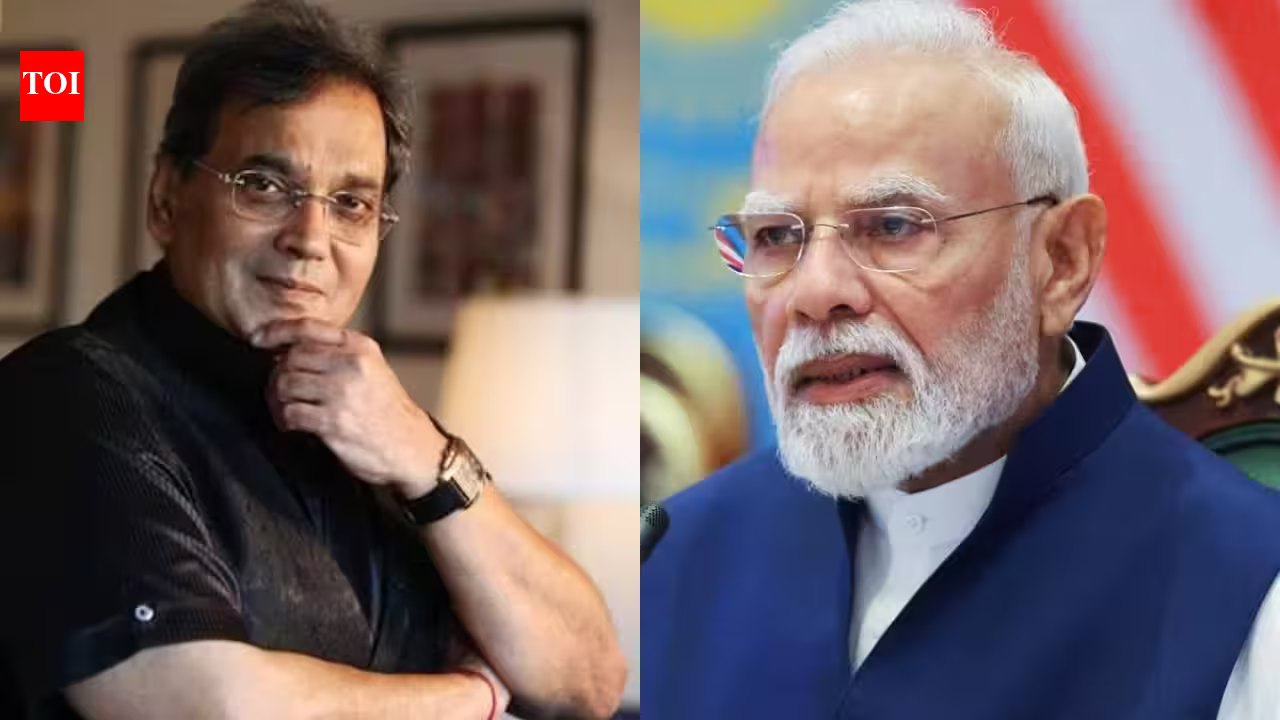
The landscape of Indian cinema is paved with the legacies of legendary filmmakers, and few carry the weight of “Showman” status quite like Subhash Ghai. Known for the grand scale of his storytelling and his quintessential Bollywood sensibilities, Ghai has spent decades crafting narratives that resonate with the national ethos. However, his latest production isn’t taking place on a soundstage; it is unfolding on the geopolitical stage.
In a recent, highly vocal display of admiration, the veteran filmmaker turned his attention to Prime Minister Narendra Modi’s recent presence at the BRICS 2026 summit. Taking to Instagram, Ghai bypassed the usual industry chatter to offer a glowing endorsement of the Prime Minister’s international diplomacy, framing it through a lens of human connection rather than just cold, hard policy.
The Diplomacy of a Smile
“Only he can do it. Love begets love,” Ghai wrote, accompanying his post with a series of photographs showing PM Modi engaging in warm, high-level interactions with world leaders at the BRICS summit. To the casual observer, international summits are often dry affairs of protocol, ink-signed agreements, and stiff handshakes. Yet, Ghai’s perspective serves as a reminder that the “soft power” of a leader’s demeanor—their ability to project warmth and build personal rapport—is a potent currency on the global stage.
Ghai’s commentary suggests that he views the Prime Minister’s international stature not merely as a result of policy prowess, but as a byproduct of a certain optimistic magnetism. “Smiles create positive energies,” he continued, arguing that history consistently proves that positivity can terminate negativity and foster human growth. For a man who has built a career on the emotional resonance of celluloid, Ghai seems convinced that the Prime Minister is effectively “directing” India’s global narrative with the same principles of engagement he might use in a blockbuster film: unity, positivity, and a touch of charismatic grace.
A History of Mutual Respect
This recent praise isn’t a sudden pivot for the Karma and Saudagar director. The relationship between Ghai and Modi traces back to a time long before the latter took his seat at the Raisina Hill. The filmmaker has often reflected on his interactions with the then-Chief Minister of Gujarat, providing a glimpse into a side of Modi that the public rarely sees: the facilitator of creative ambition.
Just last month, the industry buzz centered on a clip released by the ‘Modi Story’ account, in which Ghai recounted a pivotal 2009 meeting in Gujarat. At the time, Ghai was navigating the complex, often suffocating world of Indian bureaucracy to get his dream project—the Whistling Woods International film school—off the ground. He arrived in Gujarat prepared to battle red tape, expecting the usual long-winded delays that plague large-scale infrastructure projects. Instead, he found an unexpected partner in the Chief Minister.
The Breakfast That Changed the Blueprint
As Ghai recalls, the meeting was surprisingly informal, starting over a breakfast at the Chief Minister’s residence. It was here that the filmmaker laid out his vision: a premier institute where education wouldn’t be limited to textbooks and rigid curricula but would incorporate an “artistic dimension” necessary for holistic human development. Ghai argued that cinema, when taught with rigor, could play a vital role in nation-building and personal growth.
In most executive suites, such an idealistic pitch might be met with polite dismissal or a request for a follow-up meeting three months down the line. According to Ghai, Modi’s response was immediate and remarkably direct: “What do you need?”
That singular, no-nonsense question became the catalyst for the development of the institute. When Ghai explained the logistical requirement for land accessible to commuting teachers, the machinery of the state began to move with a speed that startled the veteran director. It is this memory of swift, decisive action that informs Ghai’s current admiration for the Prime Minister. To him, the man who cleared the path for a film school in 2009 is the same man who is now commanding respect among global premiers at BRICS 2026.
Cinema as a State-Building Tool
The connection Ghai draws between filmmaking and statecraft is subtle but persistent. By emphasizing that cinema is a “human” medium, he aligns himself with a growing movement of Indian artists who believe that the country’s cultural influence—its cinema, its philosophy, and its stories—is an extension of its political reach.
When Ghai poses the rhetorical question, “Why should we not be proud of our Prime Minister?” he is articulating a sentiment felt by many in the entertainment industry who have seen a shift in how India is perceived abroad. Whether it is through the global success of Indian content or the increasing visibility of the Prime Minister at major international forums, the narrative of “New India” is being curated with a keen eye for optics and soft power.
The Critic vs. The Patriot
In an era where political discourse is often fractured, public figures like Subhash Ghai stepping into the arena to offer unabashed praise is always going to generate noise. Some may view it as star-struck sycophancy, while others will see it as a sincere recognition of a leader’s growth. However, looking at the trajectory of Ghai’s career—one defined by epic stories of love, duty, and national pride—his alignment with Modi feels consistent with his own cinematic legacy.
Ghai’s Instagram post isn’t just a congratulatory note; it’s an endorsement of a specific style of leadership. He sees in Modi a leader who understands that global respect is built on the foundation of personal relationships. As the BRICS summit concludes and the cameras turn elsewhere, the “Showman” seems satisfied. For Subhash Ghai, the show is going exactly the way it should: with positivity, with unity, and, above all, with a smile that bridges continents.
Disclaimer: This content is auto-generated for informational purposes only.
Source: Read Original News