








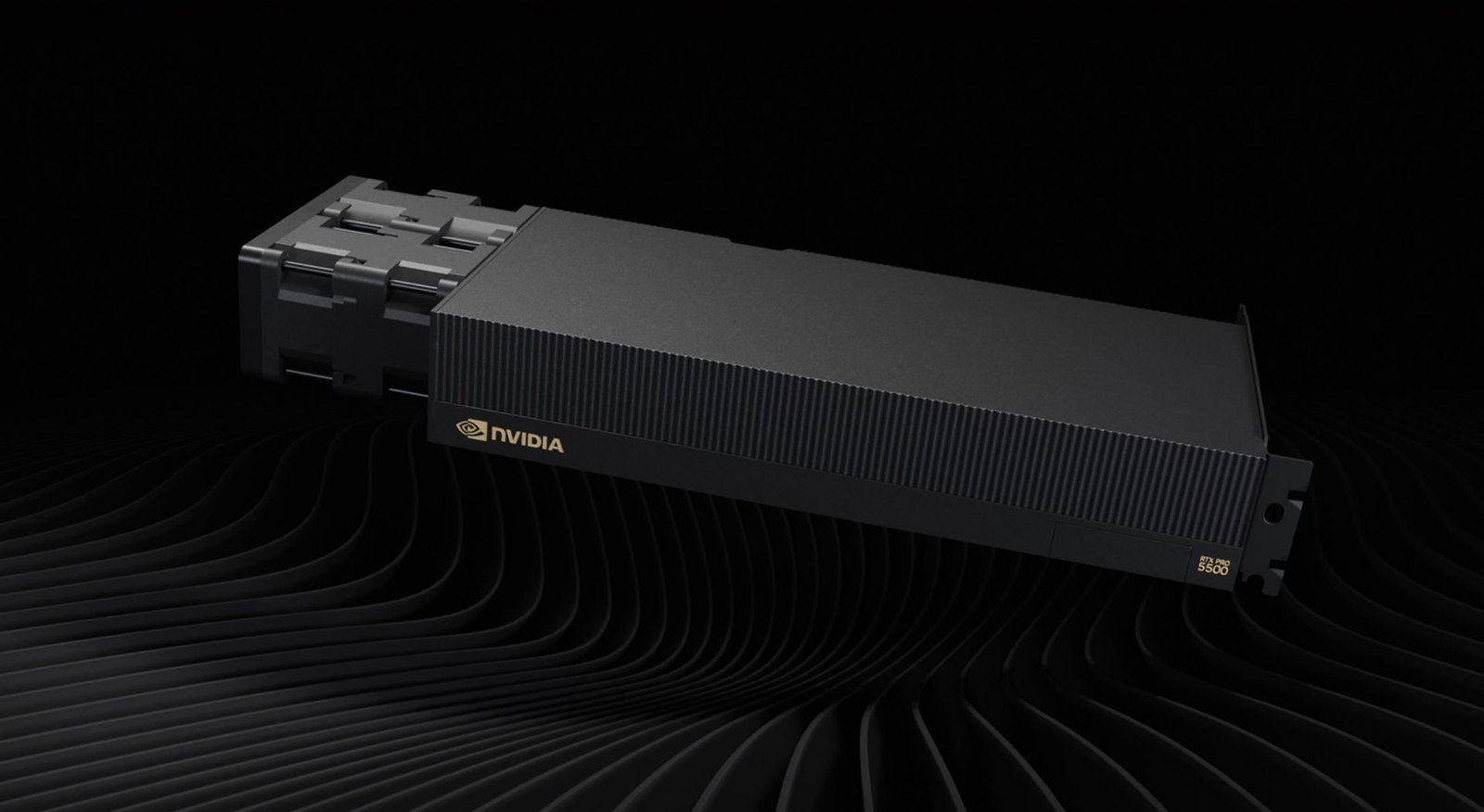
NVIDIA continues to expand its Blackwell architecture portfolio with the introduction of the RTX PRO 5500 Workstation Edition, a high-performance graphics card engineered to meet the intensive demands of modern professional environments. As part of the Blackwell PRO family, this unit occupies a significant tier between mid-range workstation hardware and the flagship solutions, offering a balanced combination of massive memory capacity and substantial computational throughput.
Architectural Foundations and Core Specifications
The RTX PRO 5500 is powered by the GB202 GPU silicon, the same robust architecture found in the highest-tier consumer and professional offerings. One of the most notable technical specifications is the inclusion of 21,760 CUDA cores. This core count matches the desktop flagship, the GeForce RTX 5090, positioning the 5500 as a formidable tool for tasks requiring high parallel processing performance.
The card operates with a Thermal Design Power (TDP) of 600W, a necessary allocation to sustain the computational load required for complex simulations and rendering tasks. Beyond the primary compute cores, the chip integrates 9th Generation NVENC and 6th Generation NVDEC engines, which are vital for professional workflows involving high-resolution video encoding and decoding. The inclusion of these specialized engines ensures that the hardware can handle media-heavy pipelines without offloading the primary compute units.
Advanced Memory Configuration and Bandwidth
A standout feature of the RTX PRO 5500 is its 84 GB GDDR7 memory capacity. This allocation represents a significant leap over previous iterations, specifically providing 36 GB more than the RTX PRO 5000 Blackwell model. The memory utilizes a 416-bit bus interface, an architectural choice that dictates its performance ceiling.
This bus width allows for a memory bandwidth reaching 1,398 GB/s, reflecting an effective memory speed of approximately 27 Gbps. While this remains slightly below the 1.792 TB/s bandwidth offered by the top-tier RTX PRO 6000, it provides a substantial upgrade for professional users who need to load massive datasets into VRAM. By utilizing a configuration that likely relies on a mix of VRAM die densities, NVIDIA has managed to reach this specific 84 GB target, effectively bridging the gap between standard professional cards and extreme-scale enterprise hardware.
Deployment and Enterprise Functionality
The hardware is specifically designed for integration into rack-mounted workstation environments. To facilitate this, the card is compatible with both air-cooled and liquid-cooled thermal solutions, allowing IT departments to select the cooling profile that best fits their specific infrastructure. This flexibility is essential for data centers and studios where thermals and noise management are primary concerns when scaling GPU power across a facility.
Furthermore, the RTX PRO 5500 supports Multi-instance GPU (MIG) functionality. This feature is particularly relevant for enterprise teams because it allows a single physical GPU to be partitioned into distinct instances. In the case of the 5500, a user could divide the card into two logical instances, each with access to 42 GB of memory. This capability allows organizations to maximize hardware utilization by running concurrent workloads on a single card, effectively doubling the deployment density of their workstation infrastructure.
Impact on Professional Workflows
The target application for the RTX PRO 5500 is broad, covering sectors such as agentic AI development, real-time physical simulation, and high-fidelity graphics rendering. Agentic AI, which requires models to interact with environments and make decisions, benefits significantly from the high VRAM capacity, as it allows for larger, more complex models to reside entirely within the GPU memory.
For engineering and scientific simulations, the card’s compute throughput allows for rapid iteration. By centralizing power within a rack-mounted setup, teams can share resources effectively across a network. The addition of four DisplayPort 2.1b outputs further ensures that the card is capable of driving high-resolution, multi-monitor professional setups, which are standard in creative and analytical fields.
Conclusion and Market Positioning
While price points for the RTX PRO 5500 have not been publicly finalized by all vendors, the precedent set by the 48 GB RTX PRO 5000, which retails for approximately $9,200 USD, suggests that the 5500 will represent a significant capital investment. However, for firms that rely on the reliability of the NVIDIA workstation ecosystem, the combination of 84 GB of GDDR7 memory and the Blackwell architecture provides a future-proofed solution for demanding workloads.
By scaling the GB202 silicon into this specific configuration, NVIDIA addresses the precise needs of engineers and designers who require more memory than standard workstation cards allow but do not necessarily require the absolute maximum capacity offered by the top-of-the-line RTX PRO 6000. As artificial intelligence and simulation technologies continue to evolve, the RTX PRO 5500 serves as a critical bridge, providing the memory-intensive headroom necessary to sustain high-level productivity.
Disclaimer: This content is auto-generated for informational purposes only.
Source: Read Original News