






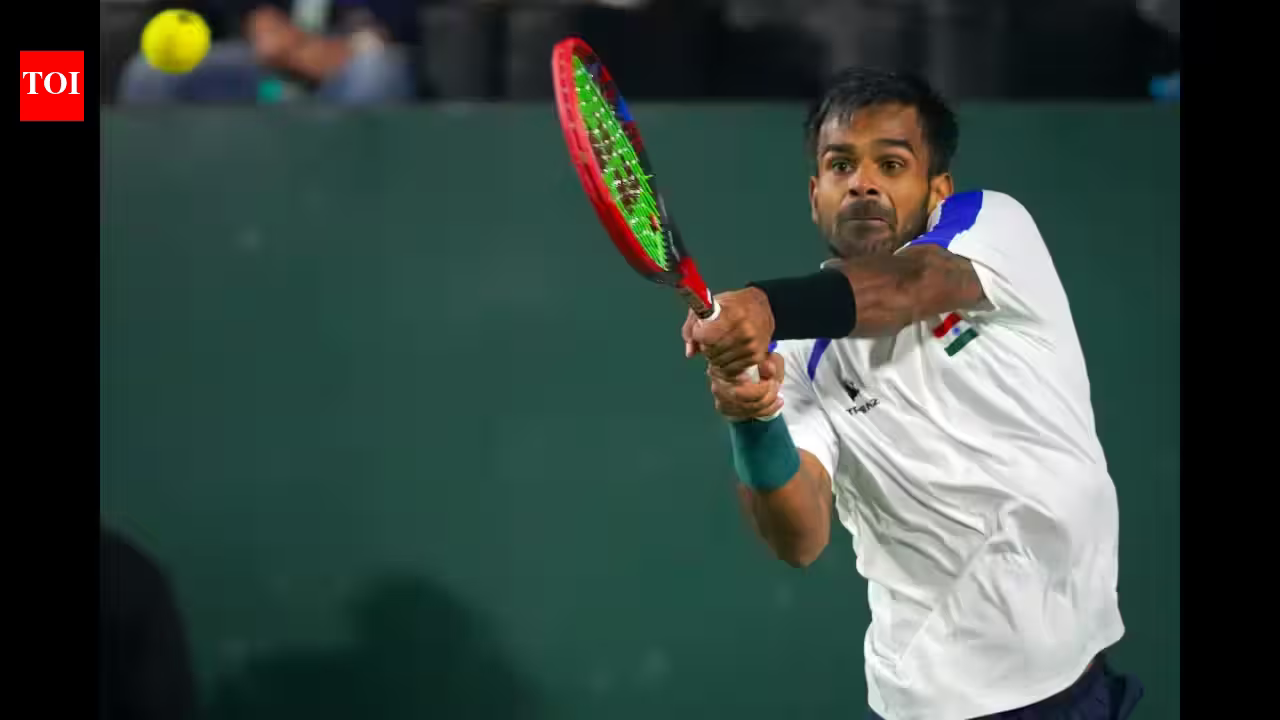
REGENERATION defines the current chapter of Sumit Nagal’s professional tennis journey. As India’s top-ranked singles player, the 29-year-old has endured a 2026 season defined by physical adversity, ranking fluctuations, and, most importantly, a profound psychological transformation. Sliding to No. 247 in the world rankings, Nagal is no longer defined by the cold arithmetic of ATP points, but by a newfound commitment to the process over the outcome.
The season began with the kind of momentum-crushing misfortune that can derail a professional athlete. Following a hip injury sustained during a Challenger event in Thailand, Nagal found himself in a race against time. Despite the injury, his patriotism took center stage as he prioritized India’s Davis Cup tie against the Netherlands in Bengaluru.
“I started the year with an injury, then played Davis Cup,” Nagal reflected in a candid interview. “I was always running behind time. I came in early to play because it was Davis Cup and Team India. If it wasn’t for the Davis Cup, I would have taken the whole month off.”
The physical toll only worsened from there. A subsequent wrist injury lingering into May ensured that for the first half of the year, Nagal was competing in a state of compromised fitness. The physical pain, however, paled in comparison to the mental fatigue of the “injury-recovery-injury” cycle.
A Shift in Philosophy
The turning point for the Delhi-born athlete came not on a pedestal of victory, but in the solitude of a post-match car ride following a defeat to Jan Kumsat in Prague. It was there that Nagal recognized the toxicity of his own internal narrative. By placing the entirety of his self-worth on the result of every match, he was effectively burning out his reserves before the first serve was even struck.
“I’m done playing the victim,” Nagal declared. “I take it as what it is, how it is, and I try to enjoy every day. I realized that I need to be more happy. Very simple, actually. And not focus too much about winning, winning, winning, winning. Because I was doing that and it wasn’t really working for me.”
This shift from an outcome-oriented mindset to a performance-oriented one has already begun to bear fruit. Despite his ranking drop, Nagal secured a Challenger title in Romania and a semifinal run in the Czechia, proving that his technical capabilities remain at an elite level when his mind is clear.
His recent performance at the US Open qualifying rounds further reinforced this belief. While he fell 3-6, 6-7(4) to Arthur Gea, the narrow margins of that defeat against a player who eventually surged to the fourth round of the main draw provided a vital diagnostic for his progress. “I feel like it’s there; it’s just I need to work hard for it to go in my favor,” he noted.
Competing Over Calculating
With his focus reset, Nagal is consciously distancing himself from the pressure of the top 100 rankings. For a player who has lived in the high-stakes environment of Grand Slam qualifications and international representation, this is a radical change in pacing.
“You always want to play the Slams. You want to be top 50, top 30. But I wouldn’t say that’s my focus right now. The focus right now is to compete, man,” Nagal stated.
This admission is an indictment of his earlier struggles, where the weight of expectations often led to a lack of focus during critical third sets or mid-match lapses. He admits that he frequently succumbed to the “victim mentality,” feeling that circumstances were aligned against him. He now recognizes that this narrative was the primary architect of his own stagnation.
“For a lot of weeks, I was playing two good sets and not the third set… because I was just playing the victim thing. And like this, you’re not going to reach anywhere.”
A Silent Leader for Indian Tennis
Beyond his own resurgence, the conversation inevitably turns to his role within the broader landscape of Indian tennis. As the standard-bearer for the nation, Nagal is frequently looked upon as a mentor for the next generation of talent. However, he remains humble and measured in his approach, preferring to lead by example rather than by mandate.
“I’m always open for them. I guide them if something is needed. But also, I don’t want to be in there, let’s say, as a leadership role when it’s not asked,” he explained.
For Nagal, the future of the sport in India is a collective endeavor rather than a one-man mission. “At the end of the day, it’s still a team sport. It shouldn’t be one guy leading the team. Of course, my help is there. I’ve always said it. I always want Indian tennis to do well. Never a question.”
As the 2026 season winds toward its conclusion, Sumit Nagal finds himself at a fascinating juncture. The ranking numbers are merely a starting point for a man who has finally reclaimed the joy of the game. If his recent form is any indication, the “victim” narrative has been permanently retired, and in its place stands a competitor who is finally, purely, playing tennis.
Disclaimer: This content is auto-generated for informational purposes only.
Source: Read Original News