







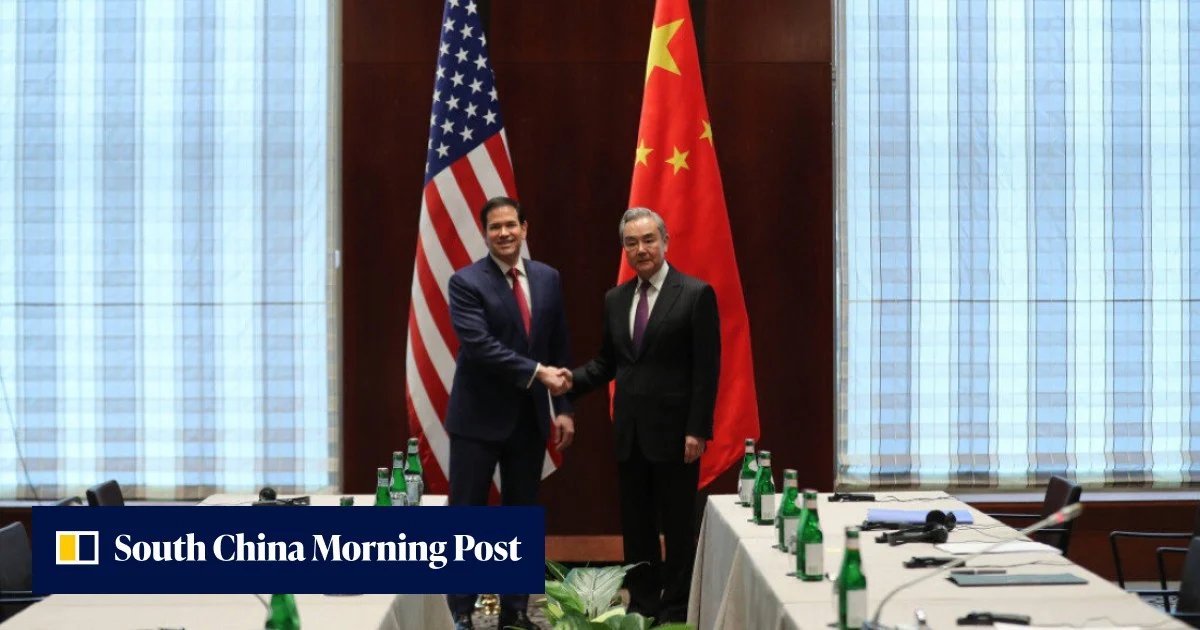
BEIJING — Chinese Foreign Minister Wang Yi held a high-stakes telephone conversation with US Secretary of State Marco Rubio on Thursday, a pivotal diplomatic maneuver coming exactly one week before President Xi Jinping is scheduled to embark on a closely watched state visit to the United States.
The call, which served as a final touchpoint between the two nations’ top diplomats, signals that preparations for a summit between President Xi and US President Donald Trump have reached their terminal phase. While details of the impending summit remain tightly held, the conversation between Wang and Rubio is widely interpreted as the definitive mechanism used to lock down the logistics and policy frameworks for the visit.
Chinese state news agency Xinhua released a brief statement following the call, noting that the two diplomats engaged in an “in-depth discussion” regarding the upcoming “high-level exchanges” between Beijing and Washington. The language, while characteristic of the opaque nature of high-level diplomatic readout releases, underscores the gravity of the meeting as both powers attempt to navigate a relationship marked by ongoing geopolitical friction and trade complexities.
This call mirrors a strategic pattern established earlier this year. Roughly two weeks before President Trump’s own state visit to China, Wang and Rubio held a similar consultation to synchronize messaging and address lingering policy disputes. Political analysts suggest that by repeating this cadence, both sides are attempting to ensure that the Xi-Trump summit proceeds without the risk of public diplomatic embarrassment or unforeseen escalations.
The pressure on this summit is immense. Since taking office, the Trump administration has maintained a firm stance on economic competition, with recent reports highlighting China’s “serious concerns” over new US technological and trade curbs. Observers expect that while the summit will likely focus on stabilizing the bilateral relationship, the two leaders will be forced to confront the growing divide over global trade policy, security, and regional influence.
Despite the friction, the frequency of contact between Wang and Rubio suggests a mutual desire to maintain open lines of communication. The dialogue acts as a necessary buffer, allowing the two leaders to air grievances before they reach the negotiating table, thereby narrowing the scope of potential conflict during the main event.
As the countdown to the trip begins, all eyes are now on the official protocols and the joint statements likely to be issued following the summit. For both Washington and Beijing, the goal remains the same: to project a sense of stability in an era defined by global uncertainty. The confirmation of the final details by Wang and Rubio provides the clearest signal yet that, despite the differences that divide them, both the United States and China are committed to the summit’s success.
Disclaimer: This content is auto-generated for informational purposes only.
Source: Read Original News