








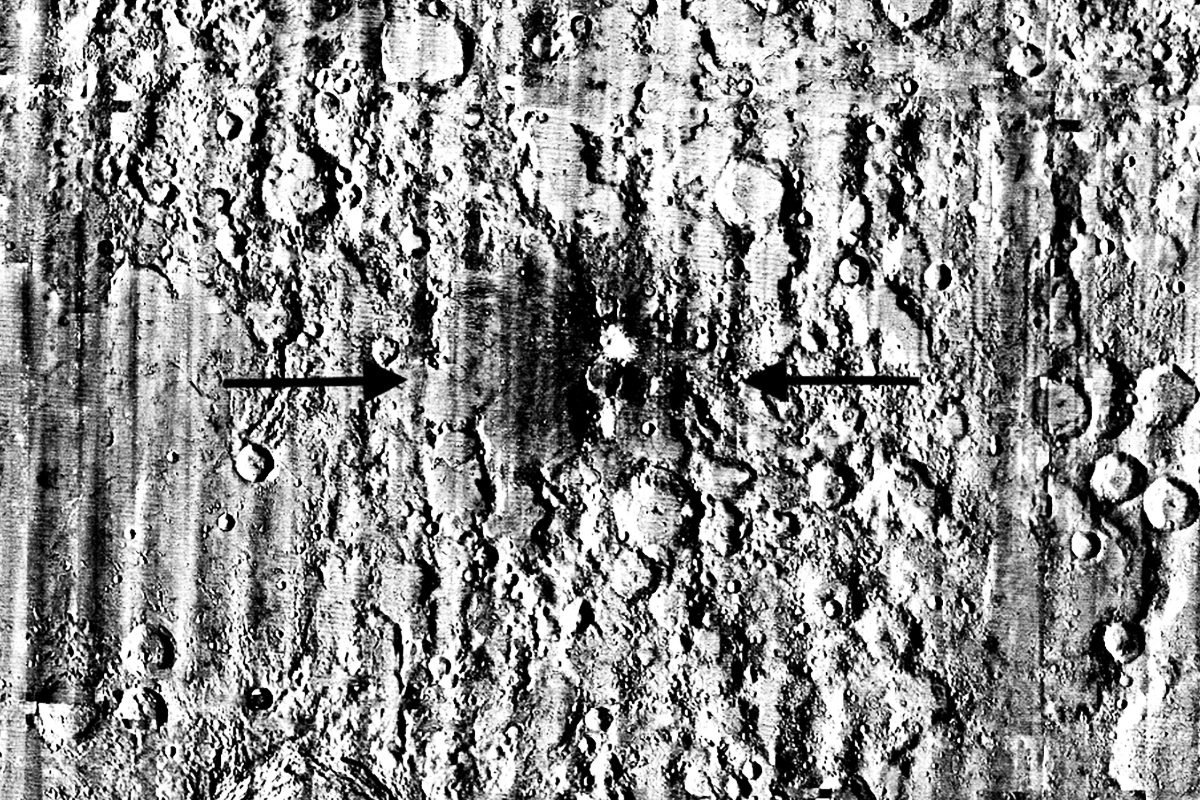
A routine digital sweep of the Moon’s surface has led to a major astronomical discovery: the largest newly-formed crater ever recorded in our Solar System. Robert Wagner, a scientist working with NASA’s Lunar Reconnaissance Orbiter (LRO), was analyzing lunar maps when he spotted a significant anomaly—a vast, brilliant bright spot encircled by a dark ring.
“I just stopped, dropped everything and started looking into what that spot was,” Wagner recalled. By comparing high-resolution “before and after” imagery of the lunar landscape, Wagner confirmed that he had identified the aftermath of a massive, recent celestial collision.
The crater, now officially named “McGetchin” in honor of late lunar scientist Tom McGetchin, is located on the Moon’s eastern edge. Data indicates that the impact occurred in a window between April 11 and May 22, 2024. The resulting scar on the lunar surface is 222 meters (728 feet) wide and 43 meters (141 feet) deep. Experts estimate that an impact of this magnitude occurs on the Moon only about once every century.
The catastrophic event was likely triggered by a comet or asteroid roughly the size of a three- to six-story building. Unlike Earth, which is shielded by a dense atmosphere that incinerates most incoming space debris, the Moon lacks such a protective layer. As a result, even small, fast-moving space rocks reach the surface with full force, constantly reshaping the lunar environment.
Since it began its mission in 2009, the LRO has been mapping the Moon’s topography and composition from an orbit of roughly 50 kilometers (31 miles). During that time, it has documented over 1,000 new impact craters and more than 100,000 changes to the lunar surface caused by crashing debris. The LRO’s precision is so acute that it can identify craters as small as 10 meters wide, caused by rocks just over a meter in diameter.
Following the initial discovery of the McGetchin crater, the science team utilized the LRO’s thermal instrument, “Diviner,” to conduct further analysis. The instrument detected a massive 6.5-kilometer-wide (4-mile-wide) area surrounding the impact site that registers about 9°C (16°F) cooler than the ambient surface temperature during the lunar night. Scientists attribute this to the fact that the impact churned up lunar dust and regolith, creating a layer of material that is less dense and less capable of retaining heat than the solid ground.
NASA officials noted that the discovery underscores the importance of the LRO’s ongoing mission, particularly as the agency prepares for a sustained human presence and expanded commercial operations on the Moon. While the chaotic bombardments of the early Solar System are a relic of history, the McGetchin crater serves as a stark reminder that our neighborhood remains a dynamic and potentially hazardous environment.
Disclaimer: This content is auto-generated for informational purposes only.
Source: Read Original News