






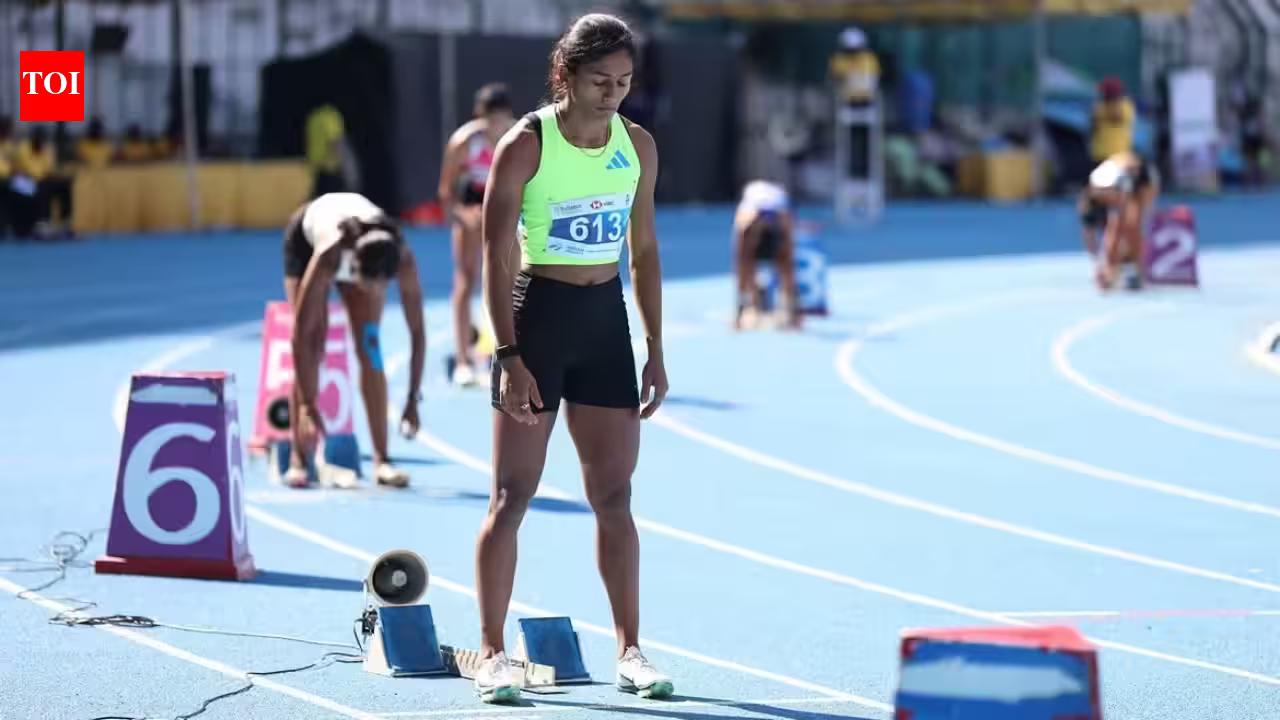
For eight long years, 400m hurdler Anu Raghavan has carried the peculiar, hollow weight of being an Asian Games medalist who has never stood on a podium. She holds the official certificate—a bureaucratic testament to her standing—but the bronze medal itself remains an abstract concept, a prize awarded in the aftermath of a doping scandal rather than through the glory of a race-day ceremony.
When Bahrain’s Kemi Adekoya was stripped of her 2018 Asian Games gold medal following a doping violation, the ripple effects elevated Raghavan from fourth place to third. On paper, history was rewritten; in reality, there was no victory lap, no national anthem, and no roar from a crowd in Jakarta. There was only an amended result sheet and a lingering, quiet ache for the moment she was denied.
“I won the bronze medal at the Asian Games despite finishing fourth,” Raghavan says with a mixture of pride and frustration. “But even now, I am sad because I still don’t have that medal in my hand. I have a certificate, but that feeling of being an Asian Games medallist is not entirely there.”
On September 28, in Aichi-Nagoya, the 33-year-old finally prepares to chase the closure that has eluded her for nearly a decade. Her journey to this point is not just a story of athleticism; it is a testament to the sheer stubbornness of a career built on grit, courtroom battles, and the relentless pursuit of self-worth.
A Career Defined by Resilience
Raghavan’s path has been anything but linear. A prodigy who emerged from the U-14 national ranks to become a cornerstone of Indian middle-distance running, her career was nearly derailed in 2016. After being controversially omitted from India’s Olympic relay squad for the Rio Games, she found herself in the middle of a high-profile legal challenge. While the dispute dominated headlines, it served as a crucible for her future.
“As everyone knows, I was eliminated from the team in the first Olympics in 2016,” she reflects. “After that, I thought that if I continued, maybe my life would be fulfilled in sports. I realized I wasn’t an international medallist yet, so I had to work for it.”
That resolve led to the 2017 Asian Championships, where she secured silver, and subsequently to that bittersweet fourth-place finish in Jakarta. However, the years between Jakarta and Aichi-Nagoya proved even more punishing. As support structures shifted and personal tragedy struck—including the loss of her mother—Raghavan was forced to become her own financier.
For five years, she funded her own travel, training, and competition, navigating the precarious reality of an elite athlete operating outside the financial umbrella of cricket-dominated sponsorships. It wasn’t until she reached the age of 32 that she finally secured the backing of the Reliance Foundation, a lifeline that allowed her to focus entirely on her craft.
The Science of Survival
The 400m hurdles is arguably the most unforgiving discipline in athletics. It requires the explosive speed of a sprinter combined with the aerobic capacity of a distance runner, all while maintaining technical rhythm despite accumulating lactic acid.
Raghavan’s approach for 2026 has been marked by a transition toward modern sports science. By utilizing force plates, biomechanical sensors, and detailed stride analysis, she has been able to quantify her performance in ways that previous generations never could.
“Earlier, we were just training,” Raghavan explains. “Now we are using data, analysis, and electronic equipment. We can actually read our strength. When I compare my numbers, I know I’m not weak. That’s what gave me confidence.”
This data-driven approach proved critical when she suffered an elbow dislocation just before the Federation Cup earlier this year. Many would have folded, but she leveraged her analytics to track her recovery, returning to the track to clock a career-best 56.54 seconds at the Indian Championships, effectively punching her ticket to Aichi-Nagoya.
Finding the ‘Why’
Perhaps the most significant hurdle Raghavan had to clear was psychological. Facing the exhaustion of years of struggle, she turned to a mindset coach to address the encroaching feeling of defeat. The simple, piercing question posed to her—”Why did you start?”—became the catalyst for her late-career surge.
“I kept thinking about that for an hour. After that, everything changed,” she says.
As she prepares for the September 19 start of the Asian Games, her training has shifted from raw intensity to tactical execution. She now spends her time visualizing every stride, every hurdle, and every transition. With a deeper field of younger competitors awaiting her in Aichi-Nagoya, the margin for error has never been thinner.
Yet, for Raghavan, the objective transcends the simple color of a medal. Whether or not she reaches the podium, she is reaching for something more substantial: the right to own her moment. She is seeking the experience that was stripped from her in 2018—the sound of her name announced in a stadium, the weight of the medal around her neck, and the final, definitive validation that her long, winding road was worth every single step.
Disclaimer: This content is auto-generated for informational purposes only.
Source: Read Original News