







The Evolution of Indian Rail Travel
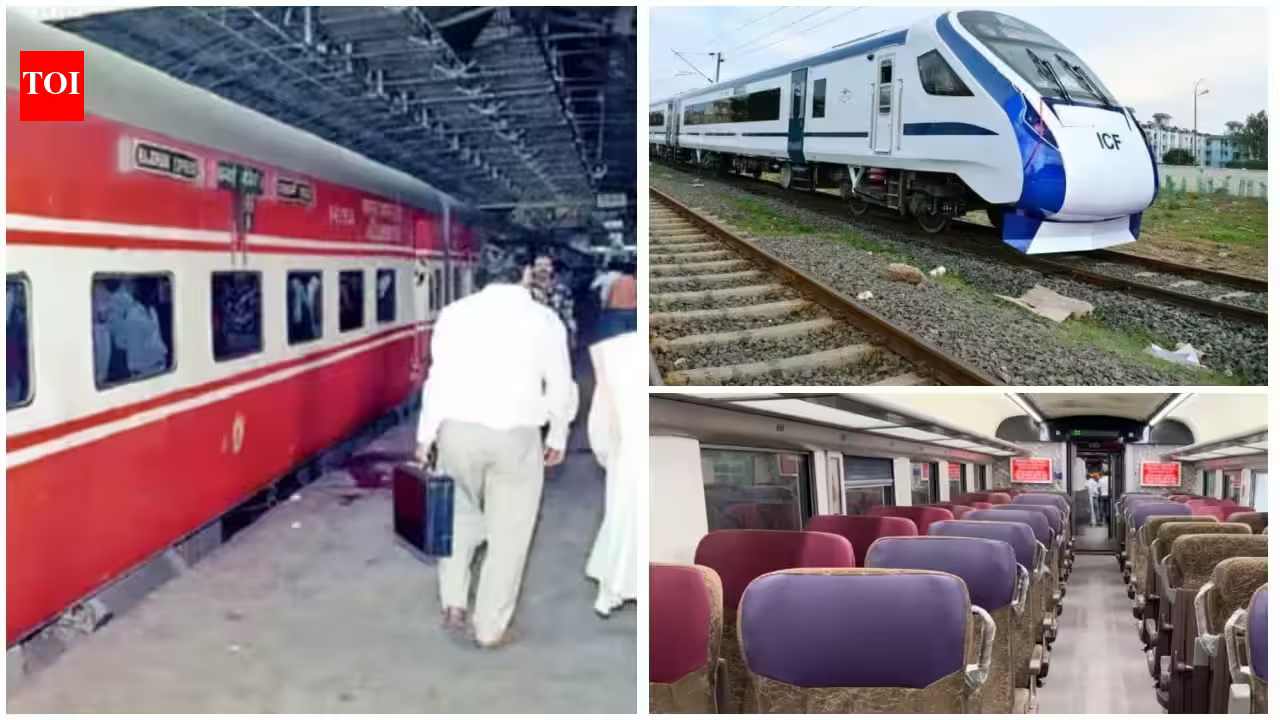
The story of India’s premium passenger trains is a reflection of the nation’s broader industrial progression. Over the past five decades, Indian Railways has systematically pushed the boundaries of speed, safety, and passenger comfort, evolving from basic locomotive-pulled carriages to sophisticated, self-propelled train sets. This journey is best categorized into three distinct generations: the era of the Rajdhani, the rise of the Shatabdi, and the current era of the Vande Bharat.
In March 1969, the debut of the Rajdhani Express marked a watershed moment. Before this, the national network was constrained by speed ceilings that had remained largely unchanged for nearly a century. With the introduction of the Rajdhani, Indian Railways broke the 96 kmph broad-gauge operating limit, proving that speed improvements were achievable without astronomical capital investment in new track infrastructure. By optimizing existing routes and rigorous trial testing, the Railways demonstrated that long-distance connectivity between the national capital and major state capitals could be significantly accelerated.
The Shatabdi Express, introduced in 1988, built upon this foundation by focusing on daytime inter-city travel. It provided a premium, fully air-conditioned experience that reduced transit times between major urban centers. Together, these two services established a branding framework for “premium travel,” where higher service standards and dedicated maintenance cycles were prioritized to ensure reliability and comfort.
The Technological Leap: From ICF to LHB
While the Rajdhani and Shatabdi defined the service experience, the underlying engineering also saw a critical shift. For years, the Integrated Coach Factory (ICF) design formed the backbone of the Indian fleet. While functional, these coaches were inherently limited in safety and comfort compared to global standards.
The year 2003 signaled a paradigm shift with the adoption of German Linke-Hofmann-Busch (LHB) technology. The transition to LHB coaches was driven by safety imperatives; these units were designed to be non-telescopic and featured anti-climbing mechanisms. In the event of a collision, these features prevented coaches from piling up on one another, a significant improvement over previous designs. The phasing out of older ICF coaches in favor of LHB technology laid the technical groundwork for higher operating speeds and smoother rides, paving the way for the sophisticated self-propelled architectures that would eventually follow.
The Vande Bharat Revolution
The arrival of the Vande Bharat Express in 2019 redefined the passenger experience by transitioning from locomotive-hauled trains to distributed-power train sets. Spearheaded by the Integral Coach Factory, this project was completed in a record 18 months, representing a masterclass in domestic engineering and rapid execution.
Unlike traditional trains, where a single locomotive pulls the entire weight of the carriages, Vande Bharat utilizes linear induction motors distributed across the coaches. This “train set” architecture offers distinct mechanical advantages. The primary benefit is improved acceleration and deceleration, which drastically reduces travel time on congested corridors. Furthermore, because power is distributed, the ride quality is significantly more stable, eliminating the transmission lag and jerking sensations common in locomotive-pulled trains.
Beyond performance, the Vande Bharat brought a contemporary aesthetic and functionality to Indian rail. With its aerodynamically designed nose, automatic plug doors, and fully sealed gangways, the train functions as a single, integrated unit. Features such as regenerative braking—which converts energy during deceleration to power onboard systems—demonstrate an increasing focus on energy efficiency. Additionally, the inclusion of the KAVACH system, an indigenous Automatic Train Protection technology, places these trains at a Safety Integrity Level-4 standard, ensuring that modern speed does not come at the cost of passenger security.
The Strategic Shift toward Localization
A crucial aspect of the Vande Bharat success story is its commitment to the “Make in India” initiative. Approximately 90 percent of the components used in these train sets are now manufactured domestically. This localization has transformed the domestic railway manufacturing ecosystem, fostering a supply chain capable of producing high-precision braking systems, sophisticated interior fittings, and advanced propulsion electronics.
The program has now expanded into the Vande Bharat Sleeper series. While the original Vande Bharat was optimized for daytime inter-city travel, the sleeper variant aims to modernize overnight long-distance transit. By integrating the benefits of self-propelled train sets with cabin amenities that exceed current Rajdhani standards, Indian Railways is effectively addressing the demand for high-speed, comfortable overnight travel across the subcontinent. With over 260 train sets planned for production through partnerships with firms like BEML, BHEL, and the Kinet consortium, the network is scaling its capacity to serve high-density routes at speeds of 130 kmph to 160 kmph.
Next Stop: High-Speed Rail
As Indian Railways consolidates its position as a modern, high-efficiency network, the next objective is the transition to true high-speed rail. The development of an indigenously designed bullet train, capable of hitting speeds of 280 kmph, marks the next phase of this industrial evolution.
Currently under development by BEML, this project is slated for trial runs in 2027. The prototype is intended to service the Mumbai-Ahmedabad high-speed corridor, signaling India’s intent to join the elite global club of nations operating high-speed rail infrastructure. This move is not merely about reaching a higher velocity; it is about establishing a domestic engineering capability that can sustain, maintain, and eventually export high-speed technology.
The trajectory of India’s railway sector—from the initial speed breakthroughs of the 1969 Rajdhani to the self-propelled Vande Bharat and the upcoming high-speed initiatives—illustrates a clear business strategy. By focusing on modular design, domestic manufacturing, and incremental technological upgrades, Indian Railways has managed to modernize its aging infrastructure while simultaneously elevating the experience for millions of passengers. The ongoing integration of digital safety systems and efficient propulsion technology ensures that the sector remains a critical engine for India’s economic growth and logistical connectivity. As the nation prepares for the next generation of rail travel, the emphasis remains on blending global engineering standards with local operational realities to create a sustainable and future-ready transport network.
Disclaimer: This content is auto-generated for informational purposes only.
Source: Read Original News